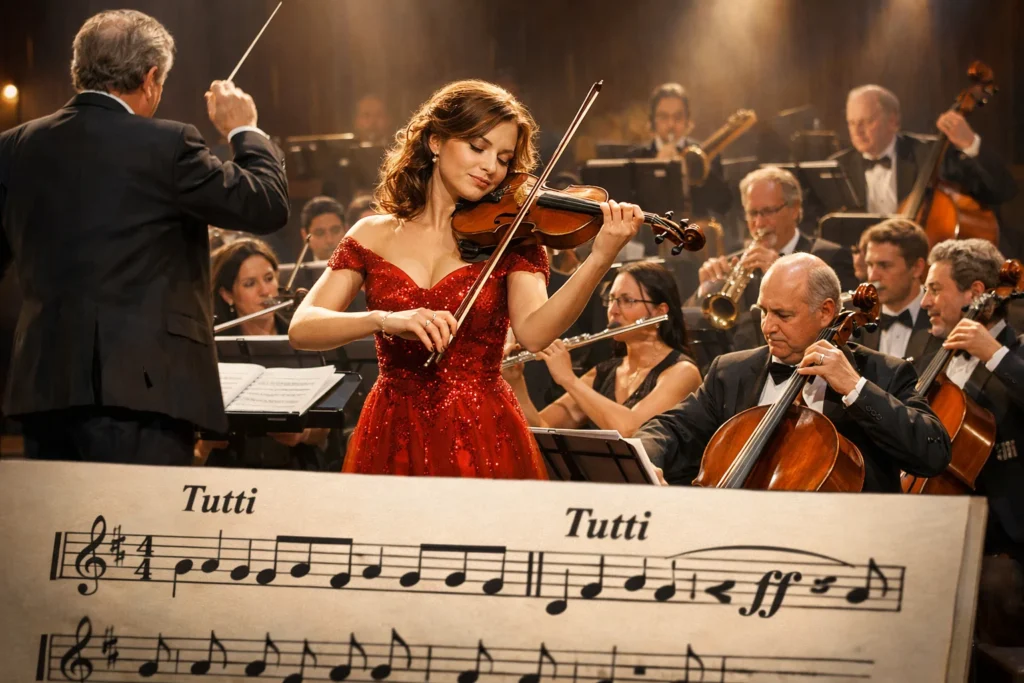
Tutti is an Italian word used in music that means “all” or “together”.
It indicates that all musicians or singers in a section should play or sing together, often after a solo passage.
In short, tutti signals full ensemble participation in a piece of music.
If you’ve ever attended an orchestra performance or played in a music class, you might have seen the term tutti in sheet music. But what does it actually mean?
Tutti is an important musical term that helps performers know when to play together, creating harmony, texture, and dynamic contrast in music. Understanding tutti is essential for musicians, students, and music enthusiasts alike.
This guide explains what tutti means in music, how it’s used, and gives examples from different musical contexts.
Why Tutti Is Important in Music
Tutti is crucial because it:
- Signals ensemble coordination
- Creates contrast after solo or small-group passages
- Enhances dynamics and richness of sound
- Maintains clarity in orchestral and choral works
Without tutti, performances can lack cohesion, and musical transitions may feel unclear.
Origin and Etymology of Tutti
The word tutti comes from Italian, meaning “all” or “everyone.”
Italian is the traditional language of musical notation and terminology, so many classical music terms, including tutti, solo, piano, and forte, are Italian.
Historically, composers used tutti to instruct the full orchestra or choir to join together, creating powerful and unified sound sections.
Core Uses of Tutti in Music
Tutti is used in several contexts in music:
- Orchestral Tutti – All instruments play together.
- Choral Tutti – All voices sing together.
- Contrast with Solo – Tutti often follows a solo section, creating contrast.
- Dynamic Emphasis – Tutti sections are often louder or more intense.
Examples of Tutti in Music
1. Orchestral Example
In a symphony, the string section might play a solo violin passage. When the score indicates tutti, all strings (or the full orchestra) join in:
- Solo: Violin plays melody alone
- Tutti: Full string section plays together
2. Choral Example
In a choir, a soprano solo might lead a phrase. After the solo, the notation says tutti:
- Solo: Soprano sings melody
- Tutti: Full choir joins for harmony
3. Dynamic Example
Tutti passages often mark a change in dynamics, signaling a forte or louder section to emphasize the music.
Example Table: Tutti vs Solo
| Term | Meaning | Use | Tone/Dynamics |
|---|---|---|---|
| Tutti | All together | Full orchestra or choir | Often louder, full sound |
| Solo | One performer | Individual instrument or voice | Softer or highlighted, expressive |
| Ensemble | Small group | Chamber music or section | Can be moderate, flexible |
| Sectional Tutti | Specific group | Strings, winds, etc. | Medium to strong, focused |
Popular Expressions Using Tutti
- Tutti a cappella – All singers perform without instrumental accompaniment
- Tutti con brio – All performers play together with spirit
- Tutti subito – Everyone plays immediately together
These instructions help musicians coordinate timing, expression, and ensemble sound.
Comparison Tutti vs Similar Musical Terms
| Term | Meaning | Difference |
|---|---|---|
| Tutti | All together | Entire section or ensemble |
| Solo | One performer | Only one musician or voice |
| Unison | Same notes | Can be a group, not necessarily the full ensemble |
| Ensemble | Small group | Partial section, not entire orchestra or choir |
Tip: Tutti is not just “playing together” but signals a return to full ensemble after a contrast or solo.
Polite or Professional Alternatives
In sheet music or academic discussion, you may see:
- Full ensemble – English equivalent of tutti
- All parts – Used in instructional material
- Complete section – Indicates everyone plays together
These are mostly used in music education or analysis.
Alternate Meanings or Misunderstandings
Outside of music, tutti simply means everyone or all in Italian.
In music, however, it always relates to full participation in a piece. It is not a tempo, dynamic, or style instruction, although it often coincides with louder or more expressive passages.
FAQs
Meaning of tutti in music?
Tutti means “all together,” indicating that the full ensemble should play or sing.
Difference between tutti and solo?
Solo is one performer highlighted; tutti is the full ensemble playing together.
Does tutti affect dynamics?
Often yes, tutti sections are louder or more intense than preceding solos.
Where is tutti used?
In orchestral, choral, chamber, and instrumental music.
Why is tutti important?
It ensures all musicians join at the right moment, creating harmony and contrast.
Can tutti appear in modern music?
Yes, it can appear in orchestral arrangements, band music, or film scores.
Is tutti Italian?
Yes, it is an Italian term, as are most classical music instructions.
Should beginners learn tutti?
Yes, recognizing tutti is essential for reading sheet music and performing correctly.
Practical Tips for Performing Tutti Passages
- Listen carefully for solo-tutti transitions
- Pay attention to dynamic markings during tutti
- Ensure timing is precise with the full ensemble
- Practice both solo and tutti sections for cohesion
- Follow conductor or leader instructions closely
Conclusion
Tutti in music is a key instruction that ensures all musicians or singers perform together, creating harmony, contrast, and richness in the sound. Understanding tutti helps performers:
- Coordinate with the ensemble
- Follow musical dynamics
- Execute transitions after solos
- Interpret music as the composer intended
Learning tutti and recognizing its role in sheet music will improve your performance, listening skills, and appreciation of music.
Discover More Related Articles:
- Lamentation Mean in the Bible: Why It Matters for Christians in 2026
- Adam Mean in the Bible: Symbolism, and Impact in 2026

Jessica Brown is a language-focused writer who creates well-researched articles on word meanings, abbreviations, and everyday expressions. She contributes to meanvoro.com, delivering simple, reliable, and reader-friendly content designed to make complex terms easy to understand.