
Definition:
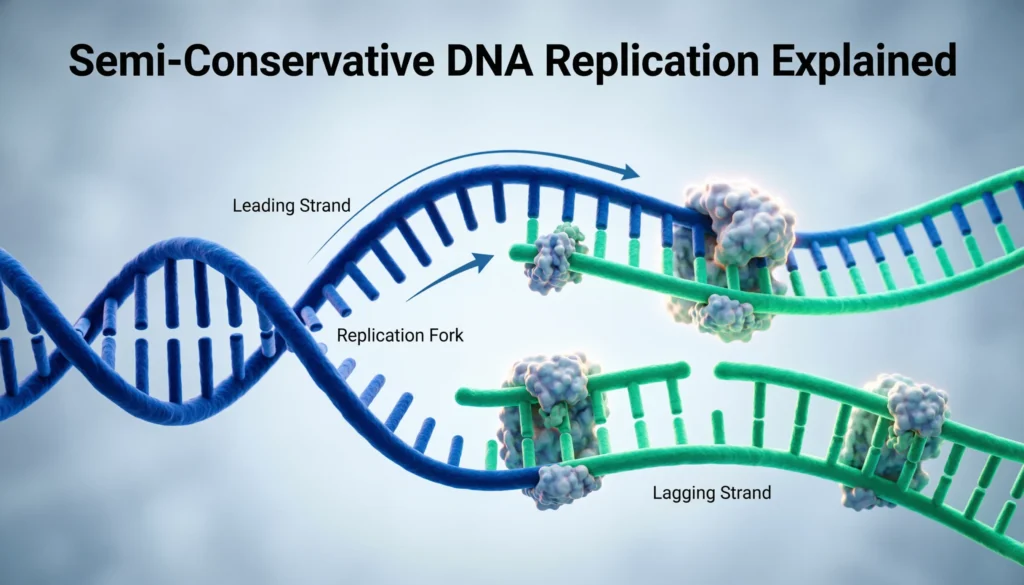
Semi-conservative DNA replication is a process in which each of the two resulting DNA molecules contains one original (parental) strand and one newly synthesized strand.
This ensures that genetic information is accurately preserved during cell division.
DNA is often called the blueprint of life, and understanding how it copies itself is key to unlocking the mysteries of biology, genetics, and even medicine. But have you ever wondered how a cell ensures that each new DNA molecule is an exact copy of the original?
This is where semi-conservative DNA replication comes in a clever mechanism that preserves genetic information while allowing life to grow and evolve.
In simple terms, semi-conservative replication means that each new DNA double helix contains one original strand and one newly made strand. This ingenious system was confirmed by the classic Meselson-Stahl experiment, and it forms the foundation of modern genetics, biotechnology, and molecular biology. 🧬
Origin of the Semi-Conservative Concept
The concept of semi-conservative DNA replication emerged in the early 1950s, shortly after the discovery of the DNA double helix by James Watson and Francis Crick.
- 1958 – The Meselson-Stahl Experiment:
Matthew Meselson and Franklin Stahl conducted a groundbreaking experiment using nitrogen isotopes (¹⁵N and ¹⁴N) to track DNA replication in E. coli. Their results confirmed that DNA replication is semi-conservative. - Why “Semi-Conservative”?
The term comes from the idea that half (semi) of the original DNA is conserved in each new molecule. Each new DNA double helix has one “old” strand and one “new” strand.
Fun fact: Before this discovery, scientists debated three models of DNA replication: conservative, semi-conservative, and dispersive. Semi-conservative won because it perfectly matched experimental evidence. 🧬
Usage of Semi-Conservative DNA Replication
Semi-conservative replication is essential for life, ensuring that every new cell has a complete and accurate copy of the genome.
Where it’s used:
- Cell Division: Mitosis and meiosis rely on semi-conservative replication to maintain genetic integrity.
- Genetic Research: Understanding DNA replication allows scientists to develop PCR, DNA sequencing, and cloning techniques.
- Medical Applications: Errors in replication can lead to mutations, cancer, or genetic disorders, making semi-conservative replication a critical focus in medical genetics.
Practical note: Semi-conservative replication maintains stability while allowing evolutionary changes through rare mutations.
How Semi-Conservative DNA Replication Works
The process involves several key steps and enzymes:
- Unwinding the DNA helix
- Helicase unwinds the double helix at replication forks.
- Single-strand binding proteins (SSBs) stabilize the separated strands.
- Primer binding
- Primase synthesizes a short RNA primer complementary to the parental DNA strand.
- DNA synthesis
- DNA polymerase adds nucleotides to the new strand, following base-pairing rules:
- A ↔ T
- C ↔ G
- DNA polymerase adds nucleotides to the new strand, following base-pairing rules:
- Strand completion
- Leading strand: synthesized continuously.
- Lagging strand: synthesized in Okazaki fragments, later joined by DNA ligase.
Key takeaway: Each resulting DNA molecule has one parental strand (conserved) and one newly synthesized strand.
Examples of Semi-Conservative Replication
| Example | Description | Tone |
|---|---|---|
| E. coli replication | Classic experimental model in Meselson-Stahl study | Neutral |
| Human DNA replication | Occurs in somatic cells during S phase | Professional |
| Viral DNA replication | Some DNA viruses use semi-conservative replication | Neutral |
| Disrupted replication | Errors may cause mutations or disease | Cautionary/Negative |
Friendly tip: You can visualize semi-conservative replication as copying a book page where one side is the original page, and the other is a newly printed page that perfectly matches it. 📖
Comparison With Related Terms
| Term | Definition | Difference from Semi-Conservative |
|---|---|---|
| Conservative replication | Original DNA stays intact; a completely new DNA molecule is synthesized | Entire original DNA is conserved; no mixed strands |
| Dispersive replication | DNA fragments from the old molecule are mixed into new DNA | Results in strands that are a mosaic of old and new DNA |
| Complementary strand synthesis | New strand is built to match the sequence of the template | Describes part of the process, not the replication model |
Summary: Semi-conservative replication balances preservation and innovation keeping one old strand while adding one new one.
Alternate Meanings and Contexts
While semi-conservative mostly refers to DNA replication, in other contexts it can mean:
- Partial retention in processes: For example, in policies or decision-making, semi-conservative may describe a cautious approach.
- Software or data replication: Maintaining part of original data while generating new copies.
Pro tip: Always clarify context when using “semi-conservative” outside genetics to avoid confusion.
Polite or Professional Alternatives
When writing or teaching, you can replace “semi-conservative” with:
- “Partially conserved replication”
- “Hybrid replication model”
- “Replication with one parental strand retained”
This can make explanations clearer to beginners or in professional reports.
FAQs
1. Why is DNA replication called semi-conservative?
Because each new DNA molecule retains one original strand and adds one new strand.
2. Who discovered semi-conservative replication?
Matthew Meselson and Franklin Stahl in 1958.
3. What are the three models of DNA replication?
Conservative, semi-conservative, and dispersive.
4. Which enzymes are involved in semi-conservative replication?
Helicase, primase, DNA polymerase, and DNA ligase.
5. Does semi-conservative replication occur in humans?
Yes, it occurs in all human cells during DNA replication in the S phase.
6. Can semi-conservative replication make mistakes?
Yes, errors (mutations) can occur, but DNA repair mechanisms usually fix them.
7. How does it differ from conservative replication?
Conservative replication keeps the original DNA intact, whereas semi-conservative keeps only one strand.
8. Why is semi-conservative replication important for evolution?
It preserves genetic information while allowing mutations, supporting evolution over generations.
Conclusion:
Semi-conservative DNA replication is one of nature’s smartest strategies for preserving life. By keeping one original DNA strand and adding one newly synthesized strand, cells ensure that genetic information is accurately passed on while still allowing room for evolutionary changes.
Understanding this process is essential for students, researchers, and anyone curious about how life maintains its blueprint. From human cells to bacteria, semi-conservative replication is fundamental for growth, reproduction, and maintaining genetic stability.
Quick memory aid: Think “semi” = half old, half new. 🧬
Discover More Related Articles:
- “NT” Mean in Gaming: GO, and Other Multiplayer Games for 2026
- Forced Air Mean in a House: A Homeowner’s Beginner Guide for 2026

Jessica Brown is a language-focused writer who creates well-researched articles on word meanings, abbreviations, and everyday expressions. She contributes to meanvoro.com, delivering simple, reliable, and reader-friendly content designed to make complex terms easy to understand.