
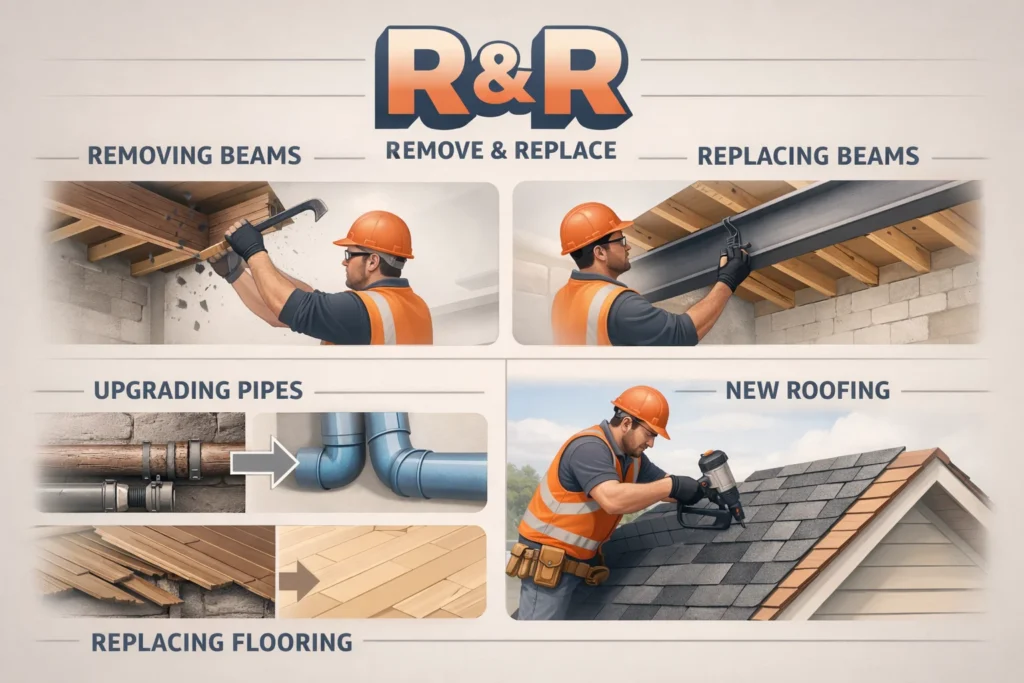
In construction, R&R stands for “Remove and Replace”. It is a term used to describe the process of removing an existing material, component, or structure and replacing it with a new one.
R&R is a common instruction in construction projects, maintenance, and renovation work.
Understanding R&R is crucial for contractors, project managers, and anyone involved in construction planning to ensure clarity, safety, and quality in project execution.
Origin and Popularity of R&R in Construction
The term R&R emerged as a practical shorthand in construction and maintenance industries. It allows project teams to communicate clearly and concisely in work orders, drawings, or contracts without writing lengthy instructions.
R&R is popular because it:
- Reduces miscommunication between contractors and workers
- Provides clarity in cost estimates and labor planning
- Appears in nearly every type of construction, from residential renovations to commercial projects
How R&R Is Used in Construction
1. Structural Components
R&R instructions are often applied to structural elements such as beams, columns, or panels that are damaged or outdated.
Examples:
- R&R the damaged wooden beams in the attic → Remove and replace the broken beams with new wood
- R&R concrete slabs that show cracks → Replace old concrete with new reinforced slabs
2. Mechanical, Electrical, and Plumbing (MEP)
R&R is frequently used for MEP systems, ensuring efficient upgrades and repairs.
Examples:
- R&R old HVAC ductwork → Replace outdated ducts for better airflow
- R&R plumbing pipes in the kitchen → Remove old pipes and install new ones
- R&R electrical panels → Replace faulty or outdated electrical components
3. Flooring, Roofing, and Finishes
In renovation projects, R&R is common for interior finishes or coverings.
Examples:
- R&R vinyl flooring in the lobby → Remove old flooring and install new vinyl
- R&R roof shingles → Replace damaged shingles with new ones
- R&R tiles in bathrooms → Remove broken tiles and re-tile
Example
| Context | R&R Example | Purpose/Reason | Notes |
|---|---|---|---|
| Structural | R&R wooden beams | Damaged or rotten wood | Ensure proper support |
| Flooring | R&R carpet in office | Worn-out or stained flooring | Use new carpet material |
| Roofing | R&R asphalt shingles | Weather damage | Check waterproofing |
| Electrical | R&R breaker panel | Faulty or outdated panel | Comply with safety codes |
| Plumbing | R&R copper pipes | Leaks or corrosion | Prevent water damage |
| HVAC | R&R ductwork | Poor airflow or damage | Improve efficiency |
Comparison With Similar Terms
| Term | Meaning in Construction | Difference From R&R |
|---|---|---|
| Repair | Fix or restore without replacing | Repair may not involve full replacement, R&R removes the old part entirely |
| Renovate | Update or modernize a space | Renovation is broader; R&R is specific to replacing components |
| Retrofit | Add new features to old systems | Retrofitting may not remove existing parts; R&R explicitly removes and replaces |
Alternate Uses of R&R
While R&R primarily stands for Remove and Replace, in other industries it can mean:
- Rest and Relaxation → Common in military or office contexts
- Rate and Review → Sometimes used in real estate or project reviews
In construction documentation, R&R always refers to removal and replacement.
Polite and Professional Alternatives
In formal construction contracts or specifications, you might see:
- Demolish and reconstruct → For larger structural work
- Extract and reinstall → When parts can be salvaged and replaced carefully
- Replace existing → Professional phrasing in work orders
Example:
- R&R old windows → Replace existing windows with new double-glazed units
Common Mistakes to Avoid With R&R
- Confusing R&R with Repair
- R&R = Remove and Replace
- Repair = Fix without full replacement
- Not specifying materials or standards
- Always indicate the type of new materials for clarity and cost accuracy
- Ignoring safety and disposal procedures
- R&R often involves debris and waste; proper disposal is critical
- Assuming R&R applies to partial replacement
- R&R typically implies complete removal and full replacement
FAQs
1. What does R&R mean in construction?
R&R stands for Remove and Replace, a common instruction to remove damaged or outdated components and install new ones.
2. Is R&R the same as repair?
No. Repair involves fixing the existing part, while R&R requires complete removal and replacement.
3. Where is R&R commonly used?
R&R is used in structural work, MEP systems, flooring, roofing, finishes, and renovation projects.
4. Is R&R only for residential projects?
No. R&R is applicable in residential, commercial, and industrial construction.
5. Can R&R include partial replacement?
Typically, R&R implies full replacement of the specified component. Partial work may need clarification.
6. What are professional alternatives to R&R?
Alternatives include: demolish and reconstruct, extract and reinstall, or replace existing.
7. Does R&R include disposal of removed materials?
Yes, proper waste management and disposal are usually part of the R&R process.
8. Why is R&R important in construction projects?
It ensures clarity, safety, quality, and accurate cost estimates while maintaining project standards.
Conclusion:
R&R is a fundamental term in construction projects, used to clearly communicate removal and replacement tasks across structural, mechanical, electrical, and finishing work. Proper understanding of R&R ensures smooth project execution, compliance with safety standards, and effective material management.
Pro Tips:
- Always specify the type and quality of replacement materials
- Distinguish R&R from repair or retrofit work
- Include safety and waste disposal instructions in the R&R plan
- Use professional alternatives in formal contracts for clarity
Discover More Related Articles:
- Lamentation Mean in the Bible: Why It Matters for Christians in 2026
- Adam Mean in the Bible: Symbolism, and Impact in 2026

Jessica Brown is a language-focused writer who creates well-researched articles on word meanings, abbreviations, and everyday expressions. She contributes to meanvoro.com, delivering simple, reliable, and reader-friendly content designed to make complex terms easy to understand.