
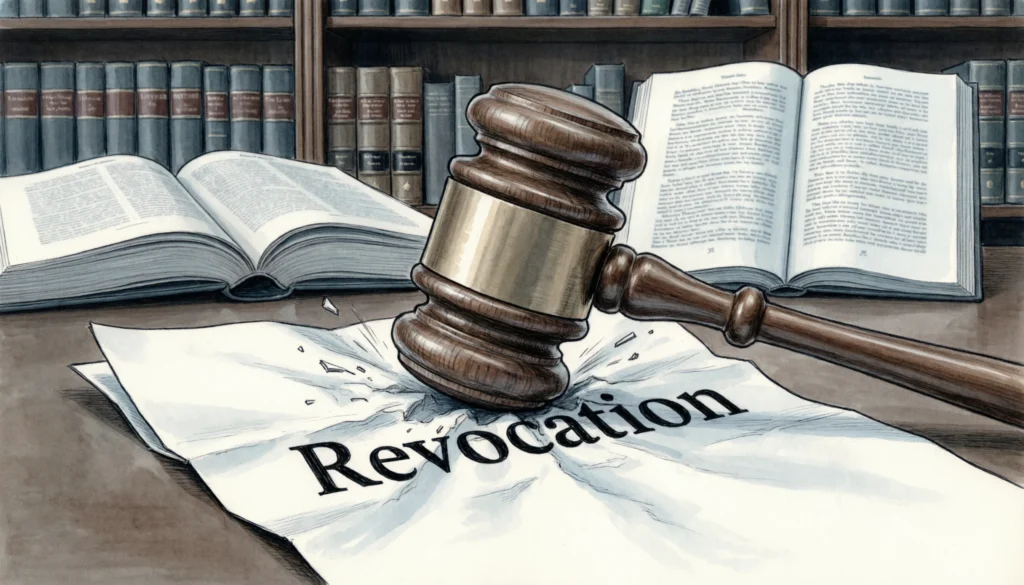
In court and legal contexts, revocation means the official cancellation, withdrawal, or taking back of a legal right, order, privilege, or agreement by a court or legal authority.
Legal words often sound intimidating, and “revocation” is one of those terms that can instantly raise concern when you hear it in a courtroom or legal document.
Whether it’s revocation of probation, revocation of a license, or revocation of bail, this word usually signals that something previously granted is being taken away often because certain rules were not followed.
Understanding what revocation means in court is important not just for legal professionals, but also for defendants, witnesses, and anyone trying to follow a legal case. The term appears frequently in criminal law, civil proceedings, and administrative hearings, and its consequences can be serious.
In this guide, we’ll clearly explain the legal meaning of revocation, where it comes from, how it’s used in real court situations, common examples, related legal terms, and what happens after a revocation occurs all in plain, easy-to-understand language.
Literal and Legal Meaning of “Revocation”
At its core, revocation means to take something back.
Legal Definition
In legal terms, revocation refers to the formal termination or cancellation of a legal right, permission, or status that was previously granted by a court or authority.
Simple Explanation
- Something was given legally
- Conditions were attached
- Those conditions were violated or changed
- The court revokes (takes back) the privilege
Origin of the Word “Revocation”
The word revocation comes from Latin:
- “Revocare”
- Re = back
- Vocare = to call
Original Meaning:
👉 “To call back” or “withdraw”
Over time, the word became a formal legal term used in courts to describe the withdrawal of permissions, rights, or benefits.
How “Revocation” Is Used in Court
Revocation is commonly used in criminal, civil, and administrative law.
1. Revocation in Criminal Court
This is where the term is most commonly heard.
Common Examples:
- Probation revocation
- Parole revocation
- Bail revocation
Example sentence:
- “The judge ordered the revocation of probation due to repeated violations.”
Meaning:
The defendant broke probation rules, so the court canceled probation.
2. Revocation in Civil Cases
In civil law, revocation often involves contracts or permissions.
Examples:
- Revocation of a power of attorney
- Revocation of consent
- Revocation of a legal offer
Example:
- “The revocation of the agreement was legally valid.”
3. Administrative or Regulatory Revocation
Courts or government agencies may revoke licenses or permits.
Examples:
- Driver’s license revocation
- Professional license revocation
- Business permit revocation
Example:
- “Her medical license faced revocation after the hearing.”
Common Types of Revocation
| Type of Revocation | What It Means | Court Impact |
|---|---|---|
| Probation revocation | Probation is canceled | Jail or prison time |
| Parole revocation | Early release is canceled | Return to custody |
| Bail revocation | Release before trial is canceled | Defendant jailed |
| License revocation | Legal permission removed | Loss of rights |
| Contract revocation | Agreement withdrawn | Legal dispute |
Tone and Legal Implications of “Revocation”
Unlike casual words, revocation always carries a serious tone in court.
Tone Breakdown:
- Formal – Used in legal documents and rulings
- Negative – Indicates loss of rights or privileges
- Final or conditional – Sometimes permanent, sometimes temporary
⚠️ Important: Revocation is often the result of non-compliance, not automatic punishment.
Revocation vs Similar Legal Terms
Many people confuse revocation with other legal words. Here’s a clear comparison:
| Term | Meaning | Key Difference |
|---|---|---|
| Revocation | Taking back a granted right | Due to violation |
| Suspension | Temporary removal | Often reversible |
| Termination | Permanent ending | No reinstatement |
| Rescission | Canceling a contract | Usually mutual |
| Invalidation | Declared legally void | Often retroactive |
Example:
- Suspension: License paused for 6 months
- Revocation: License permanently taken away
Can a Revocation Be Challenged?
Yes, in many cases, revocation can be challenged or appealed.
Common Legal Options:
- Request a revocation hearing
- Present evidence of compliance
- Argue procedural errors
- Seek reinstatement after a waiting period
Example:
- “The defendant appealed the revocation of parole.”
Polite or Professional Alternatives in Legal Writing
In legal or formal writing, you may see alternatives such as:
- Withdrawal of privileges
- Cancellation of authorization
- Termination of rights
- Rescission (contracts only)
However, “revocation” remains the most precise legal term.
Example Sentences
| Sentence | Meaning |
|---|---|
| “The court ordered revocation of bail.” | Defendant is jailed |
| “Revocation was based on non-compliance.” | Rules were broken |
| “A hearing was held before revocation.” | Due process followed |
| “License revocation is permanent.” | No automatic return |
FAQs
- What does revocation mean in court?
It means a legal right or privilege has been officially taken away. - Is revocation permanent?
Sometimes. It depends on the case and jurisdiction. - What causes revocation?
Violating court orders, laws, or conditions. - Is revocation worse than suspension?
Yes. Revocation is usually more severe. - Can revocation be reversed?
In some cases, through appeal or reinstatement. - What is probation revocation?
When probation is canceled due to violations. - Does revocation require a hearing?
Often yes, especially in criminal cases. - Is revocation a punishment?
It’s a legal consequence, not always classified as punishment.
Conclusion
In court, revocation is a powerful legal term that means a right, privilege, or legal status has been officially taken back. Whether it applies to probation, parole, bail, licenses, or contracts, revocation usually happens when rules are broken or legal conditions are not met.
Understanding what revocation means in court helps you better follow legal proceedings, court decisions, and official documents. While revocation often carries serious consequences, it is not always permanent and in some cases, it can be challenged or reversed through proper legal channels.
Discover More Related Articles:

Jessica Brown is a language-focused writer who creates well-researched articles on word meanings, abbreviations, and everyday expressions. She contributes to meanvoro.com, delivering simple, reliable, and reader-friendly content designed to make complex terms easy to understand.