
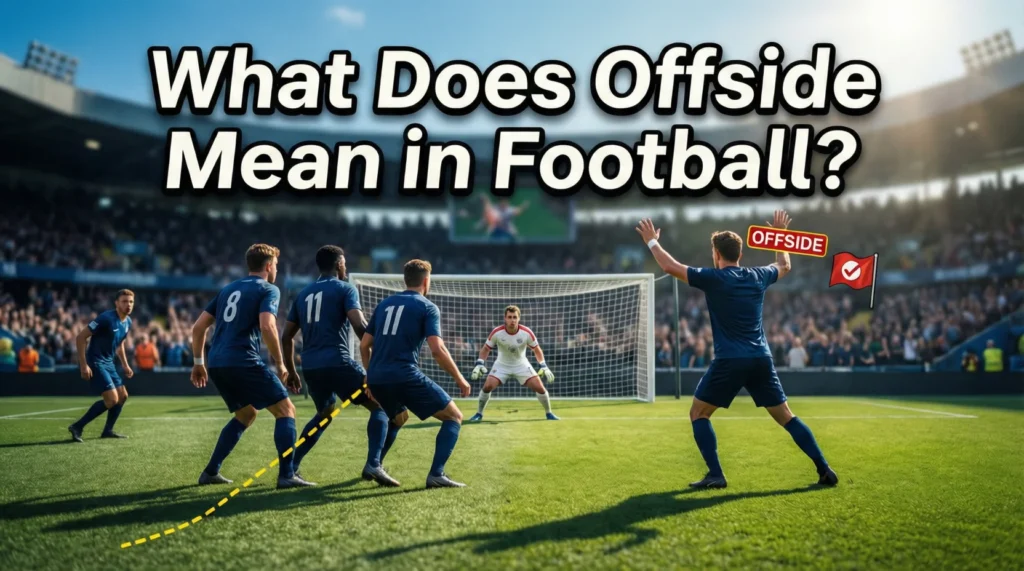
Offside in football is a rule violation that occurs when an attacking player is closer to the opponent’s goal line than both the ball and the second-last defender at the moment the ball is played to them, with the intent to gain an unfair advantage.
If you’ve ever watched a football match and heard the commentator shout “Offside Mean in Football!” you might have been left scratching your head. The offside rule is one of the most debated and sometimes confusing parts of football, but understanding it can make watching the game far more enjoyable.
In this article, we’ll break down what offside means, its history, real-world applications, examples, and even compare it to similar terms. Let’s dive in.
Simply put, you cannot “camp” near the opponent’s goal waiting for the ball.
Origin of the Offside Rule
The offside rule has its roots in early versions of football in the 19th century. Originally, it was stricter, requiring at least three defenders between the attacking player and the goal. Over time, the rule evolved to encourage attacking play and make football more exciting for spectators.
Key milestones:
- 1863: The Football Association formalizes the rule.
- 1925: Reduced the number of defenders required from three to two, increasing scoring opportunities.
- Modern adjustments: VAR technology has refined offside calls, making them more precise.
The purpose of the offside rule is to prevent goal-hanging, maintain fairness, and promote strategic play.
Why Offside Matters in Football
Offside ensures that football remains a skill-based game rather than a luck-based game. Without it, attackers could linger near the opponent’s goal, waiting for a pass reducing the need for teamwork, dribbling, and tactical strategy.
Benefits of the rule:
- Encourages passing and movement
- Rewards good defensive positioning
- Keeps the game fair and balanced
- Enhances spectator engagement
How to Identify an Offside Situation
To determine offside, referees and VAR officials check three main conditions:
- Position: The attacker is closer to the opponent’s goal line than the second-last defender when the ball is played.
- Timing: The position is measured at the moment the ball is played, not when the player receives it.
- Involvement in play: The player must be actively involved, e.g., receiving a pass, interfering with an opponent, or gaining an advantage.
Note: You cannot be offside in your own half, and there is no offside on goal kicks, throw-ins, or corner kicks.
Offside Examples in Real Matches
| Scenario | Offside? | Explanation |
|---|---|---|
| Striker receives the ball behind defenders’ line before pass | Yes | Player is ahead of the second-last defender when ball is played |
| Player in line with second-last defender | No | Offside only occurs when ahead of second-last defender |
| Player receives pass from teammate in own half | No | Offside does not apply in own half |
| Goal scored directly from a corner kick | No | Offside is not called on corners |
| Player interferes with goalkeeper from offside position | Yes | Active involvement triggers offside |
Common Offside Mistakes and Misconceptions
Many fans get confused about offside. Here are some clarifications:
- Not every forward run is offside: Only matters when the ball is played.
- Being level is safe: If the attacker is level with the second-last defender, it is not offside.
- VAR vs. human referee calls: VAR has reduced controversial calls but sometimes slows the game.
- Offside traps: Teams deliberately push defenders forward to catch attackers offside a strategic move.
Comparison with Related Terms
| Term | Definition | Difference from Offside |
|---|---|---|
| Offside Trap | Defensive tactic to catch attackers offside | Offside trap uses the rule strategically, not a violation itself |
| Goal-line | Line between goalposts | Goal-line is unrelated to player positioning, focuses on scoring |
| Handball | Illegal use of hand/arm | Handball is a different rule violation; offside is positional |
| Off the Ball | Movements without the ball | Off the ball can result in offside if positioning violates the rule |
Alternate Meanings of “Offside”
While “offside” is mostly associated with football, it also appears in other sports:
- Ice Hockey: Offside occurs when a player enters the attacking zone before the puck.
- Rugby: Offside is when a player is in front of a teammate carrying the ball.
In general English, “offside” can mean out of line or out of position, often figuratively, e.g., “His comment was offside in the meeting.”
Professional Alternatives or Synonyms
For more formal writing or sports journalism, you might replace “offside” with:
- Illegal positioning
- Rule infringement in attack
- Defensive line violation
Offside in Football: Tips for Fans
- Watch the defenders’ line: Focus on the second-last defender to judge offside.
- Follow VAR updates: Helps understand controversial decisions.
- Learn the exceptions: Corners, throw-ins, and own-half plays are not offside.
- Observe team tactics: Many teams use offside traps strategically.
FAQs
- What is offside in football?
Offside occurs when an attacker is nearer to the opponent’s goal than the second-last defender at the moment the ball is played. - Can you be offside in your own half?
No, offside only applies in the opponent’s half. - Is offside called on corner kicks?
No, a player cannot be offside from a corner kick. - What happens if a player is offside?
The opposing team is awarded an indirect free kick from where the offside occurred. - What is an offside trap?
A defensive strategy where defenders step forward to catch attackers offside. - Can goalkeepers be involved in offside?
Yes, the second-last defender is often the goalkeeper. Offside is judged relative to them. - Why is offside rule important?
It prevents goal-hanging, encourages teamwork, and maintains fair play. - Does VAR always get offside right?
VAR significantly reduces errors but sometimes relies on precise millimeter-level judgments, causing debate.
Conclusion:
Understanding the offside rule can completely change how you watch and enjoy football. It’s not just about avoiding penalties it’s about appreciating the strategy, teamwork, and timing that make the game so exciting.
By learning to spot offside, you’ll better understand match flow, anticipate plays, and enjoy football on a deeper level.
Next time you hear the referee’s whistle and “Offside!” you’ll know exactly why and maybe even impress your friends with your knowledge!
Search More Related Articles :
- BOT Mean in Baseball: Complete Guide for Fans & Players (2026)
- GIR Mean in Golf: Tips to Hit More Greens in Regulation (2026)

Jessica Brown is a language-focused writer who creates well-researched articles on word meanings, abbreviations, and everyday expressions. She contributes to meanvoro.com, delivering simple, reliable, and reader-friendly content designed to make complex terms easy to understand.