Definition
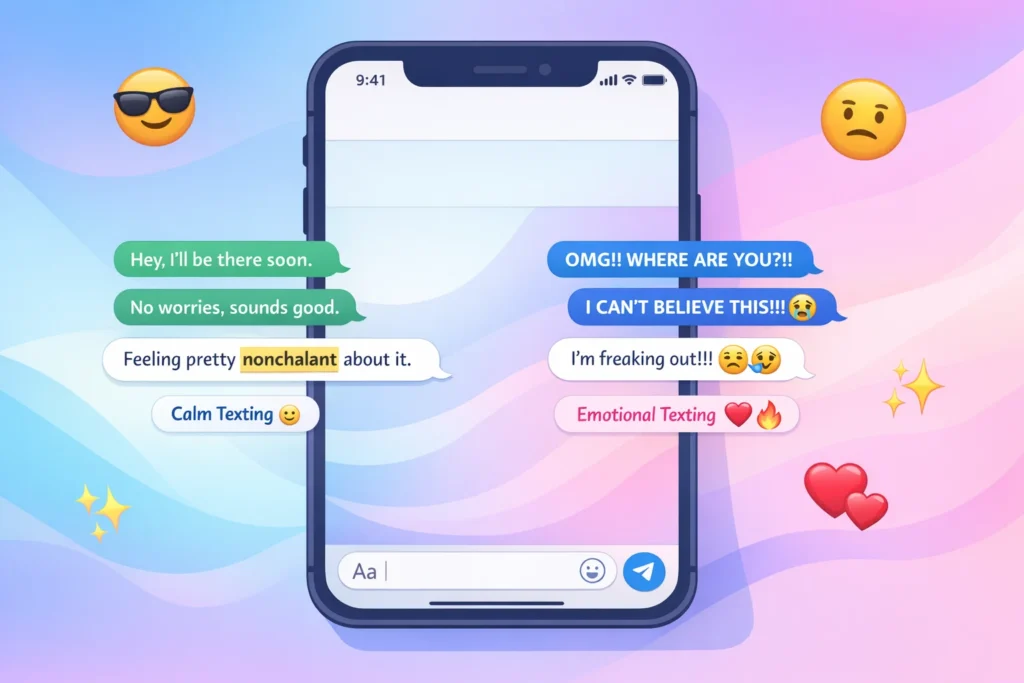
Nonchalant in text means showing a casual, relaxed, or indifferent attitude in messaging, often appearing calm, unconcerned, or emotionally detached regardless of the situation.
If you’ve ever seen someone reply with a short “ok,” a casual “lol,” or a relaxed “idk 🤷♂️” and wondered whether they’re being rude, calm, or just emotionally detached—you’re already brushing against the meaning of “nonchalant” in text conversations.
In today’s digital world, where tone is often harder to read than face-to-face communication, words like nonchalant matter more than ever. A single message can feel confident, cold, cool, or careless depending on how it’s used. That’s why understanding what “nonchalant” means in text can help you interpret messages correctly and even use the tone intentionally in your own chats.
In texting, someone who is “nonchalant” typically:
- Replies in a calm or minimal way
- Does not show strong emotion
- Seems unconcerned, cool, or laid-back
- May appear indifferent depending on context
Origin and Meaning of “Nonchalant”
The word nonchalant comes from the French word nonchaloir, which means “to be unconcerned.”
It entered English in the 18th century and originally described someone who appeared calm and composed, especially in stressful situations. Over time, it evolved into a personality descriptor used to express emotional detachment, casual confidence, or indifference.
Core meaning in modern usage:
- Calm under pressure
- Emotionally relaxed
- Sometimes uninterested or detached
- Effortlessly cool or laid-back
In texting culture, this meaning has expanded even further. Now it can describe both:
- A positive vibe (cool, calm personality 😎)
- A negative vibe (emotionally distant or uninterested 😶)
Why “Nonchalant” Is So Popular in Texting
With the rise of social media platforms, texting language has become more expressive and tone-driven. Words like nonchalant are popular because they capture emotional nuance that short messages often lack.
Reasons it’s widely used:
- People use it to describe “vibes” in conversations
- It helps explain unclear emotional tone in texts
- It’s commonly used in TikTok, Instagram captions, and memes
- It describes modern communication styles (cool, distant, low-effort texting)
For example:
- “He’s so nonchalant, he replied after 6 hours like nothing happened 😭”
- “I love her nonchalant attitude, she never stresses about anything”
How “Nonchalant” Is Used in Text Conversations
The meaning of nonchalant in text depends heavily on context and tone. It can be positive, neutral, or negative.
1. Positive Usage (Cool & Confident 😎)
Used when someone seems calm and unbothered in a good way.
Example:
- “She handled the situation so nonchalantly, I wish I had that confidence.”
2. Neutral Usage (Casual & Relaxed)
Used to describe simple laid-back behavior.
Example:
- “He texted back in a nonchalant way, just said ‘yeah sure’.”
3. Negative Usage (Indifferent or Distant 😐)
Used when someone seems emotionally unavailable or uninterested.
Example:
- “Her replies feel so nonchalant, like she doesn’t care at all.”
Examples of “Nonchalant” in Texting Contexts
Here are real-life inspired examples to help you understand tone better:
Casual Chat Examples
- “I told him I was upset and he just replied ‘ok’… so nonchalant.”
- “She’s always so nonchalant about exams, like she’s not even stressed.”
- “Bro walked in late and acted nonchalant like nothing happened 😂”
Emotional Context Examples
- “I expected a long reply but he was super nonchalant about it.”
- “She broke up with him and he acted so nonchalant… kinda scary.”
Confident Vibe Examples
- “I love how nonchalant she is, she never panics about anything.”
- “He handled the interview so nonchalantly, like it was nothing.”
Table – Different Meanings of Nonchalant in Text
| Context Type | Meaning | Example Sentence | Tone |
|---|---|---|---|
| Positive | Calm confidence | “She was nonchalant during the presentation.” | 😎 Cool |
| Neutral | Casual response | “He replied nonchalantly with ‘maybe’.” | 😐 Balanced |
| Negative | Emotional detachment | “She acted nonchalant after the argument.” | 😶 Cold |
| Social media | “Unbothered vibe” aesthetic | “Nonchalant era activated ✨” | 😌 Trendy |
Comparison With Similar Words
Understanding “nonchalant” becomes easier when you compare it with similar texting terms.
Difference Nonchalant vs Chill
- Chill: Relaxed and friendly
- Nonchalant: Calm, but sometimes emotionally distant
Using Nonchalant vs Indifferent
- Indifferent: Doesn’t care at all
- Nonchalant: Appears not to care, but may still care internally
Comparing Nonchalant vs Aloof
- Aloof: Emotionally distant or reserved
- Nonchalant: More casual and relaxed, less cold than aloof
Nonchalant vs Carefree
- Carefree: Happy and stress-free
- Nonchalant: Calm, but may or may not be emotionally engaged
Alternate Meanings of Nonchalant
While “nonchalant” mostly refers to emotional tone, it can also slightly shift meaning depending on usage:
- In personality descriptions: Calm and composed under pressure
- In fashion/social media: “Effortlessly stylish” or “underdressed but cool”
- In relationships: Emotionally distant or hard to read
Example:
- “She has a nonchalant aesthetic—minimal makeup, simple outfits, but still stylish.”
Polite or Professional Alternatives
If you’re writing formally or want softer wording than “nonchalant,” here are alternatives:
- Calm
- Composed
- Relaxed
- Unbothered
- Easygoing
- Reserved
- Detached (neutral/technical tone)
- Cool-headed
Example rewrites:
- “He was nonchalant during the meeting.”
→ “He remained composed during the meeting.” - “She gave a nonchalant response.”
→ “She responded in a calm and relaxed manner.”
Real-World Usage in Social Media & Pop Culture
The word “nonchalant” has become especially popular on platforms like TikTok and Instagram.
Common trends:
- “Nonchalant era” captions
- “He’s so nonchalant” memes
- Aesthetic edits showing calm, stylish personalities
- Songs or edits featuring emotionally “unbothered” characters
It often represents a lifestyle or attitude where someone appears:
- Unstressed
- Effortlessly cool
- Emotionally independent
Common Misunderstandings
People often misread “nonchalant” in text conversations. Here’s why:
- Short replies can seem cold even if not intended that way
- Tone is missing in text messages
- Cultural differences in texting style affect interpretation
Example misunderstanding:
- “K.” → Could be seen as nonchalant or rude
- “Ok 👍” → Might seem neutral but can feel distant depending on context
FAQs
1. What does nonchalant mean in texting slang?
It means someone is calm, relaxed, or emotionally unbothered in their messages.
2. Is being nonchalant a good thing?
It can be positive (confident and cool) or negative (emotionally distant), depending on context.
3. Does nonchalant mean rude?
Not always. It can seem rude if the tone feels cold, but it often just means relaxed.
4. What is a nonchalant attitude in text?
It’s when someone replies casually without showing strong emotion or excitement.
5. What is a synonym for nonchalant in texting?
Chill, calm, relaxed, cool-headed, or unbothered.
6. Why do people text in a nonchalant way?
To appear confident, avoid emotional intensity, or simply because of casual texting habits.
7. Can nonchalant mean ignoring someone?
Sometimes it can feel like ignoring, but it usually means low emotional response rather than intentional neglect.
8. How do you respond to a nonchalant text?
You can match their tone, ask follow-up questions, or clarify their intent if needed.
Conclusion
Understanding what nonchalant means in text helps you decode modern digital communication more accurately. At its core, it describes a calm, relaxed, or emotionally detached tone, but its meaning can shift depending on context.
Sometimes it reflects confidence and effortless coolness. Other times, it may feel distant or indifferent. The key is to always read it within the full conversation rather than judging it from a single message.
Discover More Related Articles:
- “NT” Mean in Gaming: GO, and Other Multiplayer Games for 2026
- Forced Air Mean in a House: A Homeowner’s Beginner Guide for 2026

Ryan Thompson is an experienced content writer specializing in slang terms, texting abbreviations, and word meanings. He writes for meanvoro.com, where he creates accurate and easy-to-understand language content for readers.