Definition:
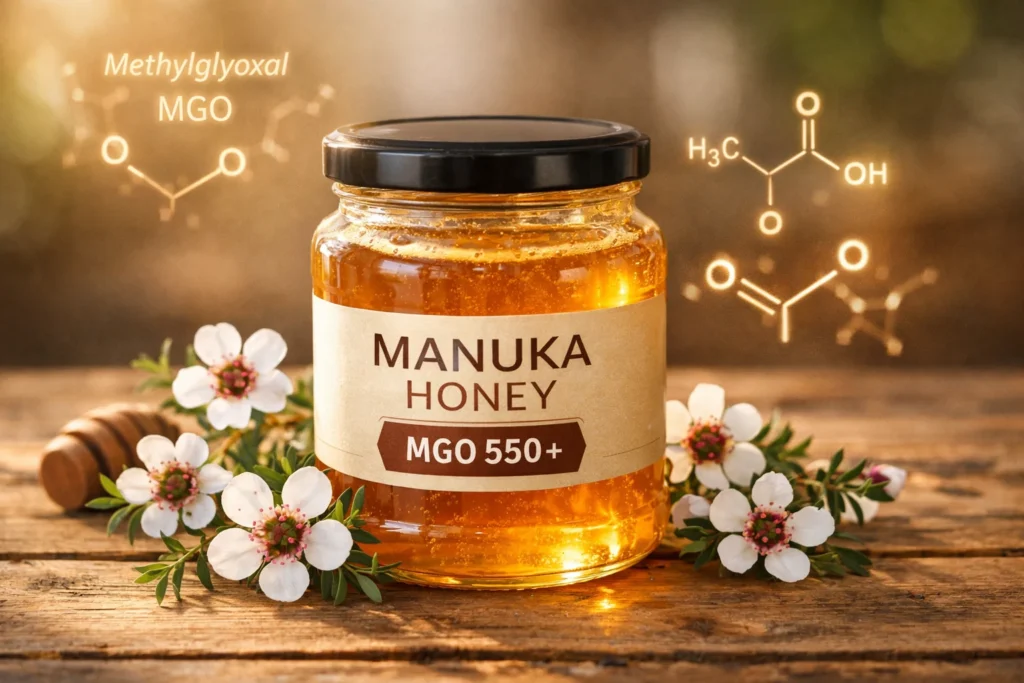
MGO in Manuka honey stands for “Methylglyoxal,” a naturally occurring compound that indicates the antibacterial strength and quality of Manuka honey the higher the MGO rating, the stronger the antibacterial activity of the honey.
If you’ve ever looked at a jar of Manuka honey and wondered what those numbers like MGO 100+, MGO 250+, or MGO 850+ actually mean, you’re not alone. This small three-letter term plays a huge role in determining the honey’s quality, price, and even its health benefits. But what exactly is MGO, why does it matter so much, and how should you understand it before buying Manuka honey?
Let’s break it down in a simple, friendly, and practical way so you can confidently choose the right Manuka honey for your needs.
What is MGO in Manuka Honey?
MGO stands for Methylglyoxal, a naturally occurring compound found in Manuka honey produced from the nectar of the Manuka bush (Leptospermum scoparium), mainly native to New Zealand.
Unlike regular honey, Manuka honey contains significantly higher levels of MGO, which is responsible for its powerful antibacterial properties.
In simple terms:
👉 MGO = the key active ingredient that measures how strong and potent Manuka honey is.
The higher the MGO number, the more concentrated the antibacterial strength.
Origin of MGO in Manuka Honey
The story of MGO is closely linked with how Manuka honey is made.
How it forms:
- Bees collect nectar from Manuka flowers.
- The nectar contains a natural compound called DHA (dihydroxyacetone).
- During honey storage and aging, DHA slowly converts into MGO.
- Over time, the MGO concentration increases.
This natural chemical transformation is what makes Manuka honey unique compared to regular floral honey.
Why New Zealand matters:
- Most high-quality Manuka honey comes from New Zealand
- The environment, soil, and native Manuka plant create ideal conditions for high MGO levels
Why MGO Became So Popular
MGO gained global attention when scientists discovered that:
- It is responsible for Manuka honey’s strong antibacterial activity
- It remains stable and effective even in low-moisture environments
- It can support wound care, skin health, and overall wellness (commonly discussed benefits)
As a result, MGO labeling became a trusted way to measure honey potency.
Today, consumers look at MGO ratings just like they look at vitamin strength in supplements.
How MGO Works in Manuka Honey
MGO works by disrupting harmful bacteria at a cellular level.
Key actions:
- Damages bacterial proteins
- Interferes with bacterial growth
- Helps reduce microbial survival
This is why Manuka honey is often used in:
- Natural skincare products
- Sore throat relief remedies
- Wound dressings (medical-grade honey)
However, it’s important to remember:
👉 MGO does not mean Manuka honey is a medicine it’s a natural food with bioactive properties.
MGO Grading System Explained
The MGO rating shows how much methylglyoxal is present per kilogram of honey.
Here’s a simple breakdown:
MGO Levels and What They Mean
| MGO Rating | Strength Level | Common Use |
|---|---|---|
| MGO 30+ to 100+ | Mild | Everyday consumption, general wellness |
| MGO 100+ to 250+ | Moderate | Immune support, daily health boost |
| MGO 250+ to 550+ | High | Skin care, stronger antibacterial use |
| MGO 550+ to 850+ | Very High | Therapeutic use, wound care |
| MGO 850+ and above | Ultra Potent | Medical-grade applications |
The higher the number, the more expensive the honey usually is.
Real-World Usage of MGO Manuka Honey
MGO Manuka honey is used in different ways depending on its strength.
Everyday use:
- Stir into warm water or tea (never boiling)
- Spread on toast
- Natural sugar substitute
Wellness use:
- Soothe sore throat
- Support digestive health
- Boost daily immunity
Skincare use:
- Apply to acne spots
- Use in DIY face masks
- Help with minor skin irritation
Example scenarios:
- Friendly tone: “I take a spoon of MGO 100+ Manuka honey every morning to feel more energized 🍯”
- Neutral tone: “MGO 250+ honey is commonly used for general immune support.”
- Strong tone: “MGO 850+ is typically reserved for therapeutic-grade applications.”
MGO vs Other Manuka Honey Ratings
People often confuse MGO with other labels like UMF and KFactor.
Here’s a clear comparison:
MGO vs UMF vs KFactor
| Rating System | What it Measures | Accuracy | Usage |
|---|---|---|---|
| MGO | Methylglyoxal level | Direct chemical measurement | Most straightforward |
| UMF (Unique Manuka Factor) | MGO + other compounds | Broad quality grading | Premium certification |
| KFactor | Pollen content + purity | Less precise | Older system |
Alternate Meanings of MGO
While in Manuka honey MGO clearly means Methylglyoxal, in other contexts it can also mean:
- Massive Gaming Online (rare slang in gaming communities)
- Managed Government Organization (business/administrative usage)
- Magnesium Oxide (MgO) (chemical compound, different capitalization)
However, in health and honey discussions, MGO almost always refers to Methylglyoxal.
Polite or Simple Alternatives to Say MGO Explanation
If you’re explaining MGO in a simple conversation, you can say:
- “MGO is the strength level of Manuka honey.”
- “It tells how powerful the honey’s natural antibacterial properties are.”
- “It’s basically the rating system for how strong the honey is.”
These alternatives are useful for beginners or casual conversations.
Examples of MGO in Sentences
Here are some natural ways people use the term:
- “This Manuka honey is MGO 250+, so it’s quite strong.”
- “I usually buy MGO 100+ for daily use.”
- “Doctors sometimes recommend higher MGO grades for skin applications.”
- “Is MGO 550+ too strong for everyday eating?”
FAQs
1. What does MGO mean in Manuka honey?
MGO stands for methylglyoxal, the compound that measures the antibacterial strength of Manuka honey.
2. Is higher MGO better?
Yes, higher MGO usually means stronger antibacterial properties, but it also depends on how you plan to use it.
3. What is the best MGO level for daily use?
MGO 100+ to 250+ is commonly used for everyday consumption.
4. Is MGO Manuka honey real honey?
Yes, it is 100% natural honey, just with higher levels of a special compound.
5. Can MGO honey help with sore throat?
Many people use it for soothing sore throats due to its antibacterial properties.
6. What is the difference between MGO and UMF?
MGO measures a single compound, while UMF measures overall quality and purity.
7. Is MGO safe for children?
Generally, honey should not be given to children under 1 year old.
8. Why is MGO Manuka honey so expensive?
Because high MGO levels are rare and require specific environmental conditions and processing.
Conclusion
MGO is the key to understanding the strength and quality of Manuka honey. It represents methylglyoxal, a natural compound responsible for the honey’s antibacterial power. The higher the MGO rating, the stronger and more potent the honey becomes.
When choosing Manuka honey, think about your purpose:
- Light wellness → MGO 100+
- Everyday health → MGO 250+
- Strong therapeutic use → MGO 550+ and above
By understanding MGO, you can make smarter, more confident choices and get the most out of this unique natural superfood.
Discover More Related Articles:
- Perseverance Mean in the Bible: Lessons from Paul, Job, and Jesus for 2026
- Subdue Meaning in the Bible: Lessons for 2026

Jessica Brown is a language-focused writer who creates well-researched articles on word meanings, abbreviations, and everyday expressions. She contributes to meanvoro.com, delivering simple, reliable, and reader-friendly content designed to make complex terms easy to understand.