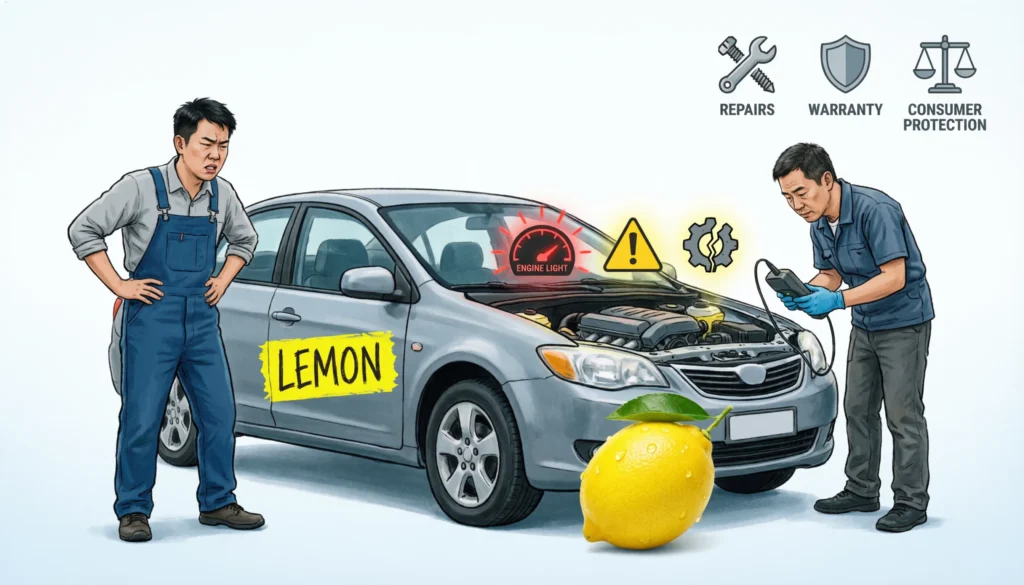
Definition
A “lemon” in cars refers to a vehicle that has significant manufacturing defects or recurring problems that affect its safety, value, or usability, even after multiple repair attempts.
In simple terms, a lemon is a bad car that never seems to work properly.
Buying a car is one of the biggest purchases many people make. You expect reliability, comfort, and value for your money. But sometimes, despite careful research and excitement about a new vehicle, the car turns out to be full of problems.
That’s where the phrase “lemon” comes in.
If someone says, “I bought a lemon,” they usually mean the vehicle has serious defects or constant mechanical issues that make ownership frustrating. The term is widely used in the automotive industry, consumer protection laws, and everyday conversation.
Understanding what “lemon” means in cars can help you avoid costly mistakes, know your legal rights, and recognize warning signs when buying a vehicle.
In this guide, we’ll explore:
- The exact meaning of “lemon” in cars
- The history and origin of the term
- Real-world examples
- How Lemon Laws protect consumers
- Differences between lemons and other used car issues
- Professional alternatives to the term
- Answers to common questions buyers search online
Let’s start with the background of the term.
Origin of the Term “Lemon”
The word “lemon” didn’t originally come from the automotive industry.
Historically, the word “lemon” was slang for something defective or disappointing.
Early Meaning
In the early 1900s, American slang used “lemon” to describe:
- A worthless item
- Something sold under false expectations
- A product that fails quickly
By the 1960s and 1970s, the term became strongly associated with cars, especially after consumer advocates began pushing for laws protecting buyers from defective vehicles.
Rise of Lemon Laws
The phrase gained widespread attention when consumer protection laws were introduced in the United States called “Lemon Laws.”
These laws protect buyers when a vehicle has:
- Repeated mechanical failures
- Unfixable defects
- Safety problems
Today, the phrase “lemon car” is used globally to describe vehicles with serious reliability issues.
What Makes a Car a “Lemon”?
Not every car with problems is considered a lemon. Vehicles may qualify as lemons when they have persistent defects that cannot be fixed after multiple attempts.
Common Characteristics of a Lemon Car
A vehicle may be considered a lemon if it has:
- Repeated engine problems
- Brake failures
- Electrical system defects
- Transmission issues
- Safety-related malfunctions
- Problems that continue after several repairs
Typical Lemon Law Criteria
While laws vary by location, many include similar conditions:
| Criteria | Explanation |
|---|---|
| Multiple repair attempts | The same issue is repaired several times but persists |
| Safety defect | The problem could cause injury or accidents |
| Vehicle unusable | Car spends many days in the repair shop |
| Early ownership period | Defects appear shortly after purchase |
If these conditions are met, the car may qualify as a lemon under consumer protection laws.
Real-World Usage of the Term “Lemon”
The word “lemon” is commonly used in everyday conversations about vehicles.
Example Situations
Here are a few typical contexts:
Example 1 (Neutral tone)
“The dealership replaced the car because it turned out to be a lemon.”
Example 2 (Frustrated tone)
“This car is a total lemon. It’s been in the shop five times already!”
Example 3 (Consumer warning)
“Always check the vehicle history so you don’t accidentally buy a lemon.”
Example 4 (Online review)
“Great design, but my unit was a lemon and had electrical issues.”
The tone usually implies disappointment or frustration, because buyers expected a reliable vehicle.
Signs You Might Have Bought a Lemon
Sometimes drivers realize their car may be a lemon only after repeated problems.
Common Warning Signs
Watch for these red flags:
- Frequent trips to the mechanic
- The same issue returning after repairs
- Warning lights that keep appearing
- Major systems failing early
- The vehicle spending weeks in the repair shop
Example Scenario
Imagine buying a new car and experiencing:
- Transmission failure in the first month
- Repaired twice but still slipping
- Vehicle stalls unexpectedly
- Dealership unable to permanently fix the issue
In this case, the car may qualify as a lemon under consumer protection rules.
Lemon Laws Explained
Lemon Laws exist to protect consumers from defective vehicles.
They allow buyers to seek compensation when manufacturers fail to fix serious issues.
Possible Remedies
Depending on the situation, buyers may receive:
- Free repairs
- Vehicle replacement
- Full refund
- Compensation
When Lemon Laws Apply
Typically, these laws apply when:
- The defect appears within a specific timeframe
- Multiple repair attempts fail
- The issue affects safety or usability
These laws encourage manufacturers to maintain quality and accountability.
Example Table: Lemon Car Scenarios
Below is a simplified table showing situations where a vehicle might be considered a lemon.
| Situation | Lemon Status | Explanation |
|---|---|---|
| Engine fails repeatedly | Likely lemon | Serious defect affecting usability |
| Minor cosmetic scratch | Not a lemon | Cosmetic issues usually don’t qualify |
| Transmission replaced twice | Possible lemon | Major system failure |
| Radio malfunction | Rarely a lemon | Minor feature defect |
| Brake system failure | Likely lemon | Safety risk |
This helps buyers distinguish serious defects from normal wear and tear.
Comparison With Related Car Terms
The word “lemon” is sometimes confused with other automotive terms.
Here’s how they differ.
| Term | Meaning | Key Difference |
|---|---|---|
| Lemon | Defective car with repeated problems | Major reliability issue |
| Used Car | Previously owned vehicle | May still be reliable |
| Salvage Car | Vehicle damaged and rebuilt | Usually accident-related |
| Certified Pre-Owned | Manufacturer-inspected used car | Higher quality assurance |
| Beater Car | Cheap, old vehicle | Works but may look worn |
A lemon is defined by persistent defects, not just age or appearance.
Alternate Meanings of “Lemon”
While “lemon” is strongly associated with cars, the term has several other meanings.
Common Alternate Uses
- Defective product – Any faulty item
- Disappointing purchase – Something that doesn’t work well
- Slang for failure – Something that performs poorly
Examples:
- “This laptop is a lemon.”
- “That investment turned out to be a lemon.”
The underlying idea is always something that fails expectations.
Professional Alternatives to Saying “Lemon”
In professional settings like dealerships or legal discussions, people may avoid slang.
Instead, they may use more formal terms.
Professional Alternatives
- Defective vehicle
- Manufacturing defect
- Nonconforming vehicle
- Faulty automobile
- Repeated mechanical failure
For example:
Instead of saying:
“This car is a lemon.”
A professional might say:
“The vehicle has a manufacturing defect that requires replacement.”
Tips to Avoid Buying a Lemon
Buying a lemon can be stressful, but careful preparation reduces the risk.
Smart Buying Tips
Before purchasing a car:
1. Check the vehicle history report
Look for accident records or repeated repairs.
2. Get a pre-purchase inspection
A trusted mechanic can detect hidden problems.
3. Test drive thoroughly
Pay attention to unusual noises or vibrations.
4. Research reliability ratings
Look for reviews and long-term reliability data.
5. Understand warranty coverage
Good warranties provide protection against defects.
These steps help buyers avoid expensive mistakes.
FAQs:
1. What does lemon mean in car slang?
In car slang, a lemon is a defective vehicle with serious or recurring problems that cannot be fixed properly.
2. Why is a bad car called a lemon?
The term comes from early slang where “lemon” meant something defective or worthless, eventually becoming common in the automotive industry.
3. What qualifies a car as a lemon?
A car may qualify as a lemon if it has major defects that persist after multiple repair attempts, especially during the warranty period.
4. What is a Lemon Law?
A Lemon Law is consumer protection legislation that allows buyers to receive repairs, replacements, or refunds for defective vehicles.
5. Can a used car be a lemon?
Yes. In some regions, used vehicles may qualify as lemons, depending on local consumer protection laws.
6. How do I know if my car is a lemon?
If your vehicle has frequent breakdowns, repeated repairs, and unresolved safety issues, it may be considered a lemon.
7. What should I do if I bought a lemon?
Keep repair records, contact the dealership or manufacturer, and check local Lemon Law protections.
8. Do all defective cars qualify as lemons?
No. Minor issues or normal wear usually do not qualify as lemon cases.
Conclusion
The term “lemon” in cars refers to a vehicle with serious defects that repeatedly fail to be fixed. While occasional mechanical issues are normal, lemons are defined by persistent problems that make the vehicle unreliable or unsafe.
Understanding this term is important for every car buyer because it helps you:
- Recognize warning signs of defective vehicles
- Understand consumer protection laws
- Avoid costly purchasing mistakes
- Know your rights if a car repeatedly fails
With proper research, inspections, and awareness of Lemon Laws, buyers can protect themselves from ending up with a frustrating and expensive lemon.
In the end, the best defense is knowledge, preparation, and careful car shopping.
Discover More Related Articles:

Ryan Thompson is an experienced content writer specializing in slang terms, texting abbreviations, and word meanings. He writes for meanvoro.com, where he creates accurate and easy-to-understand language content for readers.