
In Spanish, hora means hour. It refers to a unit of time equal to 60 minutes and is commonly used to talk about clock time, duration, schedules, and specific moments when something happens.
Ever heard someone say “a esta hora” or “en una hora” in Spanish and wondered what hora really means? You are not alone. Hora is one of the most common Spanish words, yet it carries more meaning than most learners expect.
This guide explains exactly what hora means in Spanish, how it is used in real life, and how native speakers understand it in different situations.
What Does Hora Mean in Spanish?
In Spanish, hora means hour.
It refers to a unit of time equal to 60 minutes and is used to talk about clock time, duration, schedules, and important moments.
Basic Meaning of Hora
Spanish word: hora
English meaning: hour
Part of speech: noun
Gender: feminine
Plural form: horas
Example:
Una hora tiene sesenta minutos.
An hour has sixty minutes.
Origin and History of Hora

The word hora comes from the Latin word hora, which meant a fixed period of time or a specific moment. This same root appears in many modern languages, including English, French, Italian, and Portuguese.
Because of this shared origin, hora feels familiar to many learners even before they formally study Spanish.
Why Hora Is Used So Often in Spanish
The word hora is essential in everyday Spanish because it is used to:
• Tell the time
• Describe how long something lasts
• Make plans and schedules
• Express urgency
• Talk about routines and daily life
It is just as important as words like día (day) or tiempo (time).
How Hora Is Used in Real Life
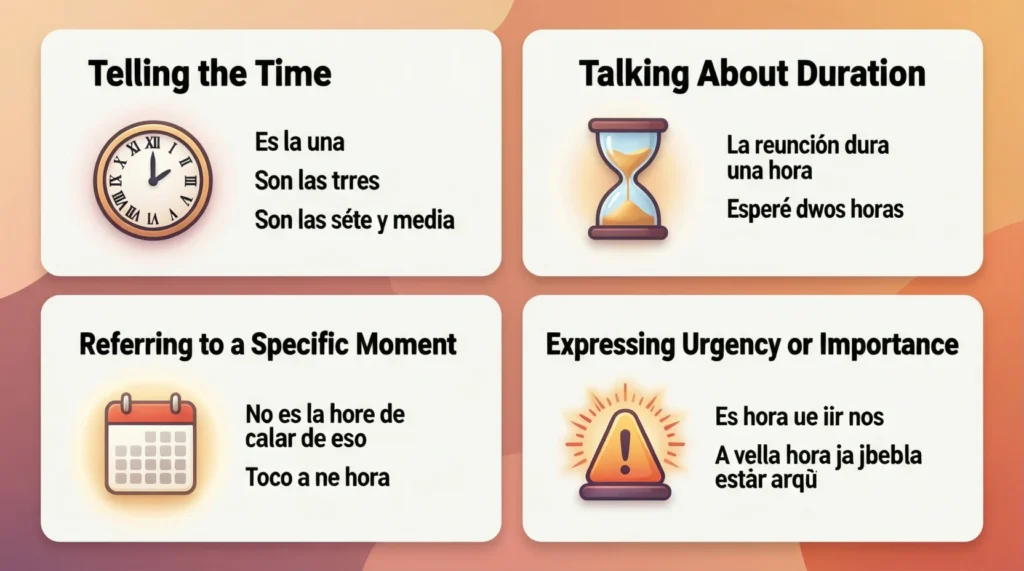
1. Telling the Time
This is the most common use of hora.
Examples:
Es la una.
It is one o’clock.
Son las tres.
It is three o’clock.
Son las siete y media.
It is seven thirty.
Important note:
Spanish uses es la only for one o’clock. All other hours use son las.
2. Talking About Duration
Hora is used to explain how long something lasts.
Examples:
La reunión dura una hora.
The meeting lasts one hour.
Esperé dos horas.
I waited two hours.
3. Referring to a Specific Moment
Sometimes hora means “the right time” rather than exactly 60 minutes.
Examples:
No es la hora de hablar de eso.
It is not the time to talk about that.
Todo a su hora.
Everything in its own time.
4. Expressing Urgency or Importance
Hora is often used to push action.
Examples:
Es hora de irnos.
It is time to leave.
A esta hora ya debería estar aquí.
By this time, they should already be here.
Tone Based Examples of Hora
Friendly or Casual Tone
¿A qué hora nos vemos?
What time should we meet?
Llegamos en una hora.
We will arrive in an hour.
Neutral or Informative Tone
La tienda abre a las nueve de la mañana.
The store opens at nine in the morning.
La clase dura dos horas.
The class lasts two hours.
Negative or Dismissive Tone
¿A esta hora vienes?
You are coming at this hour?
No son horas de llamar.
This is not an appropriate time to call.
Common Expressions Using Hora
• A esta hora meaning at this time
• En hora meaning on time
• Fuera de hora meaning late or outside regular hours
• Hora punta meaning rush hour
• A última hora meaning at the last minute
These expressions are extremely common in spoken Spanish.
Example
| Spanish Phrase | Meaning in English | Typical Use |
|---|---|---|
| A qué hora | What time | Asking about schedules |
| En una hora | In one hour | Talking about the future |
| A esta hora | By now | Expressing expectation |
| Hora punta | Rush hour | Traffic and work |
| Es hora de | It is time to | Prompting action |
Hora vs Horas
Spanish is very strict with number agreement.
Examples:
Una hora means one hour
Dos horas means two hours
Muchas horas means many hours
Sentences:
Trabajé ocho horas.
Solo necesito una hora.
Hora Compared With Similar Time Words
Difference Hora vs Tiempo
Hora refers to a specific, countable unit of time.
Tiempo refers to time in general or weather.
Examples:
No tengo tiempo.
I do not have time.
No tengo una hora.
I do not have an hour.
Compare Hora vs Momento
Hora is structured and measurable.
Momento is brief and flexible.
Examples:
Dame un momento.
Give me a moment.
Dame una hora.
Give me an hour.
Using Hora vs Reloj
Hora is the time itself.
Reloj is the clock or watch.
Examples:
¿Qué hora es?
What time is it?
Mi reloj está roto.
My watch is broken.
Alternate Meanings of Hora
In context, hora can also mean:
• The appropriate moment
Llegó la hora de decidir.
The time has come to decide.
• A scheduled period
Hora de comida meaning lunch hour
Hora de salida meaning departure time
Polite and Professional Usage
In formal situations, hora appears in polite structures.
Examples:
¿Podría decirme a qué hora es la reunión?
La cita está programada para las diez en punto.
Professional alternatives include horario (schedule) and plazo (deadline).
FAQs
- Does hora always mean exactly 60 minutes?
No. Context can make it mean “time” or “moment.” - Is hora masculine or feminine?
It is feminine: la hora. - Why do people say es la una but son las dos?
Because one is singular and all other hours are plural. - Can hora be used figuratively?
Yes. It often means the right or important moment. - What does hora punta mean?
It means rush hour. - How do you ask the time politely in Spanish?
¿Podría decirme qué hora es, por favor? - Is hora used differently in Spain and Latin America?
The meaning is the same, with minor regional phrasing differences. - What is the difference between a tiempo and en hora?
Both mean on time, but a tiempo is more common in daily speech.
Conclusion:
Hora means hour, but it also carries broader meanings related to time, moments, and urgency. It is one of the most important time words in Spanish and appears constantly in conversation.
Once you understand how hora works in real contexts, your Spanish becomes more natural and confident.
Search More Related Articles:

Jessica Brown is a language-focused writer who creates well-researched articles on word meanings, abbreviations, and everyday expressions. She contributes to meanvoro.com, delivering simple, reliable, and reader-friendly content designed to make complex terms easy to understand.