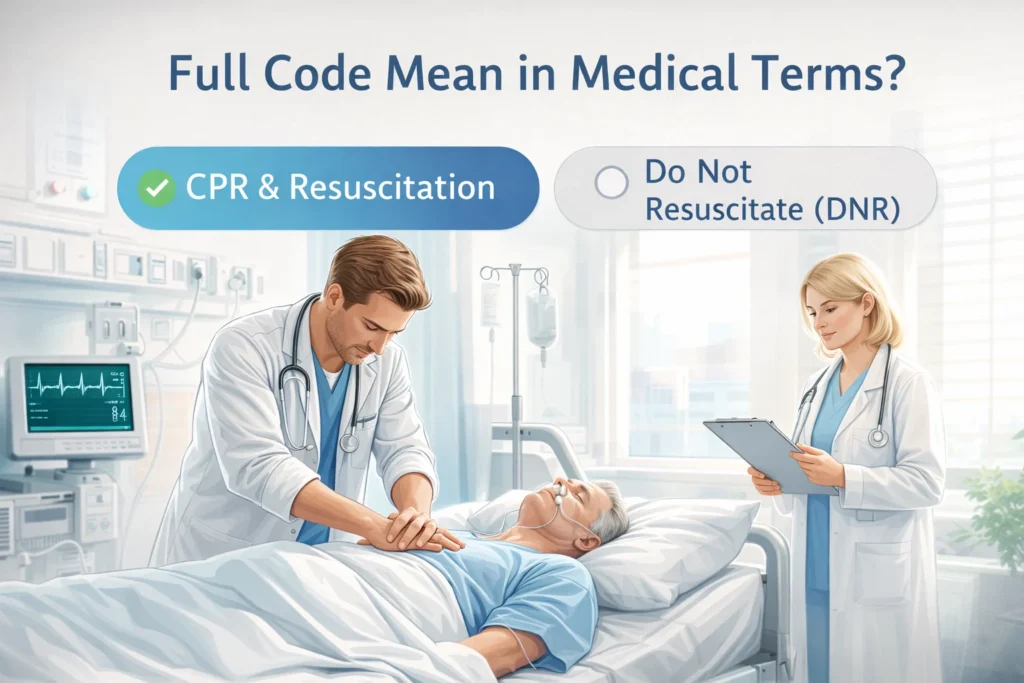
Full code in medical terms means that all life-saving measures will be performed if a patient’s heart stops or they stop breathing, including CPR, defibrillation, intubation, and advanced life support.
In simple words, full code means “do everything possible to keep the patient alive.”
Hearing the phrase “full code” in a hospital or medical setting can feel intense or confusing, especially if you’re a patient, family member, or new to healthcare terminology. It often appears in medical charts, emergency discussions, or conversations about treatment decisions.
Understanding what full code means in medical terms is important because it directly relates to life-saving actions during emergencies. This guide explains the meaning clearly, with examples, comparisons, and practical context so you know exactly what it means and when it matters.
Why “Full Code” Matters in Healthcare
Code status decisions guide healthcare teams during critical emergencies. When seconds matter, medical staff rely on a patient’s code status to know what actions are allowed.
Full code status ensures that:
- Emergency interventions are not delayed
- All resuscitation efforts are permitted
- Medical teams act aggressively to preserve life
This term is especially important in hospitals, ICUs, emergency rooms, and long-term care facilities.
Origin and Medical Background of Full Code
The word “code” comes from hospital emergency systems, where alerts like “Code Blue” signal cardiac or respiratory arrest.
Over time, hospitals adopted code status classifications to clarify patient wishes regarding resuscitation. “Full code” became the standard term indicating maximum intervention during life-threatening events.
What Happens When a Patient Is Full Code
If a patient is listed as full code and experiences cardiac or respiratory arrest, the medical team may perform:
- Cardiopulmonary resuscitation (CPR)
- Electrical shocks (defibrillation)
- Intubation and mechanical ventilation
- Emergency medications
- Advanced cardiac life support (ACLS)
All appropriate medical measures are used unless medically ineffective.
Real-World Examples of Full Code Usage
- Hospital admission: Patients are often asked their code status on admission
- Emergency situations: A full code patient receives immediate resuscitation
- Medical charts: Doctors and nurses document “Full Code” clearly
- Family discussions: Families may discuss code status for loved ones
Example sentence:
- “The patient is full code and eligible for all resuscitative measures.”
Tone and Context of “Full Code”
- Clinical and neutral: Used in professional medical settings
- Serious: Refers to life-or-death decisions
- Non-emotional: A factual term, not a value judgment
It is not meant to sound harsh or alarming, even though the situations involved are critical.
Comparison Full Code vs Other Code Statuses
| Code Status | Meaning | Key Difference |
|---|---|---|
| Full Code | All life-saving measures allowed | Maximum intervention |
| DNR | Do Not Resuscitate | No CPR or defibrillation |
| DNI | Do Not Intubate | No breathing tube |
| Comfort Care | Focus on comfort only | No aggressive treatment |
| Limited Code | Some interventions allowed | Customized care |
Full Code vs DNR Explained Simply
- Full code: Try everything to save life
- DNR: Do not attempt resuscitation if the heart or breathing stops
Neither option is “right” or “wrong.” The choice depends on personal values, health condition, and medical advice.
Polite and Professional Alternatives
In formal discussions or documentation, healthcare professionals may say:
- Full resuscitation status
- All life-saving measures authorized
- No limitations on resuscitation
Example:
- Informal: “Patient is full code.”
- Formal: “The patient has elected full resuscitative measures.”
Common Misunderstandings About Full Code
- It does not guarantee survival
- It does not mean aggressive care at all times
- It applies specifically to cardiac or respiratory arrest
A patient can still decline certain treatments while remaining full code.
FAQs
Meaning of full code in medical terms
Full code means all possible life-saving measures will be performed during an emergency.
What does being full code involve
It involves CPR, defibrillation, breathing support, and emergency medications.
Is full code the default status
Yes, most hospitals consider patients full code unless stated otherwise.
Can a patient change from full code
Yes, patients can change their code status at any time.
Does full code mean aggressive treatment always
No, it applies mainly during cardiac or respiratory arrest situations.
Is full code the same as life support
Not exactly. Full code includes resuscitation, while life support refers to ongoing support.
Who decides full code status
The patient decides, or a legal representative if the patient cannot.
Is full code appropriate for everyone
It depends on individual health, prognosis, and personal wishes.
Practical Tips for Patients and Families
- Ask healthcare providers to explain code status clearly
- Review code status regularly, especially with changing health
- Discuss wishes with family members
- Document decisions formally in medical records
- Remember that code status choices can be updated anytime
Conclusion
Full code in medical terms means that all life-saving interventions are authorized if a patient experiences cardiac or respiratory arrest. It represents the most comprehensive level of emergency care available.
Understanding this term helps patients and families:
- Make informed healthcare decisions
- Communicate clearly with medical teams
- Avoid confusion during emergencies
- Align treatment with personal values
Knowing what full code means empowers you to participate confidently in medical conversations and planning.
Discover More Related Articles:

Jessica Brown is a language-focused writer who creates well-researched articles on word meanings, abbreviations, and everyday expressions. She contributes to meanvoro.com, delivering simple, reliable, and reader-friendly content designed to make complex terms easy to understand.