
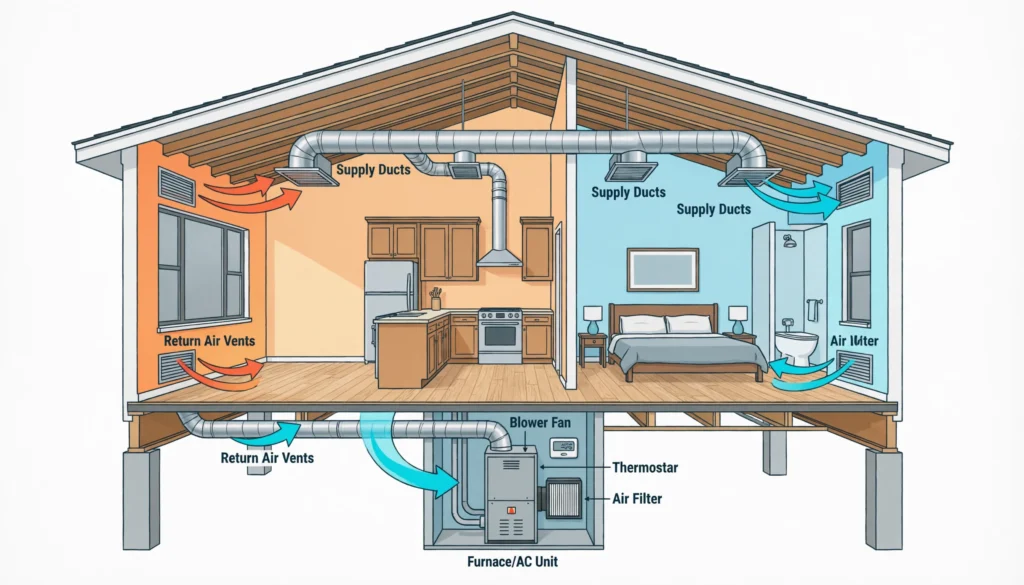
Forced air in a house refers to a heating and cooling system that uses air as the primary medium to distribute conditioned temperature throughout the home.
This system relies on a furnace or air handler to heat or cool air, which is then pushed through ducts and vents using a blower fan.
A comfortable home depends on an efficient heating and cooling system. Forced air is one of the most common HVAC (Heating, Ventilation, and Air Conditioning) systems in modern homes.
Whether you live in a cold climate needing efficient heating, or a hot region requiring cooling, knowing how forced air works helps you:
- Choose the right system for your home
- Maintain air quality and energy efficiency
- Troubleshoot common issues
- Save on energy bills
Many homeowners encounter the term “forced air” when discussing furnaces, air conditioning, or HVAC maintenance, so understanding it is key to making informed decisions.
Understanding forced air is essential for homeowners, renters, and those looking to improve comfort, efficiency, and energy savings in their homes.
Origin and Popularity of Forced Air Systems
Forced air systems became popular in the 20th century, replacing older methods like radiators and baseboard heating, which relied on convection and radiation rather than moving air.
Advantages of forced air systems include:
- Fast and even heating or cooling
- Ability to integrate air conditioning into the same ductwork
- Compatibility with filters to improve indoor air quality
Today, forced air is one of the most common heating methods in North American homes and continues to be widely used in new construction and renovations.
How Forced Air Works
A forced air system moves air through a series of components to maintain a comfortable indoor temperature.
Components of a Forced Air System:
- Furnace or Air Handler – Heats or cools the air.
- Blower Fan – Forces air through the ducts.
- Ductwork – Channels air to different rooms.
- Vents / Registers – Release conditioned air into living spaces.
- Thermostat – Controls temperature and triggers the system.
Step-by-Step Process:
- Thermostat signals the system to heat or cool.
- Furnace or air conditioner adjusts the air temperature.
- Blower fan pushes air through the ductwork.
- Conditioned air exits vents into rooms.
- Return ducts pull cooler or warmer air back for conditioning.
Types of Forced Air Systems
| System Type | Description | Pros | Cons |
|---|---|---|---|
| Gas Furnace | Uses natural gas or propane to heat air | Efficient heating, fast response | Requires ventilation, gas lines |
| Electric Furnace | Heats air with electric coils | Safe, easy installation | Higher energy costs |
| Heat Pump | Provides both heating and cooling | Energy-efficient, dual-purpose | Less effective in extreme cold |
| Air Conditioning Integration | Combines AC with forced air ducts | Centralized cooling | Requires duct maintenance |
Benefits of Forced Air Systems
- Rapid temperature control – Heats or cools rooms quickly.
- Air filtration – Improves indoor air quality with filters.
- Versatility – Works with heating, cooling, and humidifiers.
- Zoning potential – Can adjust temperature in different areas.
Common Issues With Forced Air Systems
| Issue | Symptoms | Solution |
|---|---|---|
| Dirty air filters | Reduced airflow, poor air quality | Replace filters regularly |
| Leaky ducts | Uneven heating/cooling, higher bills | Seal ducts professionally |
| Blower problems | Weak airflow | Inspect fan motor and belts |
| Thermostat malfunction | System not responding | Check wiring or replace thermostat |
Regular maintenance keeps forced air systems efficient and extends lifespan.
Examples of Forced Air in a Home
| Scenario | Description |
|---|---|
| Winter heating | Gas furnace blows warm air through vents to heat the house |
| Summer cooling | Central AC pushes cool air through same ducts |
| Air filtration | Air filter traps dust, pollen, and allergens |
| Zoning system | Different floors or rooms receive customized airflow and temperature |
Comparison With Other Heating Methods
| Heating Type | Method | Pros | Cons |
|---|---|---|---|
| Forced Air | Uses air via ducts | Fast, can integrate AC, filters improve air quality | Can spread dust, noisy blower |
| Radiant Heat | Uses hot water or electric panels | Quiet, no air movement | Slower heating, no cooling |
| Baseboard Heat | Electric convection along walls | Quiet, simple | Slow response, less even heating |
Polite and Professional Alternatives
When explaining or marketing a forced air system, other terms or phrasing may be used:
- Central air system – Emphasizes whole-home coverage
- Ducted HVAC – Highlights the duct network
- Blower-based heating and cooling – Technical description
- Air distribution system – Focus on airflow movement
Using professional terms helps in sales, maintenance contracts, or real estate listings.
FAQs
- What does forced air mean in a house?
It is a system that distributes heated or cooled air through ducts using a blower fan. - Is forced air good for homes?
Yes, it provides fast, even heating and cooling and can improve air quality. - How does forced air compare to radiant heating?
Forced air is faster and can integrate cooling, while radiant heating is quieter but slower. - Do forced air systems require maintenance?
Yes, filters, ducts, and blower fans need regular checks. - Can forced air systems be energy efficient?
Yes, modern systems with programmable thermostats and efficient furnaces or heat pumps can save energy. - What are common problems with forced air?
Dirty filters, leaky ducts, and blower issues are typical challenges. - Can forced air systems improve indoor air quality?
Yes, using HEPA or standard filters can reduce dust, pollen, and allergens. - Can forced air systems work with smart home devices?
Yes, smart thermostats and zoning systems allow precise temperature control.
Practical Tips for Homeowners
- Change filters every 1–3 months for clean airflow.
- Seal ducts to prevent energy loss.
- Schedule annual maintenance for furnace or AC units.
- Consider zoning for efficient comfort in large homes.
- Monitor airflow from vents to ensure even heating/cooling.
Conclusion
A forced air system is one of the most versatile and common HVAC systems in modern homes. By understanding how it works, its benefits, and proper maintenance, homeowners can enjoy comfortable, energy-efficient, and healthy indoor air year-round.
- Pro tip: Regular maintenance keeps airflow efficient, systems safe, and energy bills lower.
- Practice tip: Learn your system’s duct layout, filter schedule, and thermostat settings for optimal comfort.
Discover More Related Articles:
- Lamentation Mean in the Bible: Why It Matters for Christians in 2026
- Adam Mean in the Bible: Symbolism, and Impact in 2026

Jessica Brown is a language-focused writer who creates well-researched articles on word meanings, abbreviations, and everyday expressions. She contributes to meanvoro.com, delivering simple, reliable, and reader-friendly content designed to make complex terms easy to understand.