Definition:
In science, a conclusion is the final part of an experiment or investigation where the results are summarized and explained.
It states whether the hypothesis was supported or not and interprets what the findings mean based on the collected data.
Every scientific experiment follows a structured process. Scientists ask questions, form hypotheses, conduct experiments, collect data, and analyze results. But none of that work truly matters unless the findings are clearly explained.
That explanation is called the conclusion.
A strong scientific conclusion:
- Connects results back to the hypothesis
- Explains patterns in the data
- Identifies errors or limitations
- Suggests improvements or future research
Without a clear conclusion, an experiment feels unfinished. The conclusion is where science turns observations into understanding.
Understanding what a conclusion means in science is essential for students, researchers, and anyone conducting experiments. It is not just the “end” of a project. It is the part that makes sense of everything that happened during the investigation.
Origin and Meaning of the Word “Conclusion”
The word conclusion comes from the Latin term concludere, meaning “to shut up” or “to finish.” In modern English, it refers to the ending or final decision after reasoning or investigation.
In science, however, a conclusion is more than just an ending. It is a logical explanation based on evidence.
What Is a Conclusion in the Scientific Method?
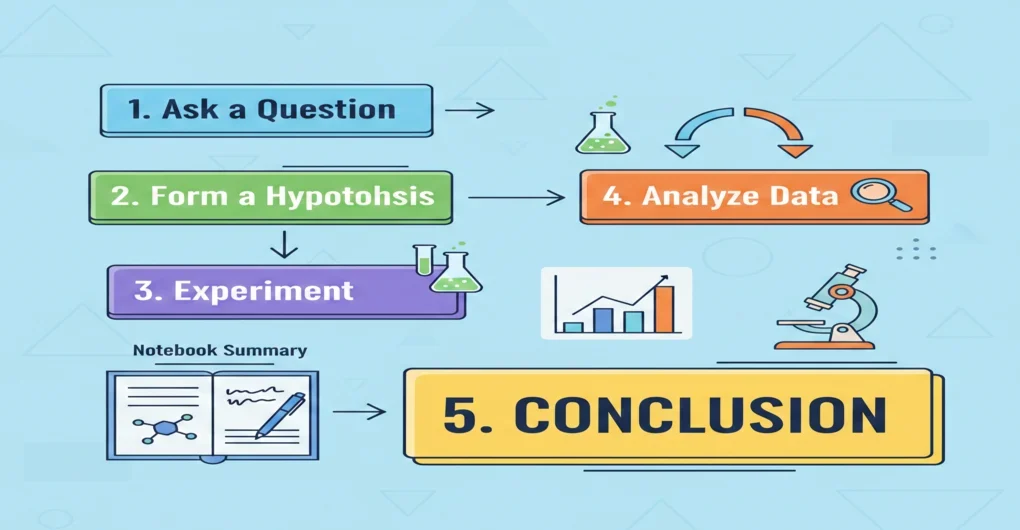
The scientific method usually follows these steps:
- Question
- Research
- Hypothesis
- Experiment
- Data collection
- Analysis
- Conclusion
The conclusion comes after analyzing the results. It answers the original research question using evidence gathered during the experiment.
Key Elements of a Scientific Conclusion
A proper scientific conclusion typically includes:
| Element | Explanation |
|---|---|
| Restated hypothesis | Reminds readers of the original prediction |
| Summary of results | Highlights important findings |
| Interpretation | Explains what the data means |
| Support or rejection | States whether the hypothesis was supported |
| Possible errors | Mentions factors that may have affected results |
| Future improvements | Suggests next steps |
Example of a Conclusion in Science
Let’s look at a simple example.
Experiment Question
Does sunlight affect plant growth?
Hypothesis
Plants exposed to more sunlight will grow taller.
Conclusion Example
The results showed that plants receiving six hours of sunlight per day grew an average of five centimeters taller than plants receiving only two hours. This supports the hypothesis that increased sunlight promotes plant growth. Minor variations may have occurred due to differences in watering amounts. Future experiments could control watering more strictly to improve accuracy.
Notice how the conclusion:
- Refers back to the hypothesis
- Uses data
- Explains findings
- Suggests improvement
That is what makes it scientific.
Types of Conclusions in Science
Scientific conclusions can vary depending on the type of investigation.
| Type | Description | Example |
|---|---|---|
| Experimental conclusion | Based on lab results | Chemistry experiment results |
| Observational conclusion | Based on patterns observed | Wildlife behavior study |
| Statistical conclusion | Based on numerical analysis | Survey data results |
| Theoretical conclusion | Based on logical reasoning | Physics model interpretation |
Each type still relies on evidence and logical explanation.
Conclusion vs Summary in Science
Students often confuse these two terms.
| Term | Meaning | Difference |
|---|---|---|
| Summary | Brief recap of information | Simply repeats key points |
| Conclusion | Evidence-based interpretation | Explains meaning of results |
A summary tells what happened.
A conclusion explains what it means.
Examples of Conclusions in Different Scientific Fields
Biology
The bacteria grew faster at warmer temperatures, suggesting that heat increases metabolic activity.
Chemistry
The reaction produced more gas at higher concentrations, supporting the theory that concentration affects reaction rate.
Physics
The object accelerated faster when force increased, confirming Newton’s second law.
Environmental Science
Pollution levels were highest near industrial zones, indicating human activity impacts air quality.
Each example connects evidence to explanation.
Common Mistakes When Writing a Scientific Conclusion
Students sometimes make errors that weaken their conclusions.
- Simply repeating results without explanation
- Adding new data that was not in the experiment
- Ignoring contradictory evidence
- Failing to address the hypothesis
- Writing opinions instead of evidence-based reasoning
A scientific conclusion must stay objective and data-driven.
How to Write a Strong Scientific Conclusion
Follow this simple formula:
- Restate the purpose of the experiment
- Summarize the main findings
- State whether the hypothesis was supported
- Explain why the results occurred
- Mention possible errors
- Suggest improvements
This structure keeps the conclusion clear, logical, and professional.
Real-Life Importance of Conclusions in Science
Conclusions are not just for school projects. They are critical in:
- Medical research
- Climate studies
- Drug development
- Engineering design
- Technology innovation
Every scientific advancement depends on clear, evidence-based conclusions.
For example, before a medicine is approved, researchers must draw strong conclusions about its safety and effectiveness based on trials.
Conclusion
In science, a conclusion is the final and most important part of an investigation. It transforms data into understanding. By restating the hypothesis, analyzing results, and explaining their meaning, a scientific conclusion completes the research process.
- Pro tip: Always connect your findings back to your original hypothesis.
- Practice tip: Use data to support every claim you make.
Mastering how to write a scientific conclusion strengthens critical thinking and scientific communication skills.
Discover More Related Articles:
- Perseverance Mean in the Bible: Lessons from Paul, Job, and Jesus for 2026
- Subdue Meaning in the Bible: Lessons for 2026

Jessica Brown is a language-focused writer who creates well-researched articles on word meanings, abbreviations, and everyday expressions. She contributes to meanvoro.com, delivering simple, reliable, and reader-friendly content designed to make complex terms easy to understand.