
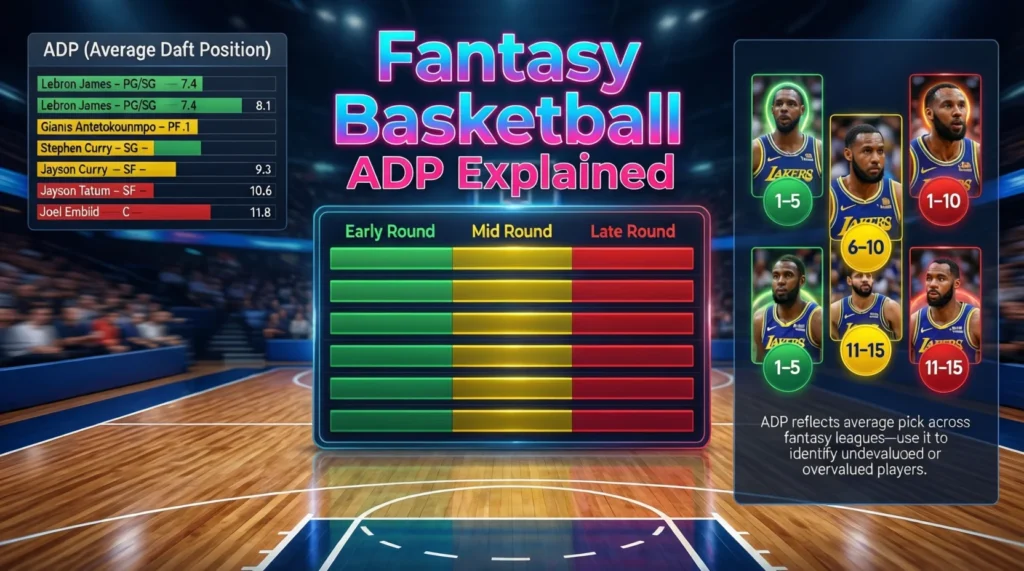
ADP (Average Draft Position) in fantasy basketball refers to the average spot at which a player is selected in fantasy drafts. It is a statistical measure that helps drafters understand a player’s perceived value in the fantasy community.
If you’ve ever dived into the exciting world of fantasy basketball, you’ve probably come across the term ADP Mean in Fantasy Basketball and wondered, “What does this even mean?” Understanding ADP can dramatically improve your draft strategy and help you dominate your fantasy league.
In this guide, we’ll break down everything about ADP what it is, how it works, and how to use it like a pro. 🏀✨
Origin of ADP in Fantasy Sports
The concept of ADP originated with the rise of online fantasy sports platforms in the early 2000s. As more players joined fantasy basketball leagues, there was a need for a standardized metric to track where players were typically drafted. Fantasy sports websites began compiling draft data from thousands of leagues and calculating the average draft position for each player.
ADP has grown in popularity because it gives both beginners and experienced drafters an objective reference point, allowing for smarter decisions during draft day.
Why ADP Is Important in Fantasy Basketball
ADP is more than just a number—it’s a strategic tool. Here’s why:
- Draft Planning: Knowing a player’s ADP helps you predict when they might be picked, avoiding the risk of waiting too long and missing key players.
- Value Assessment: If a player’s ADP is later than expected, they could be a steal pick.
- Trade Evaluation: ADP provides a benchmark for fair player trades.
- League Comparison: You can see how player values differ across standard or custom leagues.
Think of ADP as your compass during the chaotic sea of draft picks—it helps you navigate and make smart moves.
How ADP Is Calculated
ADP is calculated by taking the average pick number of a player across multiple drafts. For example:
| Player Name | Draft 1 | Draft 2 | Draft 3 | Draft 4 | Average Draft Position (ADP) |
|---|---|---|---|---|---|
| LeBron James | 1 | 2 | 1 | 3 | 1.75 |
| Anthony Davis | 3 | 5 | 2 | 4 | 3.5 |
| Ja Morant | 8 | 7 | 10 | 9 | 8.5 |
In this table, ADP reflects the consensus pick spot of each player.
Examples of ADP Usage in Drafts
- Avoid Reaching Too Early:
If a player has an ADP of 50 but you’re considering picking them in round 4, you might be overvaluing them. Waiting a few rounds could allow you to draft more efficiently. - Target Value Picks:
A player with a 30 ADP being drafted at 45 can be considered a value pick, giving you more talent for later rounds. - Draft Strategy Alignment:
By comparing ADP with your league’s scoring settings, you can adjust your draft strategy and select players whose ADP undervalues their actual contribution.
ADP vs. Draft Rank vs. Player Rankings
Many fantasy basketball players confuse ADP, draft rank, and player rankings. Here’s a breakdown:
| Term | Definition | Key Difference |
|---|---|---|
| ADP | Average Draft Position across many leagues | Data-driven, objective, changes weekly |
| Draft Rank | Your personal ranking of players | Subjective, based on your strategy or preferences |
| Player Rankings | Expert or algorithm-based rankings | May vary by source and scoring settings |
ADP is community-based, reflecting real draft trends, while draft rank is individual-based.
Alternate Meanings of ADP
While in fantasy basketball, ADP almost always means Average Draft Position, it can have other meanings in different contexts:
- Adenosine Diphosphate (Biology) – a molecule involved in energy transfer.
- Automatic Data Processing (Business) – a company providing HR and payroll solutions.
In fantasy basketball, stick to the first definition to avoid confusion.
Tips for Using ADP Effectively
- Check Multiple Sources: ADP can vary between different fantasy platforms, so review multiple sources.
- Adjust for League Type: Standard scoring vs. points league can affect ADP.
- Look for Steals: Players with ADP later than their projected value are ideal picks.
- Plan for Runs: If a position run starts, ADP can help you decide when to draft before a scarcity hits.
- Combine with Rankings: ADP alone isn’t enough—use it with player rankings to maximize draft efficiency.
Comparison: ADP vs. Auction Value
In auction-style drafts, each player has a predicted auction value (AAV) instead of a pick number. ADP is more relevant in snake drafts, whereas AAV helps in auction drafts. Still, both metrics are tools to guide decision-making.
Common ADP Mistakes to Avoid
- Blindly following ADP: Your league scoring and roster settings may differ from ADP assumptions.
- Ignoring positional needs: ADP is a guide, not a hard rule. Balance your positions first.
- Overreacting to small ADP shifts: Weekly ADP fluctuations are normal; focus on trends, not spikes.
FAQs
- What does ADP stand for in fantasy basketball?
ADP stands for Average Draft Position, representing where players are typically selected across multiple drafts. - Is a lower ADP better?
Yes! A lower ADP means the player is typically drafted earlier and considered more valuable. - How often is ADP updated?
Most fantasy platforms update ADP weekly during the draft season based on new draft data. - Does ADP differ by league type?
Yes, ADP can vary in standard, points, or custom scoring leagues. - Can ADP predict player performance?
ADP reflects draft trends, not performance guarantees. Use it with stats and projections. - Where can I find ADP data?
Popular sources include fantasy platforms like ESPN, Yahoo, CBS Sports, and Sleeper. - Should I always draft according to ADP?
No. Use ADP as a guide but adapt to your strategy, scoring, and positional needs. - Is ADP used in other fantasy sports?
Absolutely! ADP is common in fantasy football, baseball, and hockey as well.
Conclusion
ADP is an essential tool for any fantasy basketball player, whether you’re a beginner or a seasoned veteran. It provides objective insights into player value, helps you make smarter draft decisions, and prevents costly mistakes.
By combining ADP with player rankings, projections, and your personal strategy, you can maximize your chances of winning your league. 🏆
Search More Related Articles :
- BOT Mean in Baseball: Complete Guide for Fans & Players (2026)
- GIR Mean in Golf: Tips to Hit More Greens in Regulation (2026)

Jessica Brown is a language-focused writer who creates well-researched articles on word meanings, abbreviations, and everyday expressions. She contributes to meanvoro.com, delivering simple, reliable, and reader-friendly content designed to make complex terms easy to understand.