

Definition
In the word capitalism, the suffix “ism” means a system, belief, or ideology.
It shows that capitalism is an organized economic system based on specific ideas about ownership, markets, and profit.
Words like capitalism are used every day in classrooms, news discussions, and social debates, yet many people do not fully understand how these words are formed. A key part of understanding capitalism lies in a small but powerful suffix:
Ism Meaning in Capitalism for Students. This suffix turns ordinary words into structured ideas, systems, or belief frameworks.
When added to the word capital, the suffix ism transforms it into a complete economic concept. Capitalism becomes more than money or wealth. It becomes a system that explains how economies function, how resources are owned, and how profit is generated. Understanding this suffix helps clarify not only capitalism but also many other important social and economic terms.
In this article, we will explore what the suffix ism means in the word capitalism, where it comes from, how it is used, and why it matters in real life and academic discussions.
Breaking Down the Word Capitalism
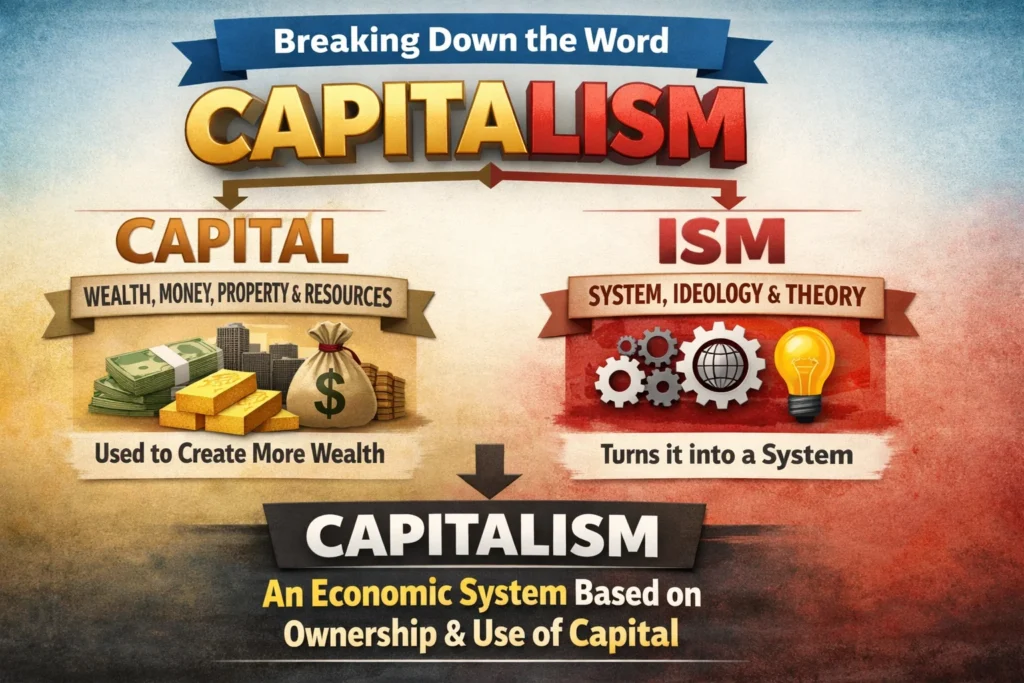
The word capitalism is made up of two parts.
Capital refers to wealth, money, property, or resources used to create more wealth.
Ism turns the word into a system, ideology, or theory.
Together, capitalism means an economic system based on the ownership and use of capital.
What Does the Suffix Ism Mean?
General Meaning of Ism
The suffix ism is commonly used in English to describe:
- A belief or ideology
- A system or doctrine
- A movement or organized theory
- A characteristic way of thinking or behaving
When you see ism at the end of a word, it usually means the word represents a structured set of ideas rather than a single action.
What Ism Means in the Word Capitalism
In capitalism, the suffix ism shows that the word refers to a complete economic system. It explains how production, ownership, and profit work within a society.
It indicates that capitalism is:
- A formal economic structure
- A theory about markets and ownership
- A system that can be studied, supported, or criticized
Without the suffix, capital only refers to money or assets. With ism, it becomes a full ideology.
Origin of the Suffix Ism
The suffix ism comes from ancient Greek and later Latin. Over time, it entered English through European languages and began to represent organized practices and belief systems.
Originally, it described actions or conditions. Later, it became widely used to name philosophical, political, and economic systems. This is why many ideologies today end with ism.
Popularity of the Term Capitalism
The word capitalism became widely used during the nineteenth century when industrial economies expanded rapidly. Thinkers needed a term to describe an economic system based on private ownership, investment, and profit.
Adding ism helped define capitalism as a clear and recognizable system that could be discussed and compared with others.
Real World Usage of Ism in Capitalism
In everyday language, the suffix ism allows capitalism to be discussed as an idea rather than just an activity.
Examples include:
Capitalism encourages competition.
Capitalism affects global markets.
Capitalism works differently in different countries.
Each sentence treats capitalism as a system of ideas rather than a single business practice.
Tone and Context of Ism in Capitalism
The suffix ism allows capitalism to carry different tones depending on context.
Neutral Use
Capitalism is an economic system based on private ownership.
Supportive Use
Capitalism promotes innovation and efficiency.
Critical Use
Capitalism can increase economic inequality.
The suffix itself is neutral. The tone comes from how the word is used.
Example
| Base Word | Word With Ism | Meaning |
| Capital | Capitalism | An economic system based on private ownership |
| Social | Socialism | A system based on collective ownership |
| National | Nationalism | A political ideology |
| Feminine | Feminism | A social and political movement |
| Real | Realism | A philosophical or artistic approach |
This pattern shows how ism consistently turns words into systems or ideologies.
Comparison With Other Ism Words
Capitalism and Socialism
Capitalism focuses on private ownership and profit.
Socialism focuses on shared ownership and social equality.
Both use ism to represent complete economic systems.
Capitalism and Communism
Capitalism emphasizes individual ownership.
Communism emphasizes collective ownership.
Again, ism signals that these are full economic theories.
Why Ism Matters in Academic Writing
In academic and professional writing, the suffix ism helps clearly classify ideas. It allows scholars and students to analyze systems logically and objectively.
Using capitalism instead of capital provides clarity and precision.
Alternate Meanings of Ism
In some cases, ism can refer to habits or tendencies. However, in the word capitalism, its meaning is strictly related to economic ideology.
Professional Alternatives to Capitalism
In formal writing, neutral alternatives may include:
Market economy
Free market system
Private enterprise economy
These terms can be useful when avoiding ideological tone.
Common Misunderstandings
Some people believe ism automatically makes a word positive or negative. This is incorrect. The suffix only identifies a system or belief. The judgment comes from interpretation, not the word its.
FAQs
1. What does the suffix ism mean in capitalism?
It means capitalism is an organized economic system or ideology.
2. Why is capitalism called an ism?
Because it represents a structured theory about how economies operate.
3. Is ism always related to beliefs?
Often yes, but it can also describe systems or movements.
4. Does ism make capitalism political?
It allows discussion in political contexts, but it is primarily economic.
5. Are there other economic isms?
Yes, including socialism and communism.
6. Is ism a negative suffix?
No, it is neutral.
7. Can capitalism exist without the word ism?
The system can exist, but the term helps explain it clearly.
8. Why is ism important in language?
It helps categorize and understand complex ideas.
Conclusion
The suffix ism gives the word capitalism its full meaning. It transforms capital from a simple concept into a complete economic system that can be studied, debated and compared. Understanding this suffix makes complex terms easier to understand and helps readers think more clearly about economic and social ideas.
Recognizing how ism works also helps decode many other important words used in education, politics, and philosophy.
Discover More Related Articles:
- Unhinged Meaning | Pop Culture & Memes In 2026
- AWOL Meaning | Why Someone Suddenly Disappears Online In 2026
- Blue Collar Meaning | Salary & Career Opportunities In 2026

Jessica Brown is a language-focused writer who creates well-researched articles on word meanings, abbreviations, and everyday expressions. She contributes to meanvoro.com, delivering simple, reliable, and reader-friendly content designed to make complex terms easy to understand.

