Definition
Trabajo is a Spanish noun that means work, job, or labor. It refers to employment, tasks, effort, or professional activity, depending on the context in which it is used. The word is widely used in everyday conversation, education, and professional settings across all Spanish-speaking countries.
The Spanish language is full of everyday words that carry important meaning, and Trabajo Spanish Meaning is one of the most commonly used. You will hear it in conversations about jobs, school, responsibilities, and even personal effort.
Because it appears so often in daily speech, understanding what trabajo means and how it is used can greatly improve your Spanish communication skills.
If you are learning Spanish or frequently hear the word trabajo, you are not alone. It is one of the most essential and commonly used Spanish words. In this comprehensive guide, you will learn exactly what trabajo means, where it comes from, how native speakers use it in real life, and how it compares to similar Spanish terms. By the end, you will be able to use trabajo naturally and confidently.
What Does Trabajo Mean in Spanish?
At its most basic level, trabajo translates to work in English. However, like the English word “work,” it carries several meanings depending on the situation.
Core Meanings of Trabajo
Trabajo can refer to:
• A job or occupation
• Work as an activity or effort
• A task or assignment
• Physical or mental labor
• A completed piece of work, such as a project or paper
Basic Translation Examples
| Spanish Term | English Meaning |
| trabajo | work |
| un trabajo | a job |
| el trabajo | work in general |
| trabajos | jobs, works, assignments |
Origin and History of the Word Trabajo
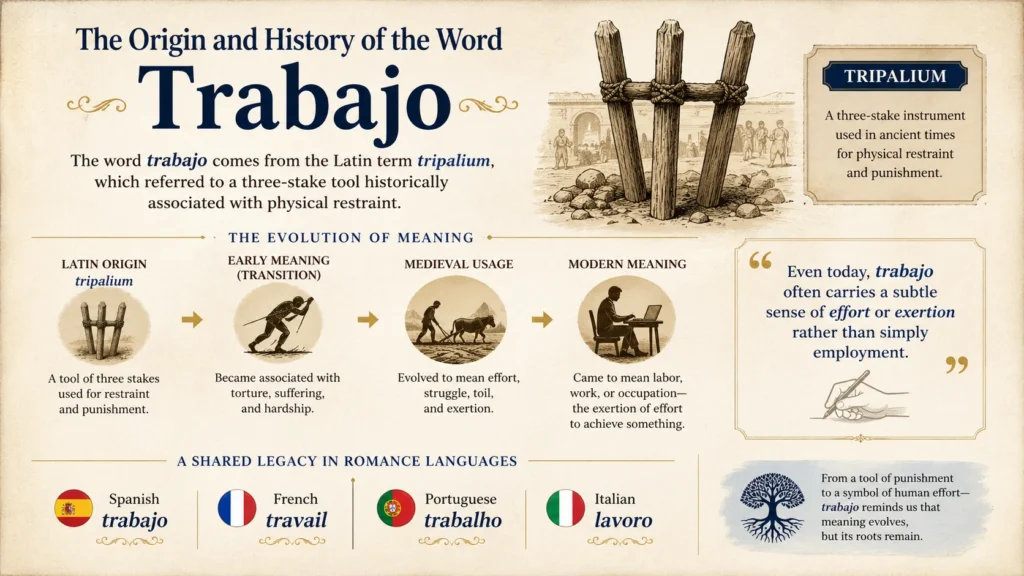
The word trabajo comes from the Latin term tripalium, which referred to a three-stake tool historically associated with physical restraint. Over time, the word evolved to describe effort, struggle, and eventually labor and work.
This shared origin explains why similar words exist across Romance languages:
• Spanish: trabajo
• French: travail
• Portuguese: trabalho
• Italian: lavoro
Even today, trabajo often carries a subtle sense of effort or exertion rather than simply employment.
How Common Is Trabajo in Spanish?
Trabajo is one of the most frequently used nouns in the Spanish language. It appears in:
• Everyday conversations
• Workplace discussions
• Academic environments
• News and media
• Formal and informal communication
Whether you are talking about your career, homework, or daily responsibilities, trabajo naturally fits into countless situations.
Real-World Usage of Trabajo
Trabajo Meaning Job or Employment
This is one of the most common uses of the word.
Examples:
Estoy buscando trabajo.
I am looking for a job.
Conseguí un nuevo trabajo.
I got a new job.
Mi trabajo es muy exigente.
My job is very demanding.
In this sense, trabajo often overlaps with empleo, though the two are not always interchangeable.
Trabajo Meaning Work or Effort
Trabajo can also describe the effort or workload involved in an activity.
Examples:
Tengo mucho trabajo hoy.
I have a lot of work today.
Este proyecto requiere mucho trabajo.
This project requires a lot of work.
This meaning emphasizes effort rather than a specific job position.
Trabajo Meaning Assignment or Academic Work
In schools and universities, trabajo commonly refers to an assignment or project.
Examples:
El profesor dejó mucho trabajo para mañana.
The teacher assigned a lot of work for tomorrow.
Tengo que entregar un trabajo de historia.
I have to submit a history paper.
Trabajo as a Creative or Professional Work
Trabajo can also describe completed work in creative or professional fields.
Examples:
Este es uno de sus mejores trabajos.
This is one of his or her best works.
Su trabajo ha sido reconocido internacionalmente.
His or her work has been internationally recognized.
Tone and Emotional Nuance of Trabajo
The word trabajo is usually neutral, but tone changes depending on context.
Neutral Tone
Trabajo de oficina
Office work
Trabajo remoto
Remote work
Friendly or Casual Tone
Ando con mucho trabajo últimamente.
I have been pretty busy lately.
Negative or Frustrated Tone
Este trabajo es una pesadilla.
This job is a nightmare.
Mucho trabajo y poco tiempo.
Too much work and not enough time.
Native speakers rely on tone, emphasis, and body language to convey emotion.
Common Expressions with Trabajo
Some of the most common phrases include:
• Trabajo duro
• Trabajo en equipo
• Trabajo a tiempo completo
• Trabajo a tiempo parcial
• Trabajo remoto
• Carga de trabajo
• Buscar trabajo
• Perder el trabajo
These expressions are used across professional and casual conversations.
Trabajo in Context Table
| Spanish Sentence | English Meaning | Context |
| Tengo trabajo pendiente | I have pending work | Professional |
| Busco trabajo desde hace meses | I have been job hunting for months | Employment |
| El trabajo quedó excelente | The work turned out excellent | Academic |
| Mucho trabajo hoy | A lot of work today | Casual |
| Ese trabajo no vale la pena | That job is not worth it | Negative |
Trabajo vs Similar Spanish Words
Trabajo vs Empleo
| Trabajo | Empleo |
| General concept of work | Formal job |
| Can be paid or unpaid | Usually paid |
| Includes tasks and effort | Focuses on job position |
Example:
Tengo mucho trabajo.
I have a lot of work.
Tengo un empleo estable.
I have a stable job.
Trabajo vs Tarea
Trabajo refers to broader or long-term work, while tarea refers to a specific task.
Tengo mucho trabajo esta semana.
Esta tarea es fácil.
Trabajo vs Obra
Trabajo refers to effort or work in progress, while obra usually refers to a finished creation or construction.
Es una obra maestra.
El trabajo fue muy difícil.
Polite and Professional Alternatives to Trabajo
In professional settings, speakers may choose more refined terms:
• Labor profesional
• Actividad laboral
• Funciones laborales
• Responsabilidades del puesto
• Proyecto profesional
These alternatives sound more formal and are common in business communication.
Alternate Meanings of Trabajo
Although rare, trabajo can sometimes imply difficulty or trouble in informal speech.
Me dio mucho trabajo entenderlo.
It took a lot of effort to understand it.
FAQs
What does trabajo literally mean?
Trabajo literally means work or labor.
Is trabajo masculine or feminine?
Trabajo is masculine. El trabajo.
Can trabajo mean homework?
Yes. In academic contexts, trabajo often means an assignment or project.
Is trabajo the same as empleo?
Not exactly. Trabajo is broader, while empleo usually means a formal job.
Can trabajo be plural?
Yes. Trabajos refers to jobs, works, or assignments.
Is trabajo formal or informal?
It is neutral and appropriate in both formal and informal settings.
How do you say “at work” in Spanish?
En el trabajo.
Can trabajo have a negative meaning?
Yes, depending on tone, it can imply stress, difficulty, or dissatisfaction.
Conclusion
Trabajo is a simple yet powerful Spanish word that means work, job, or effort, and it appears constantly in everyday conversations. From talking about your profession to describing tasks at school or home, trabajo helps express what people do and how much effort something requires.
Its meaning can change slightly depending on context, but it always relates to activity,responsibility, or effort. By understanding how trabajo is used in daily Spanish, you can communicate more naturally, sound more confident, and better understand real-life conversations.
Whether you are learning Spanish for travel, study, or work, trabajo is an essential word worth mastering.
Discover More Related Articles:
- JOI Mean in Porn | Understanding the Adult Content Slang Term In 2026
- The Root Tele Mean in Television | Understanding the Word’s Origin In 2026
- Closed Circle Mean in Math |The Symbol Most Students Misunderstand In 2026

Ryan Thompson is an experienced content writer specializing in slang terms, texting abbreviations, and word meanings. He writes for meanvoro.com, where he creates accurate and easy-to-understand language content for readers.