
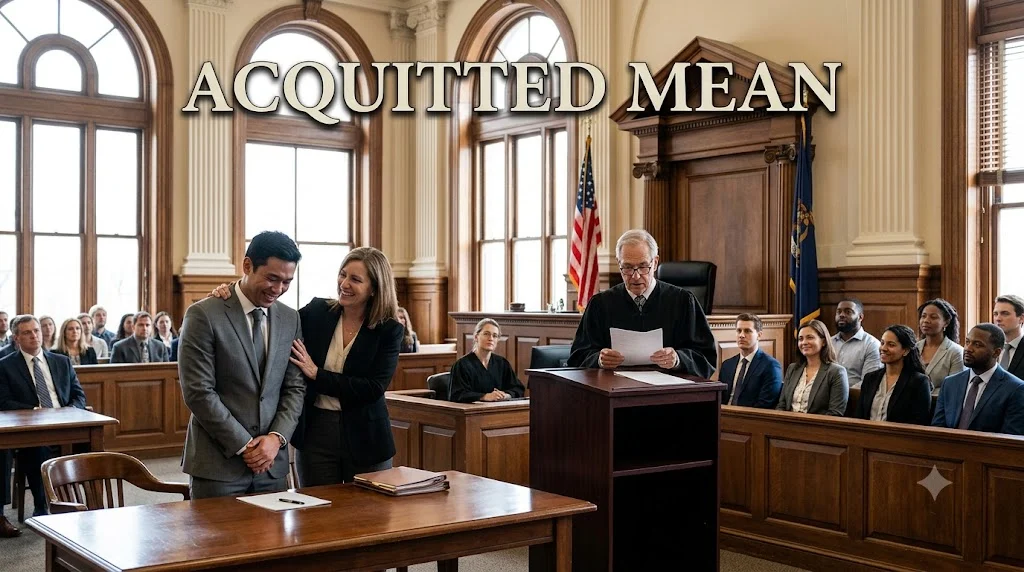
Definition
Acquitted means officially declared not guilty of a crime by a court of law after a trial because there is not enough evidence to prove the person committed the offense.
Legal terms can often sound confusing, especially if you’re not familiar with courtroom language. One word that frequently appears in news reports, movies, and legal discussions is “acquitted.” But what does it actually mean?
In simple terms, being acquitted means a court has found that there is not enough evidence to prove someone guilty of a crime. It does not always mean the person is completely innocent; rather, it means the prosecution failed to prove the case beyond a reasonable doubt.
What Does Acquitted Mean in Plain English
You watch crime shows and legal dramas all the time. The judge reads the verdict. Someone gets acquitted. But what does acquitted mean in real life? Most people think it means innocent. That’s not quite right.
Let me explain it simply. When a court acquits someone, it means the prosecution failed to prove their case. The evidence wasn’t strong enough. The jury or judge decided the charges don’t stick. That person walks free.
The legal meaning of acquitted carries weight in courtrooms across America. It triggers constitutional protections. It prevents retrial. And it represents the ultimate failure of the prosecution’s case against you.
Now let me walk you through everything about acquittal. You’ll understand the nuances, the protections, and the real-world consequences that most articles never mention.
The Official Legal Definition of Acquitted
Black’s Law Dictionary defines acquittal as the legal judgment that officially releases someone from criminal charges. The court enters this judgment after a trial or through a directed verdict from the judge.
The acquitted meaning in law stems from two sources. A jury can return a not guilty verdict. Or a judge can grant a motion for acquittal when the prosecution presents insufficient evidence. Both outcomes result in the same legal status.
The acquitted meaning also includes the presumption of innocence. You walk out of court with that presumption intact. The law treats you as innocent of those charges moving forward. But that legal fiction doesn’t always match public perception.
The Key Differences Everyone Confuses
People mix up legal terms constantly. Acquitted, not guilty, dismissed, exonerated, hung jury. They sound similar but carry drastically different meanings and consequences.
Let me clear up the confusion with a comprehensive comparison table.
Comparison Table: Legal Outcomes at a Glance
| Legal Outcome | What Actually Happens | Who Decides | Double Jeopardy Protection | Record Impact |
|---|---|---|---|---|
| Acquitted | Prosecution fails to prove guilt beyond reasonable doubt | Judge or jury | Yes, permanent protection | Arrest remains, no conviction |
| Not Guilty | Same as acquitted, just different phrasing | Jury typically | Yes, permanent protection | Arrest remains, no conviction |
| Dismissed | Case thrown out before trial ends | Judge only | Depends on dismissal type | Arrest remains, charges dropped |
| Exonerated | New evidence proves factual innocence | Court or executive authority | Yes, plus official innocence declaration | May be eligible for expungement |
| Hung Jury | Jury cannot reach unanimous verdict | No one decides | No, prosecution can retry | No resolution yet |
Acquitted vs Dismissed
What is acquitted compared to dismissal? Timing makes all the difference. A dismissal happens before the trial reaches its conclusion. The judge throws out the case for procedural reasons or lack of evidence at an early stage.
An acquittal only comes after the trial proceeds to its natural end. The prosecution presents its full case. The defense makes its arguments. Then the jury or judge renders a verdict.
Acquitted vs dismissed also affects double jeopardy. An acquittal triggers full constitutional protection. The government cannot retry you. A dismissal might not offer that same protection.
The prosecution can refile charges after certain dismissals. But with an acquittal, that door slams shut permanently. You walk free for good on those charges.
Acquitted vs Not Guilty
Here’s the honest truth. Acquitted and not guilty mean virtually the same thing in practice. Most legal professionals use them interchangeably.
The subtle difference lies in usage. A jury returns a verdict of not guilty. The judge then enters an order of acquittal based on that verdict. Not guilty represents the jury’s finding. Acquittal represents the court’s official action.
When someone asks what does acquitted mean versus not guilty, you can tell them it’s basically the same outcome. Both result in freedom. Both trigger double jeopardy.
Acquitted vs Exonerated
This distinction matters enormously. Acquitted means the prosecution didn’t prove its case. Exonerated means new evidence proves you actually didn’t commit the crime.
The acquitted meaning in law doesn’t require factual innocence. O.J. Simpson got acquitted of murder charges. Most people believe he committed those murders. The evidence just didn’t meet the beyond reasonable doubt standard.
Exoneration requires positive proof of innocence. DNA evidence. A confession from the real perpetrator. Alibi witnesses with rock-solid credibility. Something that conclusively shows you didn’t do it.
Many wrongfully convicted people get exonerated after years in prison. They didn’t get acquitted at trial. They got convicted and later proved their innocence through new evidence or legal appeals.
Acquitted vs Hung Jury
A hung jury creates massive confusion. When the jury can’t reach a unanimous decision, the judge declares a mistrial. This isn’t an acquittal. It’s a do-over.
What does acquitted mean compared to a hung jury? Freedom versus limbo. An acquittal means you walk. A hung jury means you wait. The prosecution decides whether to retry the case with a new jury.
Hung juries happen when jurors disagree. Some think you’re guilty. Others think you’re innocent. The judge can’t force a unanimous decision. So the case stalls without resolution.
Double jeopardy doesn’t apply to hung juries. The prosecution gets another shot. They can bring the same charges against you in a new trial. You have to go through the entire process all over again.
Acquitted vs Dismissed: The Hidden Trap You Need to Know
Most people think an acquittal and a dismissal offer similar protection. They don’t. This misunderstanding can cost you dearly.
The acquitted meaning in court guarantees finality. Once you’re acquitted, the case ends forever. The prosecution cannot appeal. They cannot refile. You’re done.
Dismissals don’t offer that same guarantee. When a judge dismisses a case without prejudice, the prosecution can refile charges. They can bring new evidence. They can try again later.
What does acquitted mean for your immediate freedom? You leave court that day. No supervision. You’re completely free.
A dismissal might still require conditions. The judge might dismiss the case but keep you on bail pending appeal. Or the prosecution might dismiss with plans to refile later. You don’t get the same clean break.
Always understand the difference between acquitted and dismissed. Your future freedom might depend on knowing exactly which outcome you received.
Acquitted vs Exonerated: The Moral Versus the Legal
This distinction cuts to the heart of what people really want to know. Does acquitted mean innocent in the eyes of the law? Yes. Does it mean innocent in the eyes of the public? Often not.
The acquitted definition in legal terms focuses entirely on the prosecution’s failure. They couldn’t prove their case. The evidence fell short. The jury had reasonable doubt. So the defendant gets acquitted.
Exoneration goes further. It means new evidence conclusively proves the defendant’s factual innocence. This rarely happens. Most acquitted defendants never get officially exonerated.
The civil trial later found him liable for wrongful death. That’s the other side of acquittal. Criminal acquittal doesn’t prevent civil liability. The lower burden of proof in civil cases often results in different outcomes.
Exoneration carries more weight in public perception. When someone gets exonerated, it means they were completely innocent all along. Acquittal leaves room for doubt. That doubt follows many defendants for life.
Does an Acquittal Clear Your Record? The Honest Answer
This question matters more than you might think. Many people assume acquittal means their record disappears. That assumption is dead wrong.
The legal meaning of acquitted doesn’t include record expungement. Your arrest remains on your record. The charges remain visible. The court proceedings remain public.
When employers run background checks, they see everything. They see that you went to trial and got acquitted. All that information stays available.
The best approach involves proactive legal action. File for expungement immediately after acquittal. Demand correction from background check companies. Keep documentation of your acquittal to show potential employers. Your future depends on managing this process aggressively.
Can You Be Sued After an Acquittal?
Here’s something most articles won’t tell you. An acquittal in criminal court offers zero protection against civil lawsuits.
The acquitted meaning in criminal law doesn’t apply to civil court. Different outcomes entirely.
In criminal court, the prosecution must prove guilt beyond a reasonable doubt. That’s the highest legal standard. It protects you from wrongful conviction. But it also makes convictions harder to secure.
Civil court uses a much lower standard. Preponderance of the evidence. That means more likely than not. Fifty-one percent certainty versus ninety-nine percent certainty. That’s a massive difference.
Always consult with an attorney about civil exposure. Your criminal defense lawyer should warn you about this possibility. If they don’t, find someone who will. The financial consequences can destroy you even without a criminal conviction.
Famous Acquittals That Shaped Legal History
Real cases illustrate the acquitted meaning better than any textbook. Let me walk you through three famous acquittals that changed how we understand the legal system.
The O.J. Simpson Trial
The Simpson case remains the most famous acquittal in American history. Charged with two counts of murder. Represented by a dream team of defense attorneys. Acquitted after a lengthy televised trial.
What does acquitted mean in this context? The jury had reasonable doubt. The prosecution’s evidence, particularly the DNA handling, raised serious questions. The defense effectively attacked every piece of evidence.
The acquittal sparked nationwide debate about race, justice, and celebrity influence. Many Americans believed Simpson committed those murders. The legal system said otherwise. The gap between public opinion and legal outcome grew enormous.
Simpson later faced civil liability. The victims’ families won a wrongful death judgment. The criminal acquittal didn’t protect him from paying damages. He eventually went to prison for an unrelated crime in Nevada.
The Casey Anthony Trial
Casey Anthony faced charges for her daughter’s murder. The prosecution presented a compelling case. The defense argued the child drowned accidentally. The jury acquitted Anthony of the most serious charges.
The acquitted meaning here created massive public outrage. Millions watched the trial. Most believed Anthony guilty. The jury disagreed. They found reasonable doubt about the cause of death and the circumstances surrounding it.
Anthony walked free but faced public condemnation. Her acquittal didn’t restore her reputation. It didn’t help her find employment or rebuild her life. The legal victory came with devastating social consequences.
The case also highlighted the difference between acquitted and exonerated. Anthony was never exonerated. No new evidence proved her innocence. The prosecution simply couldn’t meet its burden of proof.
The Amadou Diallo Case
Police officers fired 41 shots at Amadou Diallo, killing him. The officers claimed they thought Diallo reached for a weapon. He reached for his wallet. The officers faced criminal charges and got acquitted.
What does acquitted mean when police officers kill unarmed civilians? It means the prosecution couldn’t prove criminal intent or excessive force beyond reasonable doubt. The legal system accepted the officers’ self-defense claims.
This acquittal sparked protests and police reform efforts. It showed how acquitted meaning in court doesn’t necessarily reflect justice in the community. The legal outcome and public perception diverged sharply.
The officers later faced civil rights violations from the federal government. But they never faced criminal consequences for the shooting. Their acquittal protected them from criminal liability but not from public scrutiny.
These cases demonstrate the complex reality of acquittal. Legal victory doesn’t guarantee social acceptance. The what does acquitted mean question often leads to deeper questions about justice, fairness, and the gap between law and morality.
What Acquittal Means for Defendants’ Rights Going Forward
The acquitted definition carries enormous constitutional weight. It triggers specific protections that permanently affect your legal status.
Double jeopardy represents the most important protection. The Fifth Amendment prohibits trying someone twice for the same offense. Once you’re acquitted, the government cannot retry you on those specific charges.
This protection applies immediately. The moment the jury returns a not guilty verdict, double jeopardy attaches. Even if new evidence emerges later, the prosecution can’t use it. Your acquittal stands forever.
You maintain all your constitutional rights after acquittal. No restrictions on voting. The acquittal restored your full legal status as a citizen.
Common Misconceptions About Acquittal
Let me bust some persistent myths about what does acquitted mean.
Myth: Acquitted Means Innocent
This is the biggest misconception. Acquitted means the prosecution failed to prove guilt beyond reasonable doubt. It doesn’t mean you’re factually innocent. It means the legal system couldn’t convict you.
The acquitted definition doesn’t include a finding of actual innocence. The jury simply says the evidence doesn’t meet the high standard required for conviction. That’s a very different thing.
Myth: The Prosecution Can Appeal an Acquittal
The government cannot appeal an acquittal. Double jeopardy prevents any retrial. The prosecution accepts the jury’s verdict, even when they disagree with it.
The prosecution can sometimes appeal legal rulings that led to acquittal. But they can’t appeal the acquittal itself. Once the jury says not guilty, the case ends for the prosecution.
Myth: Acquittal Automatically Clears Your Record
Your arrest remains on your record. The charges remain visible. The trial proceedings remain public. You need separate legal action to expunge or seal your records.
The legal meaning of acquitted doesn’t include record cleanup. That’s a completely separate legal process with different requirements and standards.
Myth: Acquittal Protects You From Civil Lawsuits
Civil court uses a lower standard of proof. Your criminal acquittal doesn’t prevent civil liability. You can face financial judgments even after winning your criminal case.
The what does acquitted mean question must include this distinction. Criminal acquittal and civil liability are entirely separate legal outcomes.
Myth: A Hung Jury Means Acquittal
A hung jury results in a mistrial, not an acquittal. The prosecution can retry the case with a new jury. Double jeopardy doesn’t apply. You remain vulnerable to prosecution.
The acquitted meaning doesn’t include hung jury outcomes. You only get acquitted after the trial reaches a final verdict or the judge grants a directed acquittal.
Myth: Acquittal Means You Walk Free Immediately
Usually, yes. But sometimes the prosecution detains you on other charges or holds you for immigration authorities. Your acquittal might not mean immediate release.
The legal meaning of acquitted applies only to those specific charges. You could face unrelated charges, outstanding warrants, or immigration proceedings that keep you in custody.
The Emotional Reality of Acquittal
Let me be honest about something. Getting acquitted changes your life, but not always for the better.
The what does acquitted mean question often comes from people facing criminal charges. They want to know what happens after the verdict. The reality is more complex than you might expect.
You feel relief. Overwhelming, crushing relief. The weight of potential prison time lifts. You can plan for the future again.
But that relief doesn’t last. Soon you face the aftermath. Your job might be gone. Your relationships might be strained. The legal victory doesn’t fix these problems.
Support groups help. Connecting with others who’ve been acquitted provides perspective. They understand the complex emotions. They know what you’re going through.
The legal meaning of acquitted doesn’t address any of this. The system declares you innocent and moves on. Your personal recovery becomes your own responsibility. That’s the hidden reality of what does acquitted mean.
What to Do After an Acquittal
You got acquitted. Congratulations. Now what? Let me give you actionable steps.
Immediate Steps
First, get your court documents. Request certified copies of the judgment of acquittal. You’ll need these for employment applications, background check disputes, and legal proceedings.
Second, contact your attorney about expungement. Ask specifically about your state’s laws for record sealing. Start this process immediately. Don’t wait.
Third, check your credit report. Your arrest and trial might appear on background checks. Dispute any inaccurate information. The Fair Credit Reporting Act gives you this right.
Fourth, address employment concerns. Talk to your employer about your situation. If you lost your job, start looking for new opportunities. Be honest about your acquittal but emphasize your innocence.
Fifth, seek mental health support. The trial likely traumatized you. Counseling helps. Support groups offer community. Don’t ignore your psychological needs.
Long-Term Steps
First, protect your civil rights. Your acquittal restores your voting rights, firearm rights, and other privileges. Exercise these rights fully.
Second, rebuild your life. Find stable employment. Repair damaged relationships. Reestablish your community connections. The trial disrupted everything. Rebuilding takes time.
Third, stay informed about your legal status. Monitor your record periodically. Ensure background checks show your acquittal accurately. Correct errors immediately.
Fourth, consider advocacy. Many acquitted people become criminal justice advocates. Their experience gives them unique perspectives. Sharing your story helps others facing similar situations.
Fifth, plan for the future. You survived the trial but still face challenges. Financial planning, career development, and personal growth all require attention. Don’t let the trial define your future.
The what does acquitted mean question ultimately resolves into action. You got acquitted. Now you move forward. The legal victory provides protection. Your personal journey provides meaning.
Protecting Yourself Against Future Legal Issues
Your acquittal doesn’t guarantee future legal safety. You need to take proactive steps to protect yourself.
First, stay out of trouble. This seems obvious. But many acquitted people develop resentment toward the legal system. That resentment sometimes leads to poor decisions. Don’t let that happen to you.
Second, maintain legal counsel. Keep your attorney’s contact information. You might need them again. Having an existing relationship helps tremendously.
Third, understand your rights. Your acquittal taught you about the legal system. Build on that knowledge. Understand search and seizure law. Understand your rights during police encounters. Understanding protects you.
Sixth, maintain documentation. Keep copies of all court records. Store them safely. You might need them years later. Good documentation prevents problems down the road.
The acquitted meaning extends beyond the courtroom. You beat the charges. Now you need to protect that victory. These steps help you maintain your freedom and rebuild your life.
The Broader Impact of Acquittal on the Justice System
Individual acquittals affect the entire criminal justice system. Each acquittal teaches lessons about evidence, procedure, and fairness.
Prosecutors learn from acquittals. They adjust their approach for future cases. The system improves through these failures.
Defense attorneys learn too. . They develop new arguments. Each acquittal provides educational value for the legal community.
The public learns through high-profile acquittals. They see the system working, even when they disagree with the outcome. They understand reasonable doubt better.
FAQs
Can you be retried after acquittal?
No. The Fifth Amendment’s double jeopardy clause prohibits retrial. Once you’re acquitted, the case ends permanently. New evidence doesn’t change this. The prosecution cannot appeal or refile charges.
Does acquittal mean the charges are dropped?
Not exactly. Charges get dropped before trial. Acquittal happens after trial when the jury or judge finds you not guilty. It’s a final judgment, not a dismissal.
Can you get an acquittal without a trial?
Yes. Sometimes judges grant a motion for judgment of acquittal before the jury deliberates. This happens when the prosecution’s evidence is legally insufficient.
Does an acquittal show on background checks?
Yes. Your arrest and the charges appear on most background checks. The acquittal also appears, but employers still see the entire history.
Is acquittal the same as exoneration?
No. Acquittal means the prosecution couldn’t prove its case. Exoneration means new evidence proves actual innocence. They’re completely different legal concepts.
Can you get compensation after acquittal?
Some states offer compensation for wrongful conviction. But acquittal doesn’t automatically qualify you. You typically need clear evidence of innocence.
What does acquitted mean for immigration status?
Acquittal can affect immigration proceedings. Non-citizens might still face deportation for the conduct underlying the charges, even with an acquittal.
Can the victim sue after acquittal?
Yes. Criminal acquittal doesn’t prevent civil lawsuits. Victims and their families can sue for damages in civil court. The lower burden of proof makes civil liability more likely.
Conclusion:
Understanding the meaning of acquitted is important because it is one of the most common legal terms used in court cases and news reports. When a person is acquitted, it means the court has found that the prosecution did not prove the charges beyond a reasonable doubt. As a result, the person is found not guilty of that specific offense.
However, being acquitted does not always mean the court has declared the person completely innocent. Instead, it means there was not enough evidence to support a conviction under the law. This distinction is an important part of many legal systems.
Whether you come across the word in legal documents, newspapers, or everyday conversations, knowing what acquitted means can help you better understand court decisions and legal proceedings. By learning this term and how it differs from words like convicted, dismissed, or not guilty, you’ll have a clearer understanding of legal language.
Discover More Related Articles:
- Womp Womp Mean | The Sound Effect Turned Internet Expression In 2026
- Pushin P Mean | The Viral Phrase Everyone Is Using Online In 2026

Madison Taylor is an experienced content writer who focuses on researching and explaining word meanings, slang, and texting terms. She writes for meanvoro.com, creating clear and accurate to help readers understand language easily.