Definition
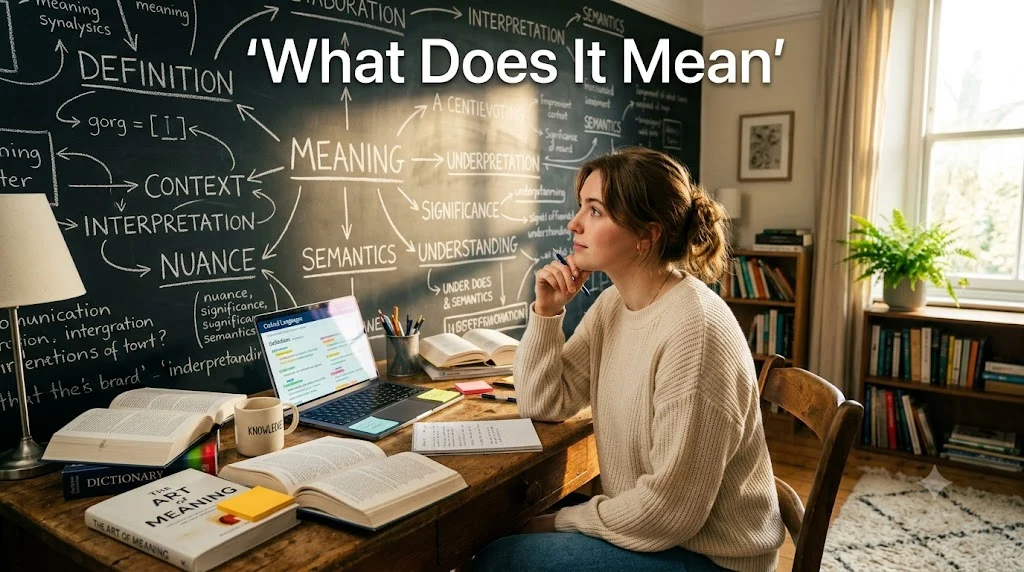
“What does it mean?” is a question people ask when they want to know the definition, purpose, significance, or interpretation of a word, phrase, symbol, action, or situation.
Have you ever stared at a word, a phrase, or a text message and thought what on earth does that actually mean? You’re not alone. Whether it’s a slang term your teenager used at dinner, a confusing line in an email from your boss, or a word you stumbled across while reading meaning isn’t always obvious. And honestly, that’s what makes language so fascinating.
This guide cuts through the confusion. No dictionary-speak, no academic fluff. Just a clear, honest breakdown of what meaning really is, how it works across different contexts, and how you can decode any word or phrase with confidence.
Let’s get into it.
What Does “Meaning” Actually Mean?
Before unpacking all the layers, it’s worth asking the most basic question: what exactly is meaning?
At its core, meaning is the idea or concept that a word, phrase, or expression communicates. It’s what you understand when someone says something to you. It’s the mental picture a sentence paints.
But here’s where it gets interesting. Meaning isn’t fixed. It shifts depending on who’s talking, where they are, and what they’re feeling. A single word can carry five different meanings in five different mouths. That’s not a flaw in language that’s the whole point of it.
“The limits of my language mean the limits of my world.” Ludwig Wittgenstein
The Literal Meaning vs. The Intended Meaning
These two concepts sit at the heart of almost every miscommunication ever.
Literal meaning is what the words say on the surface. Taken at face value, no interpretation needed.
Intended meaning is what the speaker actually wants you to understand sometimes deeper, sometimes ironic, sometimes completely opposite to the literal words.
Take the word “cool.” Literally, it means a mild temperature. But when your friend says “That’s cool,” they mean something entirely different. They’re expressing approval. They’re not talking about the weather.
Or consider this classic: someone asks, “Can you pass the salt?” Literally, that’s a yes-or-no question. But nobody answers “yes” and does nothing. Everyone knows the intended meaning is a request.
This gap between literal and intended meaning is where most communication breaks down and where a lot of humor lives, too.
The Exact Difference Between Definition and Meaning
People use these words interchangeably, but they’re not the same thing.
| Term | What It Is | Real Example |
|---|---|---|
| Definition | The formal, dictionary explanation of a word | “Fast” = moving at high speed |
| Meaning | How the word functions in real use | “Fast” in “breaking a fast” = not eating |
| Interpretation | What a specific person takes from the word | “Fast results” = something worked efficiently |
| Connotation | The emotional weight a word carries | “Cheap” feels negative; “affordable” feels neutral |
| Denotation | The literal, factual meaning with no emotional charge | “Dog” = a four-legged domesticated mammal |
Notice how “fast” shifts completely depending on context. That’s meaning doing its job.
The Different Types of Meaning You Need to Know
Understanding meaning isn’t one-size-fits-all. Language carries multiple layers at once. Once you see them, you can’t unsee them.
Literal Meaning
This is the straightforward layer. No symbolism, no subtext. The words mean exactly what they say.
Examples of literal meaning in action:
- “The door is open” = the door is physically open
- “She cried during the movie” = she actually shed tears
- “The phone is dead” = the battery ran out
Literal meaning is most reliable in technical writing, legal documents, and instructions. You want a surgeon’s instructions to be literal. You don’t want your IKEA manual to be poetic.
Figurative and Symbolic Meaning
Here’s where language gets creative. Figurative meaning involves figures of speech expressions that aren’t meant to be taken at face value.
Common types of figurative language:
| Figure of Speech | What It Does | Example |
|---|---|---|
| Metaphor | Compares two things directly | “Life is a rollercoaster” |
| Simile | Compares using “like” or “as” | “She runs like the wind” |
| Idiom | A fixed phrase with a non-literal meaning | “Bite the bullet” = endure something painful |
| Hyperbole | Extreme exaggeration | “I’ve told you a million times” |
| Irony | Saying the opposite of what you mean | “Oh great, another Monday” |
| Euphemism | A softer word for something harsh | “Passed away” instead of “died” |
Idioms are particularly tricky for people learning English. “It’s raining cats and dogs” sounds alarming if you take it literally. It isn’t. It just means heavy rain.
Contextual Meaning
Context is arguably the most powerful force in language. The same word can mean completely opposite things depending on where, when, and how it’s used.
Look at the word “sick”:
| Context | Meaning |
|---|---|
| Doctor’s office | Physically unwell |
| Skateboarding video | Incredibly impressive |
| Text from a friend | Disgusted or grossed out |
| 90s slang revival | Cool, excellent |
And “bad”? Michael Jackson built an entire album around the fact that “bad” can mean extraordinarily good.
Context clues the words and sentences surrounding an unfamiliar term are your fastest tool for figuring out meaning on the fly. Before you reach for Google, read the full sentence. The answer is often already there.
Hidden and Deeper Meaning
Some communication carries a second layer underneath the surface words. This is subtext what someone means without saying it directly.
Subtext shows up everywhere:
- In relationships (“I’m fine” after an argument rarely means fine)
- In professional settings (“That’s an interesting approach” often means “I disagree”)
- In literature (an author’s choice of a dying tree can symbolize lost hope)
- In politics (almost constantly)
Recognizing subtext takes practice. The biggest clue is usually the gap between what someone says and how they say it their tone, timing, and body language.
Spiritual and Symbolic Meaning
Beyond everyday communication, many words, numbers, and symbols carry spiritual or cultural weight that goes far beyond their dictionary definition.
Examples:
- The number 7 is considered lucky in Western cultures and sacred in several religions
- The color white means purity in Western weddings but mourning in several Asian cultures
- An owl symbolizes wisdom in Western culture but death in parts of Africa and the Middle East
- The word “Amen” appears in Hebrew, Arabic, and Greek and carries spiritual weight across Christianity, Judaism, and Islam
This kind of meaning is culturally loaded. It can’t be looked up in a standard dictionary. You need cultural context and sometimes, lived experience.
What Does It Mean in Modern Communication?
Language isn’t frozen in time. It’s constantly evolving especially now that billions of people communicate through screens, keyboards, and emoji. The meaning of words in 2025 looks very different from what it looked like in 1985.
What Does It Mean in Texting?
Texting has created an entirely new dialect. The same message can feel warm, cold, furious, or completely fine depending on tiny details most people don’t even think about consciously.
Punctuation as emotional signal:
| Text | What It Actually Signals |
|---|---|
| “Ok.” | Cold, possibly annoyed |
| “Ok!” | Enthusiastic, positive |
| “Ok” | Neutral, normal |
| “okay…” | Something is wrong |
| “K” | Almost certainly annoyed |
A period in a casual text has become a hostility marker. That’s a genuine linguistic shift that happened in the last 15 years.
Common texting abbreviations decoded:
| Abbreviation | Full Phrase | Actual Meaning in Use |
|---|---|---|
| LOL | Laughing out loud | Often just a softener, not actual laughter |
| SMH | Shaking my head | Disbelief or disappointment |
| NGL | Not gonna lie | What follows is an honest opinion |
| IYKYK | If you know, you know | Inside reference for a specific group |
| TBH | To be honest | Genuine admission follows |
| TLDR | Too long, didn’t read | Summary of something lengthy |
| IMO / IMHO | In my (humble) opinion | Personal opinion, not fact |
| BRB | Be right back | Short absence from conversation |
Slang Meaning | A Living, Breathing Language
Slang isn’t lazy language. It’s language that moves fastest because it’s tied to culture, identity, and community.
Every generation coins its own vocabulary. Here’s a quick cross-era comparison:
| Era | Slang Word | Meaning |
|---|---|---|
| 1950s | “Cool” | Good, excellent |
| 1980s | “Radical” | Impressive, exciting |
| 1990s | “Phat” | Excellent, great |
| 2000s | “Sick” | Impressive |
| 2010s | “Lit” | Exciting, fun |
| 2020s | “Bussin” | Extremely good (usually food) |
| 2020s | “No cap” | No lie, seriously |
| 2020s | “It’s giving” | It reminds me of / it has the energy of |
| 2020s | “Slay” | Performing excellently |
The key thing about slang: it has a shelf life. Once it enters mainstream use or shows up in advertisements, the community that coined it usually drops it. That’s part of how slang identity works.
Meaning on Social Media and the Internet
Different platforms developed their own meaning systems. A word or phrase that lands one way on Reddit lands completely differently on TikTok.
Platform-specific meanings:
| Word/Phrase | Platform | Meaning |
|---|---|---|
| “Ratio” | Twitter/X | When a reply gets more likes than the original post — a sign the original was bad |
| “NPC” | TikTok/Gaming | Someone who seems to have no independent thought (from video game non-player characters) |
| “Based” | 4chan/Reddit/mainstream | Confidently holding an unpopular opinion |
| “Main character” | TikTok | Someone behaving like they’re the hero of their own movie |
| “Understood the assignment” | TikTok | Did exactly what was expected, perfectly |
| “CEO of” | TikTok | The ultimate example of something |
| “This isn’t it, chief” | Disapproval of someone’s opinion or action |
Meme culture deserves its own mention. Memes create shared meaning through image, text, and context. When someone posts a Distracted Boyfriend meme, they’re communicating a complex relational dynamic through a stock photo and millions of people instantly get it. That’s remarkably efficient communication.
Common Internet Abbreviations and Their Exact Meaning
| Abbreviation | Meaning | Context |
|---|---|---|
| AFK | Away from keyboard | Not available right now |
| DM | Direct message | Private message on social media |
| ETA | Estimated time of arrival | When something is expected |
| FOMO | Fear of missing out | Anxiety about missing experiences |
| GG | Good game | Sportsmanship, sometimes sarcastic |
| HMU | Hit me up | Contact me |
| IRL | In real life | Outside of the internet |
| OG | Original gangster | The original, the first, a legend |
| TFW | That feeling when | Relates a specific emotional experience |
| WYD | What you doing | Casual check-in |
How to Find the Meaning of Any Word or Phrase
Okay, practical time. You’ve hit an unfamiliar word. Here’s exactly what to do.
Step-by-Step: Decode Unfamiliar Words Like a Pro
Step 1: Read the full sentence first Don’t stop at the unfamiliar word. Finish the sentence and the paragraph if needed. Context clues are embedded everywhere.
Step 2: Break the word apart English borrows heavily from Latin, Greek, French, and Germanic roots. Knowing common word parts unlocks dozens of meanings instantly.
| Root/Prefix | Meaning | Examples |
|---|---|---|
| “bio” | life | biology, biography, biosphere |
| “port” | carry | transport, export, portable |
| “micro” | small | microscope, microwave, microchip |
| “pre” | before | preview, prehistoric, prevent |
| “un” | not | unhappy, unlikely, unaware |
| “ology” | study of | psychology, geology, terminology |
Step 3: Identify the word type Is it a noun (thing), verb (action), adjective (descriptor), or adverb (modifier)? That instantly narrows its possible meanings.
Step 4: Check the tone of the writing Formal text? Academic? Casual? Sarcastic? The tone tells you which layer of meaning is in play.
Step 5: Confirm with an example Don’t just read the definition. Find the word used in a sentence you understand. That’s where meaning actually lives.
What Makes a Definition Insufficient
Dictionaries define words. But they can’t always tell you:
- Whether a word is considered rude in certain contexts
- Whether a word is outdated or has recently shifted meaning
- How a word is actually pronounced in casual speech vs. formal speech
- Whether a word is more common in British or American English
- What emotional charge a word carries in a specific community
Real example: The word “quite” means something very different in British English vs. American English.
- American: “That’s quite good” = very good (positive emphasis)
- British: “That’s quite good” = it’s okay, nothing special (mild understatement)
Same word. Same sentence. Opposite implications.
The Origin of Meaning | Where Words Actually Come From
Words have histories. And knowing a word’s origin its etymology makes it easier to remember, use correctly, and connect to related words.
Why Etymology Is Surprisingly Useful
Understanding roots multiplies your vocabulary without extra memorization.
The Latin root “scrib/script” (to write) gives you:
- Describe
- Prescription
- Manuscript
- Inscription
- Transcript
- Postscript
- Scribble
Learn one root, unlock ten words. That’s leverage.
Words That Completely Changed Meaning Over Time
Language shifts. Some words today mean the exact opposite of what they originally meant.
| Word | Original Meaning | Modern Meaning |
|---|---|---|
| Awful | Full of awe, inspiring wonder | Terrible, very bad |
| Silly | Blessed, happy | Foolish, absurd |
| Nice | Foolish, ignorant (from Latin “nescius”) | Pleasant, kind |
| Villain | A farm worker, peasant | An evil character |
| Artificial | Artistic, showing craft | Fake, not natural |
| Terrific | Causing terror | Excellent, wonderful |
| Sad | Satisfied, full | Unhappy, sorrowful |
This process is called semantic shift when a word’s meaning drifts over time through usage. It happens slowly, organically, and nobody officially approves it. Communities just start using a word differently until the new meaning sticks.
How Other Languages Shape English Meaning
English is one of the most borrowed-from languages on earth. About 60% of English vocabulary has French, Latin, or Greek roots. The rest comes from Old Norse, German, Arabic, Hindi, and hundreds of other languages.
A few borrowed words and where they came from:
| Word | Origin Language | Original Meaning |
|---|---|---|
| Algebra | Arabic (al-jabr) | Reunion of broken parts |
| Jungle | Hindi (jangal) | Dense forest |
| Robot | Czech (robota) | Forced labor |
| Kindergarten | German | Garden of children |
| Bungalow | Hindi (bangla) | Bengali-style house |
| Shampoo | Hindi (champo) | To massage/press |
| Coffee | Arabic (qahwa) | Wine, then the beverage |
Each borrowed word carried nuance from its original culture. That richness is baked into the meaning even when speakers don’t know the history.
Meaning in Conversation | Real Talk About Communication
All this theory is only useful if it helps you communicate better in real life. So let’s get practical.
Decoding What People Actually Mean
There’s what people say and what they mean. Closing that gap is one of the most valuable skills you can build.
Common phrases and their real meaning:
| What They Say | What They Often Mean |
|---|---|
| “That’s interesting.” | I disagree but I’m being polite |
| “We should catch up soon!” | Vague social obligation, may not happen |
| “I’m almost ready.” | Give me 15 more minutes |
| “It’s fine.” | It is definitely not fine |
| “Do whatever you want.” | I have a preference but I won’t say it |
| “I’m not upset.” | I am upset |
| “No worries!” | It’s fine, genuinely |
| “Let me think about it.” | Probably no |
Reading these correctly requires attention to tone, history with the person, and situational context. It’s not about being suspicious. It’s about being tuned in.
Why Miscommunication Happens
Most miscommunication comes from four sources:
1. Assumed shared meaning You think a word means one thing. The other person uses it to mean something else. Neither of you checks.
2. Missing context An email lacks tone of voice. A text lacks facial expression. A lot of nuance gets lost in translation between mediums.
3. Emotional filtering When you’re anxious, stressed, or defensive, you read neutral messages as threatening. Your emotional state literally changes how you interpret meaning.
4. Cultural differences What’s direct and honest in one culture sounds rude in another. What’s politely indirect in one culture sounds evasive in another.
How to Ask for Clarification Without Awkwardness
Asking “what do you mean?” can feel blunt. Here are natural alternatives:
- “Just to make sure I’m following do you mean…?”
- “Could you give me an example of that?”
- “So when you say [word], are you referring to…?”
- “I want to make sure I understand are you saying…?”
These phrases show engagement without implying the other person was unclear. Big difference.
Understanding Meaning | A Beginner’s Guide
If you’re learning English as a second language, or you just want to sharpen how you decode unfamiliar words, this section is for you.
The Fastest Ways to Build Vocabulary Through Meaning
Immersion beats memorization every time.
Research consistently shows that exposure to words in context reading them in sentences, hearing them in conversations, seeing them used naturally builds deeper, more durable vocabulary than flashcard drilling.
Practical strategies:
- Read widely. Novels, news articles, subtitles, menus. Every text is vocabulary training.
- Watch content in English with English subtitles. You connect spoken and written form simultaneously.
- Keep a personal phrase journal. When you encounter an interesting expression, write it down with the full sentence you found it in not just the word alone.
- Talk to people. Real conversation exposes you to pronunciation, tone, and contextual meaning in ways no textbook replicates.
- Use words right after you learn them. The fastest route to ownership is immediate application.
A Simple Framework for Decoding Any New Term
Use this every time you hit an unfamiliar word:
Ask yourself these four questions:
- What type of word is it? (noun, verb, adjective, adverb)
- What is the sentence trying to say overall?
- Does the definition I’m guessing make logical sense here?
- Can I find this word used in a sentence I already understand?
If you can answer all four, you’ve got the meaning. If not, that’s when you reach for a dictionary and then look for example sentences, not just the definition.
Common Vocabulary Mistakes and Their Real Meanings
Even native speakers mix these up:
| Confused Pair | Correct Use |
|---|---|
| Affect vs. Effect | “Affect” is usually a verb; “effect” is usually a noun |
| Fewer vs. Less | “Fewer” for countable things; “less” for uncountable |
| Literally vs. Figuratively | “Literally” means it actually happened |
| Ironic vs. Coincidental | Irony involves an opposite outcome; coincidence is just chance |
| Infamous vs. Famous | Infamous means famous for something bad |
| Comprise vs. Compose | The whole comprises the parts; the parts compose the whole |
Meaning with Examples | Seeing It In Action
Theory is only useful when it connects to real use. Here are concrete examples showing how meaning shifts across contexts.
The Word “Run” | One Word
“Run” might be the most meaning-dense word in English. The Oxford English Dictionary lists over 645 definitions for it. Here’s a small sample:
| Sentence | Meaning of “Run” |
|---|---|
| “She runs every morning.” | Physical exercise |
| “He runs the company.” | Manages, leads |
| “They made a run for it.” | Escaped quickly |
| “The printer ran out of ink.” | Depleted |
| “The play had a long run.” | Duration of performance |
| “There’s a run in her tights.” | A tear or snag |
| “The salmon are running.” | Migrating upstream |
| “He’s running for office.” | Campaigning |
Same word. Eight completely different meanings. Context does all the heavy lifting.
Before and After: Vague vs. Clear Communication
Vague: “Can you handle that thing we talked about?” Clear: “Can you send the quarterly report to Sarah by Thursday at 5 PM?”
Vague: “I feel like you’re being distant.” Clear: “I’ve noticed we haven’t spent much time together this week. Is everything okay?”
The difference isn’t just clarity it’s respect. Clear communication saves time, reduces conflict, and builds trust.
Quick Reference: Phrases and Their Meanings
| Phrase | Literal Meaning | Real Meaning |
|---|---|---|
| “Break a leg” | Injure your leg | Good luck |
| “Bite the bullet” | Chew on a bullet | Endure something difficult |
| “Costs an arm and a leg” | Literal body parts | Very expensive |
| “Hit the nail on the head” | Strike a nail accurately | Exactly correct |
| “Under the weather” | Below the clouds | Feeling ill |
| “Spill the tea” | Pour hot tea | Share gossip |
| “Pull someone’s leg” | Physically pull | Joke or tease someone |
| “Burn bridges” | Set fire to bridges | Ruin relationships permanently |
| “Cut to the chase” | Skip a film scene | Get to the point |
Frequently Asked Questions About Meaning
What’s the real difference between meaning and definition?
A definition is what you find in the dictionary a formal explanation of a word. Meaning is broader and more dynamic. It includes how a word feels, what it implies, and how it functions in real communication.
How do I find the meaning of a slang word?
Context first always. Read the surrounding conversation. For newer internet slang, a TikTok or Twitter search often shows you the word in use, which is even more valuable than a written definition.
Why does the same word mean different things in different contexts?
Because language is a tool for communication, not a fixed code. Words are labels that communities assign to ideas.. That’s not a bug in language it’s a feature. It’s how language stays alive and relevant.
What does it mean spiritually when something keeps happening?
In spiritual traditions, recurring events or symbols are often interpreted as signs, synchronicities, or messages from the unconscious or divine. Many spiritual frameworks, from numerology to Native American symbolism to Christian theology, assign deeper significance to recurring patterns.
How do I understand what someone really means in a text?
Consider tone first. Is the message shorter than usual? Are they skipping punctuation they normally use? Did they respond unusually fast or unusually slow? Combine what they said with how they said it, and with what you know about their communication style.
What does it mean when a word has multiple definitions?
It means the word is polysemous it carries more than one established meaning. Most common English words are polysemous. The word “bank” has at least 10 distinct definitions. “Light” has even more.
How do I correctly use a new word in a sentence?
Learn the word’s grammatical role (noun, verb, etc.), find three to five real sentences using it, identify what patterns it follows, and then try writing your own sentence. Read it aloud does it sound natural?
Conclusion
Here’s the honest truth about meaning: it’s never simple. It’s layered, contextual, cultural, emotional, and constantly shifting. That used to feel like a problem. But it’s actually the opposite.
The richness of language the fact that “cool” can mean cold air or social approval, that “awful” once meant wonderful and now means terrible, that a single period in a text can signal fury that’s not a flaw. That’s language doing what human minds do. Evolving, adapting, expressing things that precise definitions can never fully capture.
Understanding meaning makes you a sharper thinker, a clearer communicator, and a more empathetic listener. You start hearing what people mean, not just what they say.
And once you develop that ear? Every conversation gets richer.
Bookmark this guide. Come back whenever a word stumps you, a phrase confuses you, or you want to understand the layers underneath what someone said. Language is endlessly interesting and you’ve now got the tools to explore it.
Discover More Related Articles:
- Ethos Meaning | How It Builds Trust & Credibility In 2026
- Six Seven Meaning | Social Media Trends & Pop Culture In 2026
- ICYMI Meaning | Why People Use It on Twitter and Instagram In 2026

Jessica Brown is a language-focused writer who creates well-researched articles on word meanings, abbreviations, and everyday expressions. She contributes to meanvoro.com, delivering simple, reliable, and reader-friendly content designed to make complex terms easy to understand.