
Have you ever stumbled across the word atria in a book, a conversation about architecture, or perhaps a medical documentary? If your first thought was, “Is that a typo for ‘atrial’?” or “Wait, is that related to a name like Tia?” don’t worry, you are not alone.
Here is the honest truth: Atria sounds elegant, slightly scientific, and a little mysterious. But once you understand its core meanings, you will start seeing it everywhere from the design of a luxury coffee shop to diagrams of the human heart.
In this friendly, deep-dive guide, we will unpack everything you need to know about atria meaning. No confusing jargon. No fluff. Just clear explanations, real-life examples, and even a few tips on how to use the word naturally (without sounding like a textbook).
Let’s jump in.
What Is the Meaning of Atria?
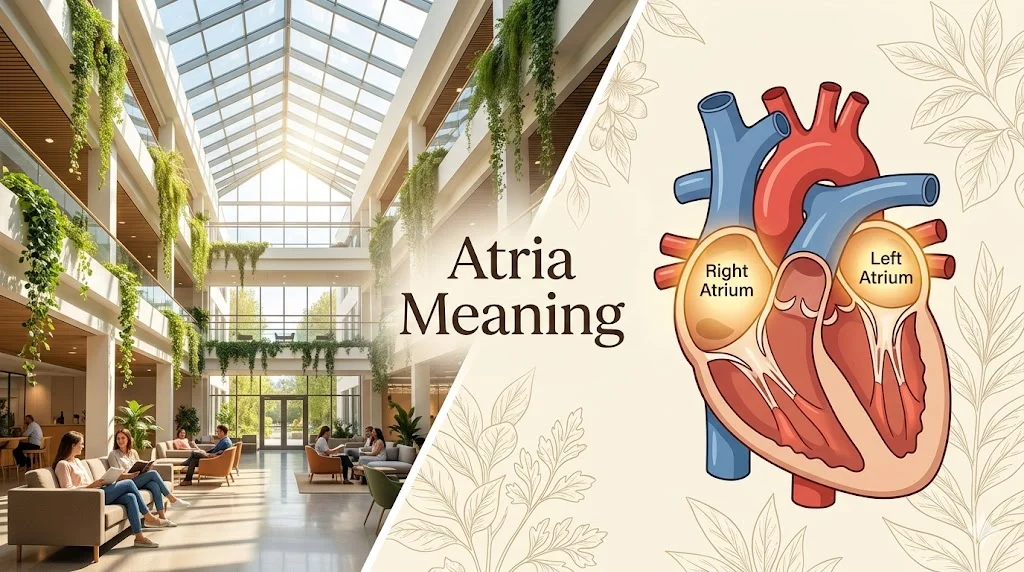
Atria is the plural form of atrium. It has two primary meanings:
- In architecture and design: An atrium (plural: atria) is a large, open, central space within a building, often extending up through multiple floors and having a glass roof or large windows to let in natural light.
- In biology and medicine: In the human heart (and the hearts of other mammals), the atria (singular: atrium) are the two upper chambers that receive blood returning to the heart. They are often called the right atrium and left atrium.
✅ Quick example:
“The office building’s modern atria were filled with lush green plants and natural sunlight.”
“During exercise, the heart’s atria contract to push blood into the lower chambers.”
In short: Atria = open central spaces (buildings) OR upper heart chambers (biology).
Origin of the Word ‘Atria’: From Ancient Rome to Modern Medicine
The word atrium (and thus atria) comes directly from Latin. In ancient Rome, an atrium was the central room of a Roman house (a domus). This room was open to the sky, often featuring a shallow pool (impluvium) underneath an opening in the roof (compluvium) to collect rainwater.
The Romans used the atrium as a reception area, a gathering space for family and guests, and a place to display ancestral masks and treasures. It was the heart of the home both literally and symbolically.
Over centuries, architects borrowed the term. By the late 20th century, atrium became a buzzword in hotel, mall, and office design. Then, medical Latin adopted the same word because the upper chambers of the heart resemble small open spaces or entryways welcoming blood before sending it onward.
Cool fact: The word atria has remained almost unchanged for over 2,000 years. That is linguistic staying power.
How Popular Is ‘Atria’? Real-World Usage Trends
While atria is not as common as everyday words like “house” or “heart,” it enjoys a steady, respectful place in:
- Architectural magazines and real estate listings
- Medical textbooks and cardiology reports
- Home design blogs (especially for modern, airy floor plans)
- Crossword puzzles (yes, “atria” is a favorite for the plural of atrium)
If you search Google Trends, you will see periodic spikes when:
- A new luxury building with a dramatic atrium is featured in the news.
- Heart health awareness campaigns discuss atrial fibrillation (“AFib”).
- Pinterest users search for “atria house design” or “indoor courtyard ideas.”
👉 Semantic variations to know:
- Atrial (adjective) | e.g., “atrial walls,” “atrial septal defect”
- Atrium-style | e.g., “an atrium-style lobby”
- Multi-story atria | e.g., “hotels with multi-story atria feel more spacious”
Atria Meaning in Different Contexts + Examples
1. Architectural Atria (Neutral to Positive Tone)
This is the most common everyday use. People use atria to describe beautiful, light-filled spaces.
Friendly example:
“We had our wedding reception in a hotel with stunning glass atria it felt like we were outdoors but with air conditioning!” 🌿
Professional (neutral) example:
“The building’s atria improve natural ventilation and reduce energy costs by 20%.”
Enthusiastic (positive) example:
“You have to see this coworking space they have three separate atria with hanging gardens. I’d never want to leave.” 😍
2. Medical Atria (Neutral to Educational)
Here, atria is clinical but not scary. It appears in health articles, doctor explanations, and patient education.
Doctor-friendly example:
“Your heart’s two atria act like receiving rooms blood comes in, then moves to the lower chambers, the ventricles.”
Neutral example from a science textbook:
“During atrial systole, the atria contract to push blood into the ventricles.”
Negative/Dismissive tone (rare, but possible in frustration with medical complexity):
“I’ve read my EKG report three times and still don’t understand what ‘enlarged atria’ means why can’t they just say ‘upper heart chambers’?” 😤
3. Metaphorical or Poetic Atria (Creative Tone)
Sometimes writers use atria metaphorically to mean central, open, or gathering spaces.
“The town’s main square became its social atria, where everyone eventually crossed paths.”
Comparison: Atria vs. Similar Terms
Sometimes people confuse atria with other architectural or biological terms. Here is a quick comparison table:
| Term | Primary Meaning | Key Difference from Atria |
|---|---|---|
| Atria | Plural of atrium — open central spaces (building) OR upper heart chambers (biology) | Always plural; singular is atrium |
| Atrium | Singular form (one open space or one heart chamber) | Use when referring to just one |
| Auricle | A small, ear-shaped pouch on each atrium (heart) | Not the main chamber — an appendage of the atrium |
| Ventricles | Lower chambers of the heart | Ventricles pump blood out; atria receive blood in |
| Courtyard | An unroofed open area surrounded by walls or buildings | Atria are typically inside a building (often roofed with glass); courtyards are open to the sky |
| Foyer | A small entrance hall or lobby | Atria are usually much larger, often spanning multiple floors |
💡 Pro tip: If you see atria in a real estate listing (“grand atria”), they mean architecture. If you see it on a hospital chart (“atria are normal”), they mean the heart.
Alternate (Less Common) Meanings of Atria
Briefly, because a thorough SEO article covers all bases:
- Atria as a brand name: Several companies use “Atria” in their name, including senior living communities (Atria Senior Living) and real estate firms.
- Atria as a place name: A few small towns and neighborhoods worldwide are named Atria (e.g., Atria, Finland).
- Atria in fiction/gaming: In fantasy novels or role-playing games, “Atria” may appear as a kingdom, a character name, or a magic location unrelated to the Latin root.
However, these are proper nouns, not the common word meaning. For SEO and everyday conversation, focus on architectural and biological definitions first.
Polite & Professional Alternatives to ‘Atria’
Are you writing for an audience that might find atria too technical? Or do you simply want to vary your language? Here are friendly alternatives based on context:
Instead of Architectural Atria:
- Open central space (very clear)
- Light court (used in some green building design)
- Interior courtyard (if partially open to sky)
- Grand hall (if emphasizing size)
- Sky-lit lobby (for hotels or offices)
Instead of Medical Atria:
- Upper heart chambers (best for patient-friendly content)
- Receiving chambers (descriptive and simple)
- Atrial chambers (still medical but slightly softer)
✅ Example swap:
Original: “The atria receive deoxygenated blood.”
Friendly version: “The heart’s two upper chambers, called atria, receive blood returning from the body.”
This keeps accuracy while improving readability.
Labeled Example Table: Atria in Architecture vs. Medicine
| Feature | Architectural Atria | Medical Atria |
|---|---|---|
| What it is | Open, multi-story interior spaces | Upper chambers of the heart |
| Location | Inside buildings (hotels, offices, malls) | Inside the heart (right and left sides) |
| Primary function | Bring in natural light, improve airflow, create gathering space | Receive blood returning to the heart |
| Typical material (metaphor) | Glass, steel, plants, stone | Muscle tissue, valves, blood |
| Singular form | Atrium | Atrium |
| Adjective form | Atrial (e.g., “atrial lighting”) | Atrial (e.g., “atrial fibrillation”) |
| Commonly confused with | Courtyard, foyer, lobby | Ventricles, auricles |
| Example sentence | “The office’s atria reduce the need for artificial lights.” | “Healthy atria contract in rhythm to move blood.” |
Practical Tips for Using ‘Atria’ Naturally
You now understand the meaning but how do you use atria without sounding awkward? Follow these three friendly rules:
- Use “atria” only when plural. If you mean one space or one chamber, say atrium.
✅ “The museum has two impressive atria.”
❌ “The museum has two impressive atrium.” - Provide context clues. Because atria is less common, help your reader:
“The building’s glass atria those bright, open central spaces were perfect for the art exhibit.” - Choose the right domain. Use architectural atria for design, travel, or real estate content. Use medical atria for cardiology, anatomy, or patient education. Mixing them carelessly can confuse.
🧠 Memory trick: Think of Atria = Air + Atrium (open space) OR Atria = Atrium of the heart (the upper chamber).
FAQs:
Here are real search queries people use answered clearly and conversationally.
1. What is the simple definition of atria?
Atria is the plural of atrium. It means either the open central spaces in large buildings (often with glass roofs) or the two upper chambers of the heart that receive blood.
2. How do you pronounce ‘atria’?
Say: AY-tree-uh (rhymes with “cafeteria” without the “cafe”). In American English, the first syllable sounds like the letter “A.”
3. Is ‘atria’ singular or plural?
Plural. The singular form is atrium.
✅ One atrium → two atria
❌ Incorrect: “one atria”
4. What are atria in the heart?
The right atrium and left atrium are the two upper chambers. They receive blood returning to the heart the right atrium gets oxygen-poor blood from the body; the left atrium gets oxygen-rich blood from the lungs.
5. What is an example of an architectural atrium?
A hotel lobby that rises four stories with a glass ceiling, indoor trees, and balconies overlooking the center is a classic atrium. Many modern shopping malls also have central atria with skylights.
6. Is ‘atria’ used in everyday conversation?
Not frequently, but it appears in real estate, architecture, interior design, and medical contexts. Most people will understand it from context, especially if you say “the building’s atria” or “the heart’s atria.”
7. What is the difference between an atrium and a courtyard?
An atrium is inside a building and usually covered (often with glass). A courtyard is outside or partially outside, open to the sky, and surrounded by walls or buildings.
8. Can a house have an atrium?
Yes! Many modern homes include a small atrium an interior room with a glass roof or large skylight, often used as a greenhouse, reading nook, or indoor garden. It is sometimes called an “interior courtyard” in residential design.
Conclusion:
Words like atria are small keys that unlock big concepts. When you know that atria can refer to both a stunning glass-roofed hotel lobby and the quiet, steady work of your own heartbeat, you realize how beautifully language connects the built world to the human body.
Whether you are describing a dream home, writing a health article, or simply impressing friends with your vocabulary, you now have a complete, friendly, and professional grasp of atria meaning.
And next time you walk into a sun-drenched hotel lobby or read about heart health you will smile and think, “Ah, there are the atria.” ☀️
Discover More Related Articles:

Ryan Thompson is an experienced content writer specializing in slang terms, texting abbreviations, and word meanings. He writes for meanvoro.com, where he creates accurate and easy-to-understand language content for readers.