“Mismo” in Spanish is an adjective or pronoun that generally means “same,” “self,” or “very,” depending on context.
It is commonly used to indicate identity, emphasis, or repetition, and it can appear in expressions like el mismo (“the same”), yo mismo (“myself”), or ahora mismo (“right now”).
The Spanish word “mismo” is a useful and flexible term commonly used in everyday language. It generally means “same” or “self,” depending on how it is used in a sentence. “Mismo” helps add emphasis, clarify identity, or show that something remains unchanged, making it an important word for expressing precision and meaning in Spanish communication.
Understanding “mismo” is essential for anyone learning Spanish, as it is highly versatile and widely used in both everyday conversations and formal writing. In this guide, we will explore its origins, meanings, examples, comparisons, and alternatives to help you master this common Spanish word.
Origin and Popularity of “Mismo”
The word “mismo” comes from Latin ipse, ipsa, ipsum, which translates to “self” or “the very one.” Over centuries, Spanish adopted it into everyday speech, keeping its core meaning of identity or emphasis.
Today, “mismo” is incredibly common in Spanish-speaking countries, appearing in conversations, literature, social media, news, and formal writing. Its popularity stems from its versatility:
- Indicates sameness: El mismo libro → “The same book”
- Emphasizes identity: Yo mismo lo hice → “I did it myself”
- Indicates immediacy: Ahora mismo → “Right now”
Because of these uses, “mismo” is often one of the first adjectives or pronouns Spanish learners encounter after mastering basic nouns and verbs.
Meaning and Usage of “Mismo”
“Mismo” can function as both an adjective and a pronoun, and its meaning depends on context.
1. As an Adjective
When used as an adjective, “mismo” agrees in gender and number with the noun it modifies:
| Spanish Phrase | English Translation | Explanation |
|---|---|---|
| El mismo coche | The same car | “Mismo” emphasizes that the car is identical to one previously mentioned. |
| La misma casa | The same house | Feminine singular form. |
| Los mismos libros | The same books | Masculine plural form. |
| Las mismas ideas | The same ideas | Feminine plural form. |
2. As a Pronoun
“Mismo” can replace a noun to avoid repetition, often combined with reflexive pronouns:
| Spanish Phrase | English Translation | Explanation |
|---|---|---|
| Yo mismo lo hice | I did it myself | Emphasizes the subject performing the action personally. |
| Tú mismo puedes verlo | You can see it yourself | Gives emphasis and responsibility to the subject. |
3. Emphasis or Intensity
“Mismo” is also used for emphasis or immediacy, especially in idiomatic expressions:
- Ahora mismo → Right now / immediately
- El mismo día → The very same day
- Hasta el mismo → Even the very…
Examples of “Mismo” in Context
Here’s how “mismo” appears in different tones and contexts:
| Tone | Spanish Example | English Translation |
|---|---|---|
| Friendly | Yo mismo te ayudaré 😊 | I’ll help you myself 😊 |
| Neutral | Compré el mismo modelo. | I bought the same model. |
| Formal | La misma regla aplica a todos. | The same rule applies to everyone. |
| Negative/Dismissive | Él hizo lo mismo otra vez 😒 | He did the same thing again 😒 |
Adding emojis in casual texts can enhance tone, showing friendliness or mild frustration depending on context.
Comparison With Related Terms
“Mismo” is often confused with other Spanish words or expressions. Here’s a quick comparison:
| Term | Meaning | Difference from “Mismo” |
|---|---|---|
| Igual | Equal / alike | “Igual” refers to similarity, not exact identity. “Mismo” indicates exact sameness. |
| Propio | Own / personal | “Propio” emphasizes possession. “Mismo” emphasizes identity or immediacy. |
| Mí mismo | Myself (reflexive) | Used for personal emphasis. Example: Me lo daré a mí mismo. |
| Exactamente | Exactly / precisely | Emphasizes precision, not identity. |
Alternate Meanings of “Mismo”
Depending on context, “mismo” can carry subtle variations:
- Self – Él mismo decidió → He decided himself.
- Very / exact – El mismo día → The very day.
- Right away / immediately – Ahora mismo → Right now.
These nuances make “mismo” flexible and highly idiomatic in Spanish.
Polite or Professional Alternatives
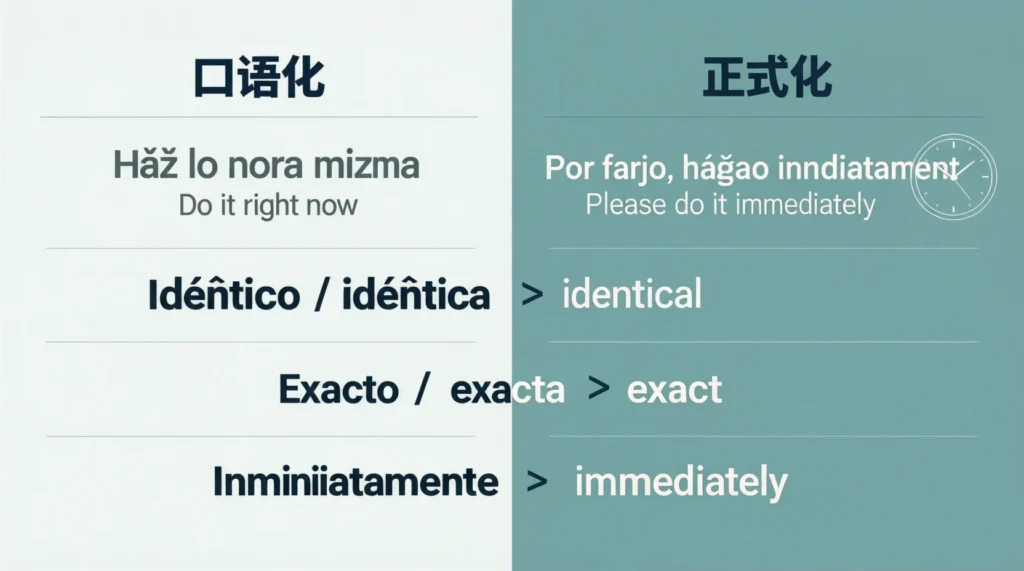
When speaking formally or in professional settings, you might use alternatives to avoid repetition or casual tone:
- Idéntico / idéntica → identical
- Exacto / exacta → exact
- Inmediatamente → immediately
Example:
- Casual: Házlo ahora mismo. → Do it right now.
- Professional: Por favor, hágalo inmediatamente. → Please do it immediately.
Common Expressions With “Mismo”
Here are some phrases you will often hear:
- Yo mismo → I myself
- Tú mismo → You yourself
- El mismo problema → The same problem
- Ahora mismo → Right now / immediately
- Lo mismo da → It’s all the same / it doesn’t matter
FAQs
- What does “mismo” mean in Spanish?
“Mismo” generally means “same,” “self,” or “very,” depending on context. - How do you use “mismo” in a sentence?
Example: Yo mismo lo haré. → “I’ll do it myself.” - Is “mismo” formal or informal?
It can be both. It’s used in everyday conversations and in formal writing. - What is the difference between “mismo” and “igual”?
“Mismo” indicates exact sameness; “igual” means similar or alike. - Can “mismo” mean immediately?
Yes, in phrases like ahora mismo, it means “right now” or “immediately.” - Does “mismo” change with gender or number?
Yes, it agrees with the noun: mismo, misma, mismos, mismas. - Are there polite alternatives for “mismo”?
Yes, you can use idéntico or exacto in professional contexts. - What is a common mistake with “mismo”?
Learners sometimes confuse it with igual or overuse it in places where “propio” or “exacto” fits better.
Practical Tips for Using “Mismo”
- Always match gender and number with the noun.
- Use mismo for emphasis or identity, not just similarity.
- Combine with reflexive pronouns (yo mismo, tú mismo) to stress personal action.
- Remember idiomatic expressions like ahora mismo or lo mismo da.
Conclusion
“Mismo” is a versatile, everyday word in Spanish that enriches both spoken and written communication. Whether you are emphasizing identity, expressing immediacy, or saying “the same,” understanding its nuances is key to sounding natural in Spanish.
Mastering mismo will give your Spanish conversations precision, clarity, and authenticity.
Discover More Related Articles:
- RD Mean in a Text: On Snapchat, WhatsApp & Instagram in 2026
- Nolle Prosequi Mean in Court: Rights, Risks, and Outcomes in 2026

Ryan Thompson is an experienced content writer specializing in slang terms, texting abbreviations, and word meanings. He writes for meanvoro.com, where he creates accurate and easy-to-understand language content for readers.