

Pasar is a Spanish verb that most commonly means to happen, to pass, or to go by.
Depending on context, it can also mean to spend time, to hand something to someone, to cross a place, to exceed a limit, or to experience something emotionally or physically.
The meaning of pasar always depends on how it is used in a sentence.
Ever heard someone say “¿Qué pasó?” and wondered what just passed, literally or figuratively?
Welcome to the versatile world of pasar, one of the most commonly used verbs in Spanish.
If you are learning Spanish, watching Spanish shows, traveling, or chatting with native speakers, pasar will appear constantly and often with different meanings.
This guide explains everything in clear, friendly English. By the end, you will understand what pasar means in Spanish and how to use it naturally in real conversations.
Why Pasar Is Such an Important Spanish Verb
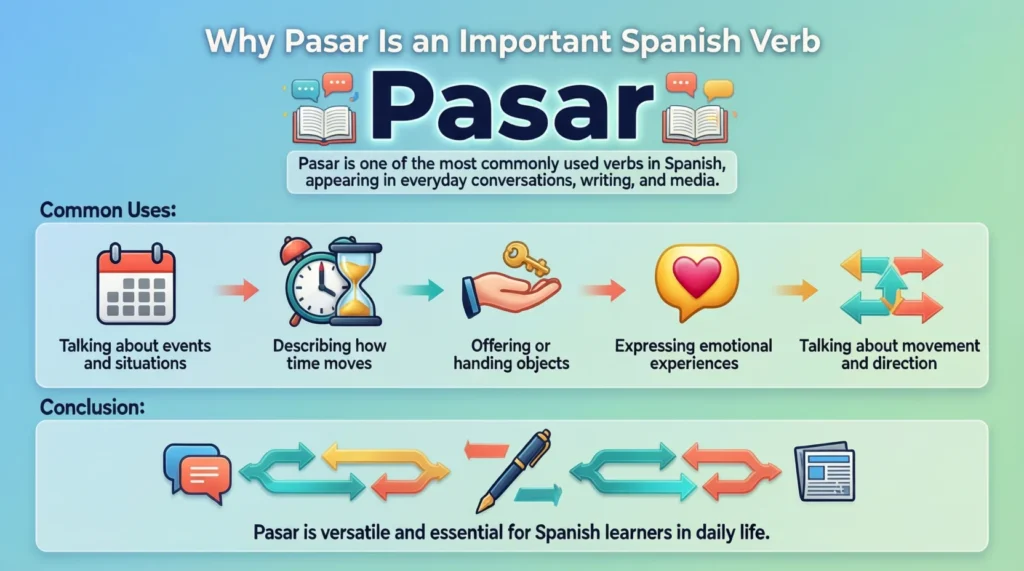
Pasar is one of the most frequently used verbs in Spanish because it fits into many everyday situations.
Common uses include:
• Talking about events and situations
• Describing how time moves
• Offering or handing objects
• Expressing emotional experiences
• Talking about movement and direction
Because of this flexibility, pasar appears in casual speech, formal writing, news headlines, and daily conversations.
Origin and Etymology of Pasar

The verb pasar comes from the Latin word passare, meaning to step or to walk.
Originally, it described physical movement, but over time it expanded to include abstract ideas.
These include:
• Events passing
• Time passing
• Emotional experiences happening in someone’s life
This history explains why pasar works for both physical movement and emotional situations.
Core Meanings of Pasar in Spanish
Below are the most common meanings you will encounter.
Pasar Meaning To Happen
This is one of the most common uses of pasar.
Examples:
• ¿Qué pasó?
What happened?
• Algo extraño pasó anoche.
Something strange happened last night.
Tone notes:
• Neutral and conversational
• Can sound urgent depending on context
• Very common in spoken Spanish
Pasar Meaning To Pass or To Go By
Used for time, people, or objects moving from one point to another.
Examples:
• El tiempo pasa muy rápido.
Time goes by very fast.
• El autobús pasó hace cinco minutos.
The bus passed five minutes ago.
Common contexts include time, vehicles, opportunities, and life stages.
Pasar Meaning To Spend Time
In Spanish, you do not spend time, you pass time.
Examples:
• Pasé el fin de semana con mi familia.
I spent the weekend with my family.
• Pasamos dos horas estudiando.
We spent two hours studying.
This usage is very natural in Spanish and essential for fluency.
Pasar Meaning To Hand Something Over
Pasar is commonly used when giving or passing an object.
Examples:
• ¿Me pasas el agua, por favor?
Can you pass me the water, please?
• Pásame ese libro.
Pass me that book.
Using por favor makes it polite and friendly.
Pasar Meaning To Cross or Go Through a Place
This meaning focuses on physical movement.
Examples:
• Pasamos por el parque.
We went through the park.
• Tienes que pasar la calle con cuidado.
You have to cross the street carefully.
Pasar Meaning To Experience Something
Pasar is also used for emotional or life experiences.
Examples:
• Estoy pasando por un momento difícil.
I am going through a difficult time.
• Pasó mucha vergüenza.
He or she felt very embarrassed.
This meaning is common in serious or supportive conversations.
Pasarse Meaning To Go Too Far
When pasar becomes reflexive, the meaning changes.
Examples:
• Te pasaste.
You went too far.
• Se pasó de la raya.
He crossed the line.
The tone can be playful or critical depending on the situation.
Example
| Meaning | Spanish Example | English Meaning | Tone |
|---|---|---|---|
| To happen | ¿Qué pasó? | What happened | Neutral |
| To pass time | El tiempo pasa rápido | Time goes by fast | Reflective |
| To spend time | Pasé el día trabajando | I spent the day working | Neutral |
| To hand over | ¿Me pasas la sal? | Pass me the salt | Polite |
| To experience | Está pasando por algo difícil | Going through something hard | Empathetic |
| To overdo | Te pasaste | You went too far | Critical or playful |
Common Expressions Using Pasar
These expressions are extremely popular in everyday Spanish:
• ¿Qué pasa?
• No pasa nada
• Pásalo bien
• Lo pasado, pasado
• Pasar de alguien o algo
The phrase pasar de can sound dismissive, so it should be used carefully.
Comparison Pasar vs Similar Spanish Verbs
| Verb | Meaning | Usage Difference |
|---|---|---|
| Pasar | To happen or pass | Very flexible and common |
| Ocurrir | To occur | More formal |
| Suceder | To happen | Often used in writing or news |
| Cruzar | To cross | Only physical movement |
| Entregar | To hand over | More formal than pasar |
If unsure, pasar is usually the safest and most natural choice.
Polite or Professional Alternatives
In formal settings, these alternatives may sound better:
• Ocurrir for official events
• Suceder for reports or articles
• Entregar for giving objects
• Atravesar for formal descriptions of movement
Example:
Informal: ¿Qué pasó con el proyecto?
Formal: ¿Qué ocurrió con el proyecto?
Alternate Meanings of Pasar
Pasar can also mean:
• To exceed
Pasar el límite de velocidad
• To skip
Pasar una pregunta
Context determines the meaning.
FAQs
- What does pasar literally mean in Spanish?
It literally means to pass, but context changes the meaning. - Is pasar formal or informal?
It works in both casual and professional Spanish. - What does ¿Qué pasó? mean?
It means what happened. - Can pasar mean to spend time?
Yes, Spanish uses pasar instead of spend for time. - What does no pasa nada mean?
It means it is okay or no problem. - Is pasar a regular verb?
Yes, it is a regular ar verb. - What does pasarse mean?
It means to go too far or overdo something. - Should beginners learn pasar early?
Yes, it is essential for everyday Spanish.
Conclusion:
Understanding pasar is essential for mastering Spanish because it is one of the most versatile and frequently used verbs. Depending on context, it can mean to happen, to pass, to spend time, to experience something, or to hand something over.
Its flexibility makes it perfect for everyday conversations, storytelling, and even formal communication when used correctly.
Pasar helps you:
• Talk about events
• Describe time
• Share experiences
• Sound natural and fluent
Mastering pasar brings you much closer to real world Spanish fluency.
Discover More Related Articles:
- IDTS Mean in Text | TikTok, Snapchat, Instagram In 2026
- What Does Surreal Mean | Art & Literature In 2026

Ryan Thompson is an experienced content writer specializing in slang terms, texting abbreviations, and word meanings. He writes for meanvoro.com, where he creates accurate and easy-to-understand language content for readers.