
Definition
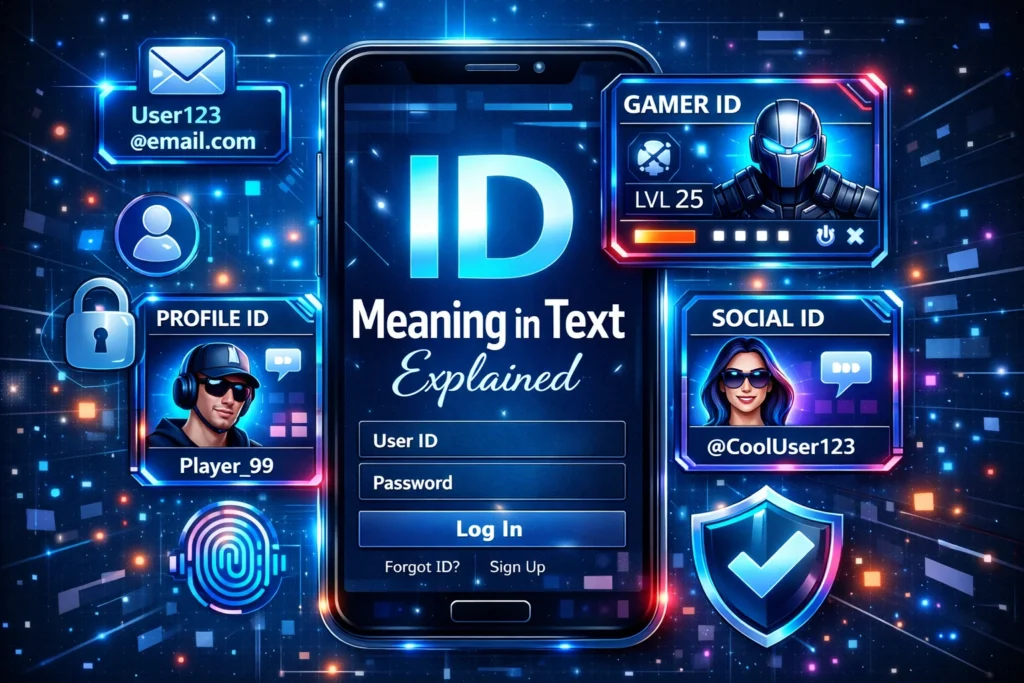
ID in text most commonly stands for “Identification” or “Identity,” and it is used to refer to a username, profile name, or unique label that identifies a person or account online.
If you’ve ever filled out a form online, joined a gaming platform, or chatted on social media, you’ve definitely seen the abbreviation “ID”. It’s one of the most common short forms used in digital communication, but its meaning can change slightly depending on the context.
From usernames to identity verification, “ID” plays an important role in both casual texting and formal systems. But in messaging and online slang, it’s often much simpler than it looks.
In simple words, ID = Identity / Identification = your online or personal identifier.
Origin and Popularity of “ID”
The term ID (Identification) comes from official and administrative systems used for proving identity, such as:
- National identity cards
- School or college IDs
- Employee identification numbers
- Government records
As digital platforms grew, the term was adapted into online spaces to represent:
- Usernames
- Account names
- Player tags in games
- Email handles
Today, “ID” is widely used in texting, gaming, apps, and social media.
Why it became popular:
- Easy abbreviation for “identification”
- Used across all digital platforms
- Important for account recognition
- Simple and universally understood
How “ID” Is Used in Text and Online Chat
In texting and online conversations, ID usually refers to a username or account name.
Common Usage Patterns:
- “What’s your ID?” → Asking for username
- “Send me your ID” → Requesting account details
- “My ID is private” → Refusing to share username
- “Add my ID on Insta” → Sharing social media handle
It is especially common in:
- Gaming (PUBG, Free Fire, Fortnite)
- Social media (Instagram, Snapchat, TikTok)
- Messaging apps (WhatsApp, Discord)
Real-Life Examples of ID in Context
Here are some simple examples to help you understand how “ID” is used:
Example Table
| Situation | ID Usage | Meaning |
|---|---|---|
| Gaming | “Drop your game ID” | Ask for player username |
| Social media | “My Insta ID is @alex123” | Instagram handle |
| Chat | “What’s your ID?” | Asking identity/username |
| Account setup | “Enter email ID” | Email address |
| Verification | “Send your ID proof” | Identity document |
Different Meanings of ID in Text
Although ID usually means “Identity” or “Identification,” it can have multiple meanings depending on context.
1. Identity / Identification (Most Common)
- Username or personal account name
- Used in apps, games, and social media
2. Email ID
- Refers to your email address
- Example: someone@gmail.com
3. Game ID
- Player’s unique gaming account number or name
- Used in PUBG, Free Fire, etc.
4. User ID
- System-generated account number or name
- Used for login or database systems
Comparison: ID vs Similar Terms
To better understand ID meaning in text, let’s compare it with related terms:
| Term | Meaning | Usage |
|---|---|---|
| ID | Identity / username | General account or profile |
| Username | Public name used online | Social media or apps |
| Handle | Social media name | Instagram, X, TikTok |
| Tag | Gaming identity | Multiplayer games |
| Email ID | Email address | Communication/login |
Key Difference:
- ID = General identity label
- Username/Handle = Specific public name on platforms
Tone and Usage Style of “ID”
The tone of ID depends on where it is used:
1. Casual Chat 😎
- “Send me your ID bro”
2. Gaming Context 🎮
- “What’s your PUBG ID?”
3. Formal / Technical 💼
- “Enter your user ID to log in”
4. Verification Context 🪪
- “Upload your ID card for confirmation”
Polite or Professional Alternatives to “ID”
In formal situations, it’s better to avoid casual wording.
Professional Alternatives:
- “Username”
- “Account name”
- “User identification”
- “Login credentials”
- “Email address”
Example:
Instead of saying:
- “Send me your ID”
Better:
- “Please share your username or account details”
Why “ID” Is So Common in Digital Communication
The popularity of ID meaning in text comes from its simplicity and universal usage.
Key reasons:
- Short and easy to type
- Works across all platforms
- Universally understood
- Used in both casual and formal systems
- Essential for online identity management
Common Mistakes When Using “ID”
Even though it is simple, people sometimes misuse it:
Mistakes:
- Confusing ID with password
- Using it without context
- Sharing sensitive ID publicly
- Mixing game ID with social media ID
Correct Usage Tip:
Always clarify what type of ID you are referring to:
- Game ID
- Email ID
- User ID
- Social media ID
FAQs:
1. What does ID mean in text?
ID means “Identity” or “Identification,” usually referring to a username or account name.
2. What is a social media ID?
It is your username or handle used on platforms like Instagram or TikTok.
3. Is ID the same as username?
Mostly yes, but ID is a broader term that can include usernames or system IDs.
4. What does email ID mean?
It refers to your email address used for communication and login.
5. Is it safe to share your ID?
Yes, but only your username or public ID. Never share passwords or private login details.
6. What is a game ID?
It is a unique player identifier used in online games like PUBG or Free Fire.
7. Can ID have different meanings?
Yes, it can mean identity, username, email address, or account number depending on context.
8. Is ID formal or informal?
It is used in both formal systems (login, verification) and informal chats (gaming, social media).
Conclusion
Understanding ID meaning in text is important in today’s digital world because it is used everywhere—from chatting and gaming to account logins and official systems. In most cases, ID simply means identity or username, making it one of the most essential terms in online communication.
Whether someone is asking for your game ID, email ID, or social media ID, the purpose is the same: to identify you in a digital space. Always be careful about what type of ID you share, especially in public chats.
Discover More Related Articles:
- What Does Herpes Look Like: Symptoms, Signs & Early Warning Changes In 2026
- Redshirt Mean in College Sports: College Sports Eligibility Rules Made Simple In 2026

Ryan Thompson is an experienced content writer specializing in slang terms, texting abbreviations, and word meanings. He writes for meanvoro.com, where he creates accurate and easy-to-understand language content for readers.