
Definition
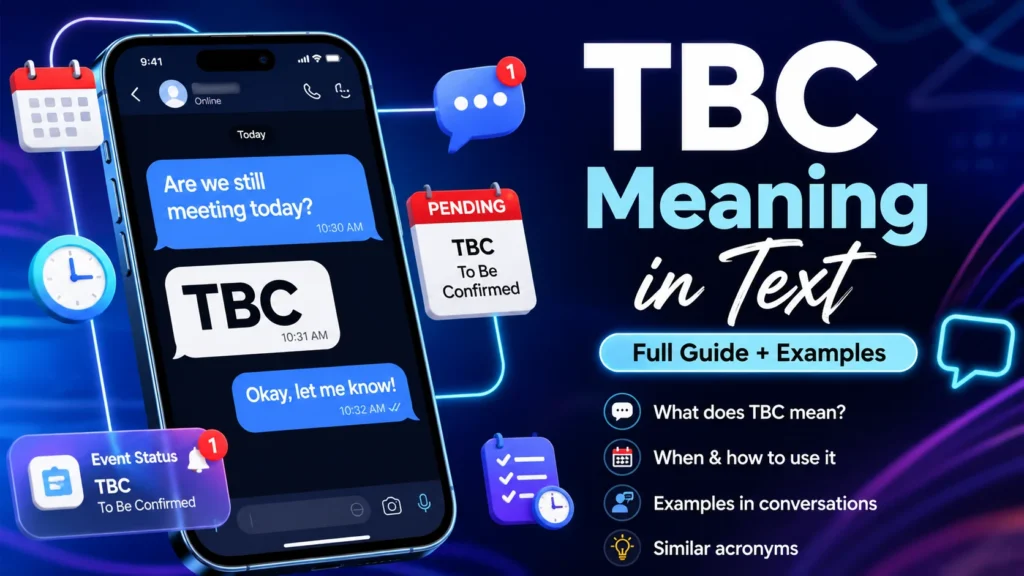
TBC stands for “To Be Confirmed.” It is used in texting, social media, business communication, and scheduling to show that information is not finalized yet and will be officially confirmed later.
If you spend time online, text with friends, watch TV schedules, or scroll through social media, you’ve probably seen the abbreviation “TBC” pop up in conversations. Whether someone says “Meeting time TBC” or “Release date TBC,” this short acronym is commonly used in both casual and professional communication.
In simple words, TBC means:
- The details are not fully decided yet
- Confirmation is still pending
- More information will come later
People use it because it saves time and quickly communicates uncertainty about plans, dates, or details.
Origin and Popularity of TBC
The abbreviation TBC (To Be Confirmed) became popular long before internet slang exploded. It was originally used in:
- Television schedules
- Event planning
- Newspapers
- Business documents
- Sports announcements
As texting and online communication became faster, TBC naturally moved into:
- WhatsApp chats
- Instagram captions
- TikTok comments
- Email conversations
- Online event announcements
Today, it is widely understood across both formal and casual communication.
Why TBC Became Popular
- Short and professional
- Easy to understand
- Useful for scheduling
- Saves typing time
- Common in digital communication
Unlike many internet slang terms, TBC works in both personal and professional settings.
What Does TBC Mean in Different Contexts?
Although “To Be Confirmed” is the most common meaning, the context changes how it is understood.
1. Event Planning
- “Venue TBC”
- Meaning: The location has not been finalized yet.
2. Travel or Flights
- “Departure time TBC”
- Meaning: The timing is pending confirmation.
3. Text Messaging
- “Movie plan tonight? TBC rn.”
- Meaning: The plan is not confirmed yet.
4. TV Shows and Entertainment
- “Season 2 release date TBC”
- Meaning: The official release date hasn’t been announced.
5. Work or Business
- “Salary details TBC”
- Meaning: Final confirmation is still pending.
How TBC Is Used in Text Conversations
In texting, TBC is often used when someone:
- Is unsure about plans
- Needs approval or confirmation
- Is waiting for more information
- Wants to avoid giving incorrect details
Basic Structure:
Topic + TBC
Examples:
- Party location TBC
- Time TBC
- Guest list TBC
- Date TBC
It is usually short, direct, and practical.
Real-Life Examples of TBC in Text
Example Table
| Situation | TBC Example | Meaning |
|---|---|---|
| Friends making plans | “Dinner time TBC 🍕” | Time not finalized |
| School announcement | “Exam venue TBC” | Location pending |
| Work meeting | “Schedule TBC” | Awaiting confirmation |
| Concert announcement | “Artist lineup TBC 🎵” | Final list not revealed |
| Sports event | “Match timing TBC” | Official timing pending |
These examples show how flexible and useful TBC is in daily communication.
Tone and Style of TBC in Communication
Unlike emotional internet slang, TBC usually has a neutral tone.
1. Professional Tone
Often used in workplaces:
- “Interview date TBC.”
2. Casual Tone
Used among friends:
- “Beach trip this weekend, plans TBC 😎”
3. Informative Tone
Used in announcements:
- “Additional details TBC.”
4. Excited/Anticipation Tone
Used before events:
- “Special guest TBC 👀”
TBC vs Similar Abbreviations
Many people confuse TBC with other scheduling abbreviations. Here’s the difference:
| Abbreviation | Meaning | Difference |
|---|---|---|
| TBC | To Be Confirmed | Details expected soon |
| TBD | To Be Decided | Decision hasn’t been made |
| TBA | To Be Announced | Information will be publicly shared later |
| FYI | For Your Information | Sharing information only |
| ETA | Estimated Time of Arrival | Predicting timing |
Key Difference:
- TBC = awaiting confirmation
- TBD = not decided yet
- TBA = announcement coming later
TBC vs TBD: Important Difference
This is one of the most searched comparisons online.
TBC (To Be Confirmed)
Means the decision is mostly made but waiting for official confirmation.
Example:
- “The meeting is Friday, exact time TBC.”
TBD (To Be Decided)
Means no final decision has been made yet.
Example:
- “The project topic is TBD.”
Easy Trick to Remember:
- Confirmed later = TBC
- Decided later = TBD
Alternate Meanings of TBC
Although “To Be Confirmed” is the main meaning, TBC can occasionally stand for other phrases depending on context.
Alternate Meanings:
| Meaning | Context |
|---|---|
| To Be Continued | TV shows or stories |
| The Breakfast Club | Pop culture/movie references |
| Total Body Conditioning | Fitness and gym programs |
| Tuberculosis | Medical abbreviation |
However, in texting and scheduling conversations, TBC almost always means “To Be Confirmed.”
Polite and Professional Alternatives to TBC
If you want to avoid abbreviations in formal writing, try these alternatives:
Professional Alternatives:
- “Awaiting confirmation”
- “Confirmation pending”
- “Details will be confirmed shortly”
- “Final information will follow”
- “Subject to confirmation”
Casual Alternatives:
- “Still figuring it out”
- “Not finalized yet”
- “Will confirm later”
- “We’ll update soon”
These alternatives can sound clearer in professional communication.
Why People Use TBC So Often
The abbreviation remains popular because it:
- Saves time in messages
- Avoids misunderstandings
- Keeps communication clear
- Works in both formal and casual settings
- Makes updates easier
Instead of writing long explanations, people simply use “TBC” to indicate uncertainty or pending confirmation.
Common Mistakes When Using TBC
Although simple, TBC is sometimes used incorrectly.
Common Mistakes:
- Using TBC when no decision exists yet
- Confusing it with TBD
- Using it without context
- Overusing abbreviations in formal emails
Correct Usage Tip:
Use TBC only when confirmation is expected soon.
Correct:
- “Venue TBC.”
Incorrect:
- “Should we even have an event? TBC.”
(In this case, TBD is better.)
How TBC Is Used on Social Media
On social platforms, TBC is often used to build anticipation or suspense.
Examples:
- “Big announcement TBC 👀”
- “Special collab TBC 🔥”
- “New project details TBC”
Brands, influencers, and creators use it because it:
- Creates curiosity
- Encourages engagement
- Builds hype before announcements
TBC in Business and Professional Communication
Unlike slang such as LOL or MFW, TBC is widely accepted in professional settings.
Common Workplace Uses:
- Meeting schedules
- Event planning
- Product launches
- Marketing campaigns
- Travel arrangements
Example:
- “Conference room allocation TBC.”
Because it sounds professional and efficient, many companies use it regularly.
FAQs:
1. What does TBC mean in texting?
TBC means “To Be Confirmed,” showing that details are pending confirmation.
2. Is TBC formal or informal?
It can be both. It is acceptable in casual chats and professional communication.
3. What is the difference between TBC and TBD?
TBC means confirmation is pending, while TBD means no decision has been made yet.
4. Is TBC commonly used online?
Yes, especially in scheduling, events, entertainment, and business updates.
5. Can TBC mean “To Be Continued”?
Yes, but that meaning is less common in texting conversations.
6. Is TBC professional?
Yes. It is widely used in emails, meetings, and corporate communication.
7. How do you use TBC in a sentence?
Example:
“The interview time is TBC.”
8. Why do people use TBC instead of full words?
Because it is faster, shorter, and easier to read in digital communication.
Conclusion
Understanding what TBC means in text is useful because the abbreviation appears in everything from casual chats to professional announcements. Most commonly, TBC stands for “To Be Confirmed,” meaning information is not final yet but will be officially confirmed later.
Its versatility makes it one of the few abbreviations that comfortably works in both informal and formal communication. Whether you are organizing plans with friends or reading an event announcement online, knowing how TBC works helps you understand conversations more clearly.
The next time you see “Date TBC” or “Details TBC,” you’ll know exactly what it means: confirmation is coming soon.
Discover More Related Articles:
- What Does Herpes Look Like: Symptoms, Signs & Early Warning Changes In 2026
- Redshirt Mean in College Sports: College Sports Eligibility Rules Made Simple In 2026

Jessica Brown is a language-focused writer who creates well-researched articles on word meanings, abbreviations, and everyday expressions. She contributes to meanvoro.com, delivering simple, reliable, and reader-friendly content designed to make complex terms easy to understand.