
Definition
Skin cancer is a condition in which abnormal skin cells grow uncontrollably, often appearing as new, changing, or unusual spots on the skin such as sores that don’t heal, irregular moles, or rough, scaly patches that may change in size, shape, or color over time.
When people first hear the phrase “what does skin cancer look like,” it often comes from worry after noticing a strange spot, mole, or patch on their skin. The truth is, skin cancer doesn’t always look the same for everyone, which is why it can sometimes be confusing or even ignored in its early stages.
The good news? Most skin cancers show visible warning signs on the skin, and learning what to look for can make a huge difference in early detection and successful treatment. In fact, skin cancer is one of the most common cancers worldwide, but also one of the most treatable when found early.
In this guide, we’ll break down exactly how skin cancer can appear, the different types, real-life examples, comparisons, and warning signs you should never ignore.
Origin and Real-World Understanding of Skin Cancer
Skin cancer has been recognized in medical science for centuries, but its awareness has grown massively in recent decades due to:
- Increased sun exposure habits (outdoor lifestyles, tanning)
- Ozone layer changes leading to stronger UV rays
- Better medical diagnosis and awareness campaigns
- Social media health education
Today, dermatologists stress that early detection is key, especially because many skin cancers begin as small, subtle skin changes that people overlook.
What Does Skin Cancer Look Like?
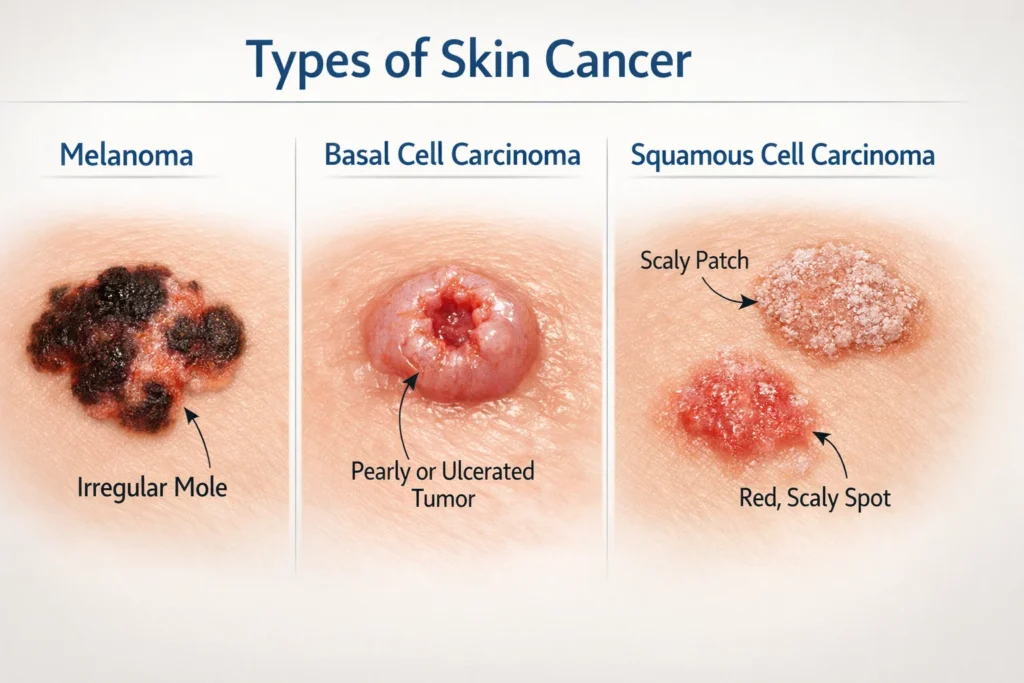
Skin cancer can appear differently depending on the type, but most cases fall into recognizable patterns.
1. Basal Cell Carcinoma (Most Common Type)
Often looks like:
- Shiny or pearly bump
- Flesh-colored or pink patch
- A sore that heals and returns
- Small blood vessels visible on the surface
👉 Example: A small bump on the nose that keeps bleeding and doesn’t fully heal.
2. Squamous Cell Carcinoma
Often appears as:
- Rough, scaly red patch
- Thickened or crusted skin
- Wart-like growth
- Open sore that doesn’t heal
👉 Example: A dry patch on the hand that slowly becomes crusty and painful.
3. Melanoma (Most Dangerous Type)
This is the type people are most concerned about when asking what does skin cancer look like.
It may appear as:
- A mole that changes shape or color
- Dark brown, black, or multicolored spot
- Irregular borders
- New mole that looks different from others
👉 Warning sign: “Ugly duckling mole” — a mole that looks different from all others on your body.
The ABCDE Rule for Identifying Skin Cancer
Dermatologists often use the ABCDE rule to help identify suspicious moles:
| Letter | Meaning | What to Look For |
|---|---|---|
| A | Asymmetry | One half looks different from the other |
| B | Border | Uneven, blurred, or jagged edges |
| C | Color | Multiple shades (brown, black, red, white) |
| D | Diameter | Larger than 6mm (pencil eraser size) |
| E | Evolving | Changes in size, shape, or color |
Common Locations Where Skin Cancer Appears
Skin cancer can develop anywhere, but commonly appears in sun-exposed areas:
- Face (nose, cheeks, forehead)
- Neck
- Ears
- Arms and hands
- Back
- Scalp (especially under hair)
However, melanoma can also appear in hidden areas like:
- Between toes
- Under nails
- On the soles of feet
Real-Life Examples
Here are simple examples to help you understand how skin cancer may look in daily life:
- A small “pimple-like bump” that never heals after months
- A mole that slowly becomes darker or uneven
- A scaly patch that feels rough like sandpaper
- A sore that keeps bleeding and forming a crust
- A dark streak under a fingernail that wasn’t there before
Skin Cancer vs Normal Skin Changes
Many harmless skin changes can look similar to early skin cancer, which is why confusion happens.
| Feature | Normal Skin Change | Possible Skin Cancer |
|---|---|---|
| Moles | Stable, unchanged | Changing size/color |
| Spots | Fade over time | Grow or persist |
| Sores | Heal quickly | Don’t heal for weeks/months |
| Texture | Smooth or consistent | Rough, crusty, or raised |
Comparison with Related Terms
Understanding related terms helps reduce confusion:
Skin Cancer vs Mole
- Mole: Usually harmless, stable
- Skin cancer: Changes over time, irregular
Skin Cancer vs Rash
- Rash: Temporary irritation or allergy
- Skin cancer: Persistent and progressive
Skin Cancer vs Acne
- Acne: Heals naturally
- Skin cancer: Doesn’t heal normally
Are There Alternative Meanings?
The phrase “what does skin cancer look like” is almost always medical in context. However, sometimes people use it online when:
- Describing suspicious skin changes humorously or exaggeratedly
- Sharing awareness posts on social media
- Searching for images for educational purposes
There are no alternate slang meanings for this keyword in texting or casual communication.
Polite or Professional Ways to Ask About It
Instead of casually saying it, people often use more formal or sensitive wording like:
- “What are the early signs of skin cancer?”
- “How can you identify skin cancer on skin?”
- “What does melanoma look like on the skin?”
- “Skin cancer warning signs explained”
Important Warning Signs You Should Never Ignore
If you notice any of the following, it’s important to consult a dermatologist:
- A mole that changes shape or color
- A sore that does not heal within 3–4 weeks
- A new dark spot that grows quickly
- Itching, bleeding, or pain in a skin lesion
- Irregular or uneven skin growth
FAQs
1. What is the first sign of skin cancer?
The first sign is usually a new spot on the skin or an existing mole that starts changing in size, shape, or color. Sometimes it can also appear as a sore that does not heal properly.
2. Does skin cancer hurt?
Not always. In many cases, early skin cancer is painless, which is why people often overlook it. Pain may appear later if the condition progresses.
3. Can skin cancer look like a pimple?
Yes, some types—especially basal cell carcinoma—can look like a small pimple, bump, or skin irritation that never fully goes away.
4. How fast does skin cancer grow?
It depends on the type. Some skin cancers grow very slowly over months or years, while others like melanoma can grow and spread more quickly.
5. Can skin cancer be cured?
Yes. When detected early, most skin cancers are highly treatable and often completely curable with proper medical care.
6. Is every changing mole cancer?
No, not every changing mole is cancerous. However, any change in a mole’s shape, color, or size should be checked by a healthcare professional.
7. Where does skin cancer usually start?
Skin cancer most commonly starts in areas exposed to the sun, such as the face, neck, arms, and hands, but it can appear anywhere on the body.
8. What does early melanoma look like?
Early melanoma often appears as a dark or multi-colored mole with irregular edges, uneven shape, and changes over time.
Conclusion
Understanding what does skin cancer look like is essential for early detection and better health outcomes. Skin cancer can appear in many forms—from small shiny bumps to dark changing moles or rough patches that don’t heal.
The key takeaway is simple: any new, changing, or unusual skin spot should not be ignored. Early awareness and regular skin checks can make a life-saving difference.
By learning the warning signs, using the ABCDE rule, and staying aware of changes in your skin, you can significantly reduce risks and catch problems early.
Discover More Related Articles:
- Minus 1 Station Mean in Pregnancy: Signs and Facts for 2026
- Star Level Mean in Clash Royale: Uses & Benefits In 2026

Ryan Thompson is an experienced content writer specializing in slang terms, texting abbreviations, and word meanings. He writes for meanvoro.com, where he creates accurate and easy-to-understand language content for readers.