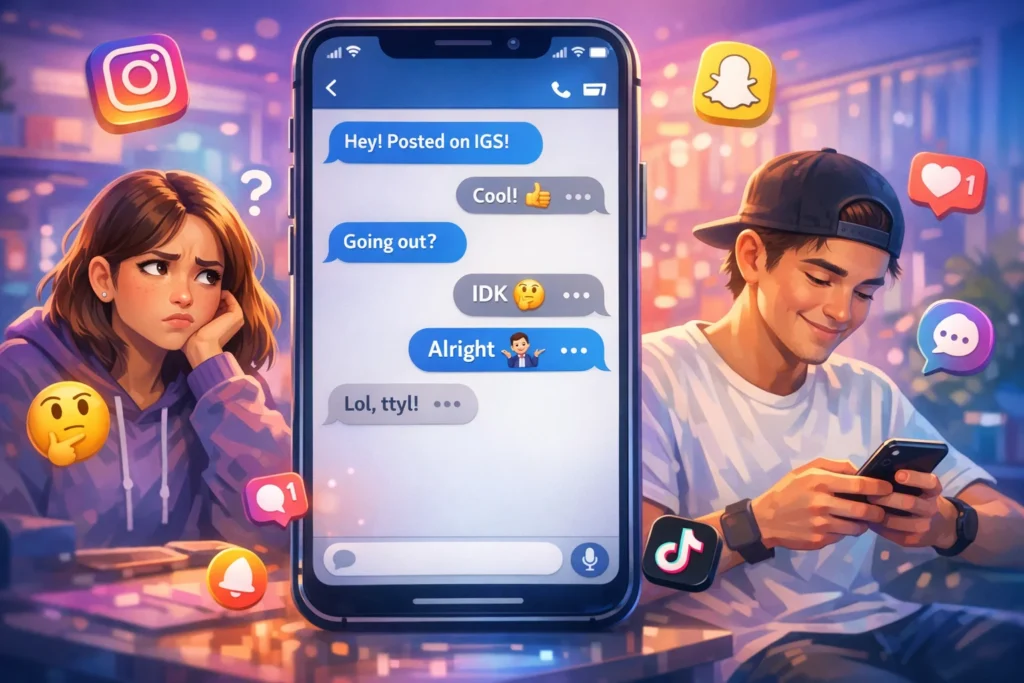
Definition
IGS in text typically means “I guess.” It is a casual internet abbreviation used to express uncertainty, hesitation, mild agreement, or a lack of strong opinion in a conversation.
If you’ve ever been scrolling through a chat, Snapchat, Instagram DM, or TikTok comment section and suddenly saw someone type “igs”, you probably paused for a second and wondered what it means. Is it slang? A typo? Or some secret internet code?
The truth is, modern texting language evolves fast. Short forms like “IGS” are part of how people communicate quickly, casually, and emotionally online. These abbreviations often carry subtle tone shifts that can completely change the meaning of a sentence.
In this guide, we’ll break down everything you need to know about what “IGS” means in text, how it’s used, where it comes from, and how to respond to it naturally in conversation.
It can also reflect a soft or indifferent tone depending on context, such as:
- agreement without enthusiasm
- unsure acceptance
- passive response
- emotional neutrality
Example:
- “Are you coming tonight?”
- “IGS…”
Origin and Popularity of IGS
The abbreviation IGS comes from the shortened form of the phrase “I guess.” It developed naturally from fast typing habits in texting and online messaging platforms.
Why it became popular:
- People wanted quicker responses in chats
- Social media platforms encouraged short, fast communication
- Mobile typing made abbreviations more convenient
- Gen Z and internet culture popularized shorthand expressions
While “IG” already exists as short for Instagram, “IGS” specifically evolved in messaging contexts to avoid confusion and express tone more clearly.
Over time, it became common in:
- Snapchat streak conversations
- Instagram DMs
- TikTok comments
- Gaming chats (Discord, Roblox, etc.)
Common Usage of IGS in Text Conversations
The meaning of IGS (“I guess”) depends heavily on tone. It’s not just a neutral phrase—it often carries emotional nuance.
1. Indifference or Lack of Interest
When someone is not fully engaged in the topic.
- “Do you like the movie?”
- “IGS, it was okay.”
2. Uncertain Agreement
When someone agrees but isn’t fully confident.
- “Should we go out tonight?”
- “IGS…”
3. Reluctant Acceptance
When someone is going along with something but not excited.
- “We’re doing group study.”
- “IGS, fine.”
4. Soft Hesitation
Used when someone is unsure how they feel.
- “Do you want to talk?”
- “IGS, maybe later.”
Real-Life Examples of IGS in Text
Here are practical examples showing how “IGS” changes meaning depending on context.
Example 1: Neutral Tone
- A: “Is pizza okay for dinner?”
- B: “IGS.”
👉 Meaning: mild agreement, no strong preference
Example 2: Dismissive Tone
- A: “Did you like the party?”
- B: “IGS… it was alright.”
👉 Meaning: not impressed
Example 3: Emotional Uncertainty
- A: “Are you mad at me?”
- B: “IGS not really sure.”
👉 Meaning: confused feelings
Example 4: Casual Agreement
- A: “Let’s leave now.”
- B: “IGS, let’s go.”
👉 Meaning: okay with plan
Example 5: Passive Response
- A: “Do you even care?”
- B: “IGS…”
👉 Meaning: emotionally distant or unsure
Example Table of IGS Usage
| Situation | Example Text | Meaning |
|---|---|---|
| Agreement | “IGS, sure” | Mild yes |
| Uncertainty | “IGS maybe” | Not sure |
| Indifference | “IGS it’s fine” | No strong feeling |
| Reluctance | “IGS if we have to” | Passive acceptance |
| Emotional confusion | “IGS idk” | Mixed feelings |
Alternate Meanings of IGS
Although “I guess” is the most common meaning, IGS can sometimes have other interpretations depending on context:
1. International Grammar School
Used in educational contexts, not texting slang.
2. Internet Gaming Slang (rare use)
Sometimes used in gaming chats, but still usually “I guess.”
3. Typo Variations
People sometimes accidentally type:
- “igs” instead of “I guess”
- or as a rushed keyboard abbreviation
👉 However, in everyday texting, “I guess” is the dominant meaning by far.
Comparison with Similar Text Abbreviations
Understanding IGS becomes easier when compared with similar slang expressions.
| Abbreviation | Meaning | Tone Difference |
|---|---|---|
| IGS | I guess | Neutral, uncertain |
| IG | I guess / Instagram | Context-dependent |
| IDK | I don’t know | More direct uncertainty |
| Meh | Indifference | Stronger boredom |
| K | Okay | Neutral but sometimes cold |
| ¯\(ツ)/¯ | Shrug | Strong uncertainty or apathy |
Key Insight:
- IGS = soft uncertainty
- IDK = direct lack of knowledge
- Meh = emotional disinterest
Polite or Professional Alternatives to IGS
In professional or respectful conversations, it’s better to avoid slang like IGS. Here are clearer alternatives:
Instead of IGS, you can say:
- “I think so, but I’m not completely sure.”
- “That sounds fine to me.”
- “I believe so.”
- “I’m okay with that.”
- “Possibly, yes.”
These alternatives sound more professional in:
- emails
- workplace chats
- academic communication
When to Use or Avoid IGS
When it’s okay to use:
- Casual texting with friends
- Social media replies
- Informal group chats
- Gaming conversations
When to avoid it:
- Job-related messages
- School assignments or formal writing
- Emails to teachers or managers
- Customer service communication
Why tone matters:
IGS can sometimes sound:
- uninterested
- unsure
- emotionally distant
So choosing the right context is important.
FAQs
1. What does IGS mean in texting?
It usually means “I guess,” expressing uncertainty or mild agreement.
2. Is IGS a rude message?
Not always. It depends on tone it can be neutral or slightly uninterested.
3. Is IGS the same as IG?
No. IG usually means Instagram or “I guess,” while IGS specifically means “I guess.”
4. Why do people use IGS instead of I guess?
Because it’s faster to type and fits casual texting culture.
5. Does IGS mean confusion?
Sometimes yes, but more often it means uncertainty or passive agreement.
6. Can I use IGS in formal writing?
No, it is informal slang and should be avoided in professional communication.
7. Is IGS commonly used on social media?
Yes, especially in Snapchat, Instagram DMs, and TikTok comments.
8. What should I reply to IGS?
You can respond depending on tone:
- “Okay 👍”
- “Got it”
- “No worries”
- or ask follow-up questions for clarity
Conclusion
In today’s fast-paced digital communication, short forms like IGS (“I guess”) help people express thoughts quickly and casually. However, its meaning is not just literal it carries emotional tone, ranging from mild agreement to hesitation or indifference.
The key takeaway is simple:
- IGS = “I guess”
- It reflects uncertainty or soft agreement
- Tone depends heavily on context
- Best used in informal conversations only
Understanding slang like IGS helps you read between the lines in chats and respond more naturally in online conversations.
Discover More Related Articles:

Madison Taylor is an experienced content writer who focuses on researching and explaining word meanings, slang, and texting terms. She writes for meanvoro.com, creating clear and accurate to help readers understand language easily.