Definition
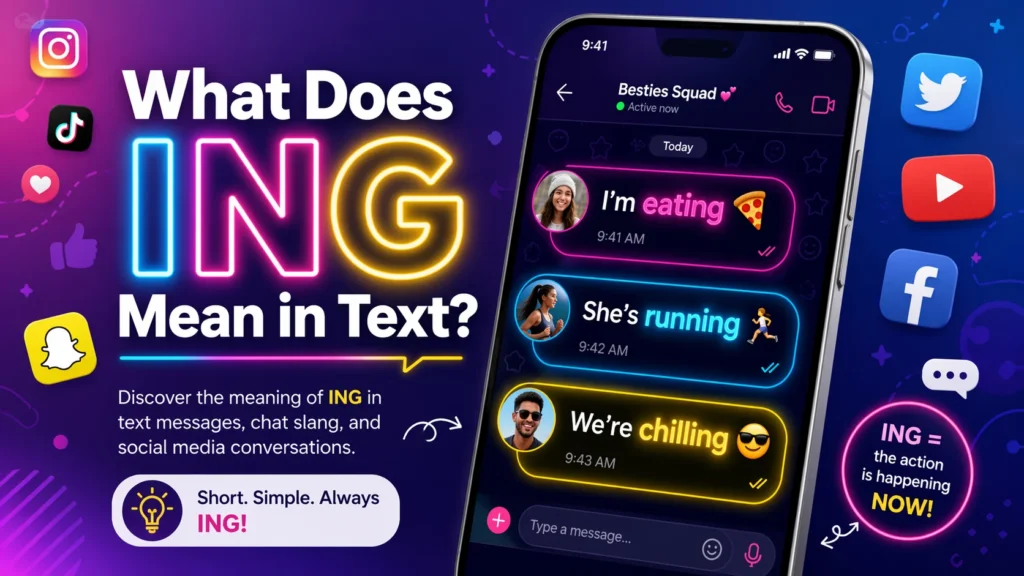
“ING” in text refers to a verb suffix that shows an action is ongoing, continuous, or currently happening. It is used to form present participles and progressive tenses, such as “running,” “eating,” or “talking,” and helps express that something is happening right now or around the current time.
If you’ve ever seen someone texting “I’m running”, “she’s singing”, or “we’re chilling” and wondered what the “-ing” really means in messages, you’re not alone. This tiny three-letter ending shows up everywhere in digital communication, from casual chats to social media captions but its meaning and function go far deeper than it looks.
In texting, “ING” is more than just grammar it shapes tone, expresses ongoing actions, and even adds emotion or personality to a message. Understanding it can help you read between the lines in conversations and even improve your own texting style.
Let’s break it down in a simple, clear, and practical way so you can fully understand what “ing” means in text and how it’s used in real conversations.
ING Meaning
The suffix “-ing” is commonly added to a verb to show that an action is happening now or is ongoing. For example, in the sentence “She is running,” the word running indicates that the action is taking place at the present moment.
The -ing form can also function as a noun (called a gerund), such as in “Reading is fun,” where reading acts as the subject of the sentence. Additionally, -ing words are used as adjectives, like in “an interesting book.” Overall, -ing is an important English ending that helps express continuous actions, activities, and descriptions.
Origin of “ING” and Why It’s So Common in Texting
The “-ing” form is not new it comes from traditional English grammar and has existed for centuries. It is part of what linguists call the present participle form.
Why it became common in texting:
- Messaging apps encourage short, natural language
- People type how they speak
- Continuous actions are often discussed in real time
- Social media captions rely heavily on “ongoing” expressions
Over time, “-ing” became a natural part of informal digital communication.
Examples of natural evolution:
- “I am eat” ❌ (incorrect grammar)
- “I am eating” ✅ (correct and natural)
- “Eating rn 🍕” (casual texting style)
How “ING” Is Used in Text Messages
The “-ing” ending is used to show that something is happening continuously or at the moment of speaking.
1. Ongoing Actions
Used when something is happening right now.
- “I’m studying”
- “She’s driving”
- “They’re watching a movie”
2. Temporary Actions
Used for short-term situations.
- “I’m staying at my friend’s place”
- “He’s working late today”
3. Describing Situations or States
- “Life is changing”
- “Things are getting better”
4. Informal or Casual Style
Sometimes shortened or stylized in texting:
- “Chilling 😎”
- “Vibing”
- “Gaming all night”
Real-World Examples of “ING” in Text Conversations
Here are examples showing how tone changes depending on context:
Friendly Tone
- “I’m cooking dinner 🍳”
- “We’re hanging out later”
Neutral Tone
- “She’s working right now”
- “I’m traveling tomorrow”
Excited Tone
- “I’m going to the concert!!! 🎶”
- “We’re winning!!!”
Slightly Negative / Tired Tone
- “I’m struggling with homework”
- “He’s ignoring my messages”
Table: “ING” Usage in Different Contexts
| Context Type | Example Sentence | Meaning |
|---|---|---|
| Present action | I’m eating lunch | Action happening now |
| Temporary state | She’s staying home today | Short-term situation |
| Emotional tone | I’m loving this song 🎧 | Expressing feeling |
| Casual texting | Just chilling 😌 | Relaxed ongoing activity |
| Social media | Working on my goals 💪 | Ongoing lifestyle action |
Why People Use “ING” in Texting
The “-ing” form is extremely popular in digital communication because it:
- Makes messages feel more natural
- Shows real-time actions
- Adds emotional tone
- Makes storytelling more engaging
- Matches spoken English patterns
In short, it helps make texting feel more human.
Comparison: “ING” vs Other Verb Forms
Understanding “-ing” becomes easier when compared with other verb forms.
1. “ING” vs Base Verb
- Run → Running
- Eat → Eating
👉 “-ing” shows action is happening
2. “ING” vs Past Tense
- I am eating → I ate
- She is working → She worked
👉 Past tense = completed action
👉 “-ing” = ongoing action
3. “ING” vs Future Meaning
Sometimes confusion happens:
- “I’m meeting him tomorrow” (future plan using -ing form)
- “I will meet him tomorrow” (direct future)
👉 Both can be correct depending on style
Alternate Meanings of “ING”
Although mostly grammatical, in texting “ING” can sometimes appear in other ways:
1. Abbreviation (Rare in casual texting)
- “ING” may refer to the bank name or brand context (not common in chat slang)
2. Stylized slang use
- “Vibing / chilling / gaming” = informal emotional state expressions
3. Typing shorthand
Sometimes people shorten:
- “Going” → “goin’” or “goin”
- “Doing” → “doin’”
But these still represent “-ing” structure.
Common Mistakes People Make with “ING”
Even native speakers sometimes misuse it in texting.
Mistake 1: Wrong tense mixing
- ❌ “I am go to school”
- ✔ “I am going to school”
Mistake 2: Missing “to be” verb
- ❌ “I running”
- ✔ “I am running”
Polite or Professional Alternatives
In formal writing or professional messages, you may want alternatives.
| Casual “ING” Text | Professional Version |
|---|---|
| I’m working on it | I am currently working on it |
| She’s busy | She is currently occupied |
| We’re meeting | We have a meeting scheduled |
| I’m checking | I will review/check |
Why “ING” Matters in Digital Communication
The “-ing” form plays a big role in:
- Expressing real-time experiences
- Making conversations more dynamic
- Adding personality to texts
- Helping people sound more natural online
- Showing emotions indirectly
For example:
- “I’m crying 😭” → emotional expression
- “I cry” → general fact (less emotional)
That subtle difference is powerful in texting.
FAQs:
1. What does ING mean in texting?
It means an ongoing action happening right now or around the present time.
2. Is ING slang?
No, it is not slang. It is a standard English grammar form used in informal texting.
3. Why do people use ING in messages?
To show continuous actions and make messages more natural and expressive.
4. Can ING change the meaning of a sentence?
Yes, it indicates whether an action is ongoing, temporary, or descriptive.
5. Is ING formal or informal?
It can be both, but it is more commonly used in informal conversations.
6. What is the difference between ING and ED verbs?
“-ing” shows ongoing action, while “-ed” shows completed action.
7. Why do captions on social media use ING words?
Because they describe ongoing experiences or lifestyle moments.
8. Can ING be used for future actions?
Yes, in some cases like “I’m meeting him tomorrow,” it refers to planned future events.
Conclusion
The “-ing” ending might look small, but it plays a huge role in how we communicate in texts and online conversations. It helps express ongoing actions, emotions, and real-time experiences in a natural and relatable way.
Whether you’re saying “I’m working,” “I’m chilling,” or “I’m learning,” the “-ing” form makes your message feel alive and immediate. Understanding it not only improves your grammar but also helps you better interpret tone in digital conversations.
Discover More Related Articles:

Ryan Thompson is an experienced content writer specializing in slang terms, texting abbreviations, and word meanings. He writes for meanvoro.com, where he creates accurate and easy-to-understand language content for readers.