
Definition:
In legal terms, “upheld” means that a court has confirmed, supported, or agreed with a previous decision, ruling, or judgment. When a higher court upholds a decision, it means the original ruling remains valid and unchanged.
If you’ve ever come across a legal article, court ruling, or news report about a lawsuit, you’ve likely seen the word “upheld.” While it may sound like a complicated legal term, its meaning is actually quite simple. Understanding this word can make it much easier to follow court decisions, appeals, and legal discussions.
In the legal world, when a decision is upheld, it means the court has reviewed a previous ruling and decided that it should remain unchanged. The original judgment stands as it is, without being overturned or modified. This term often appears in cases involving appeals, where a higher court examines a lower court’s decision.
Whether you’re reading about a high-profile court case or simply trying to understand legal language, knowing what “upheld” means can help you quickly understand the outcome. In this guide, we’ll explain the meaning of upheld, how it is used in legal contexts, and provide simple examples to make the concept easy to understand.
Legal terms can sometimes feel confusing, especially when they appear in court cases, news reports, or official documents. One word that often causes questions is “upheld.” Although it sounds formal, it’s actually a straightforward term that plays an important role in the legal system.
Origin and Legal Background of “Upheld”
The word “upheld” comes from the verb “uphold,” which dates back to Old English. It combines:
- “Up” (meaning support or maintain)
- “Hold” (meaning to keep or retain)
Over time, the term became widely used in legal systems especially in common law countries like the UK, the US, and others influenced by similar legal traditions.
Why It Became Popular in Law
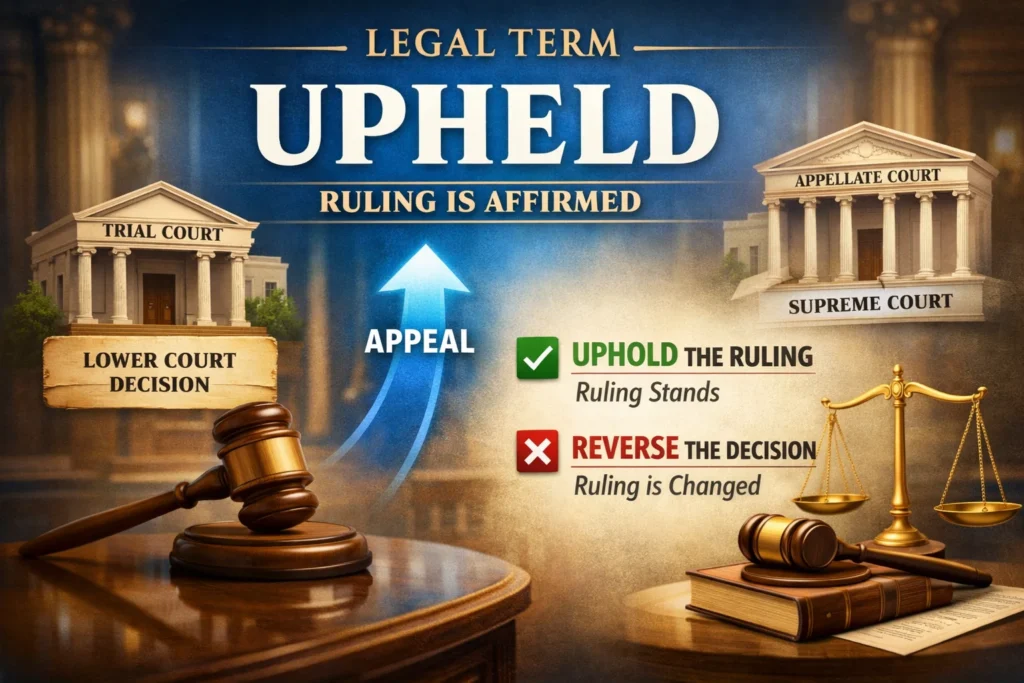
In court systems, especially those with multiple levels (trial courts, appellate courts, supreme courts), decisions are often reviewed. That’s where “upheld” comes in.
- A lower court makes a ruling
- Someone appeals (asks a higher court to review it)
- The higher court decides to either:
- Uphold the ruling (keep it as is)
- Or change it (reverse or modify it)
Because appeals are so common, the word “upheld” became a standard legal term.
How “Upheld” Is Used in Court
In legal contexts, “upheld” is typically used in appeal cases.
Basic Structure
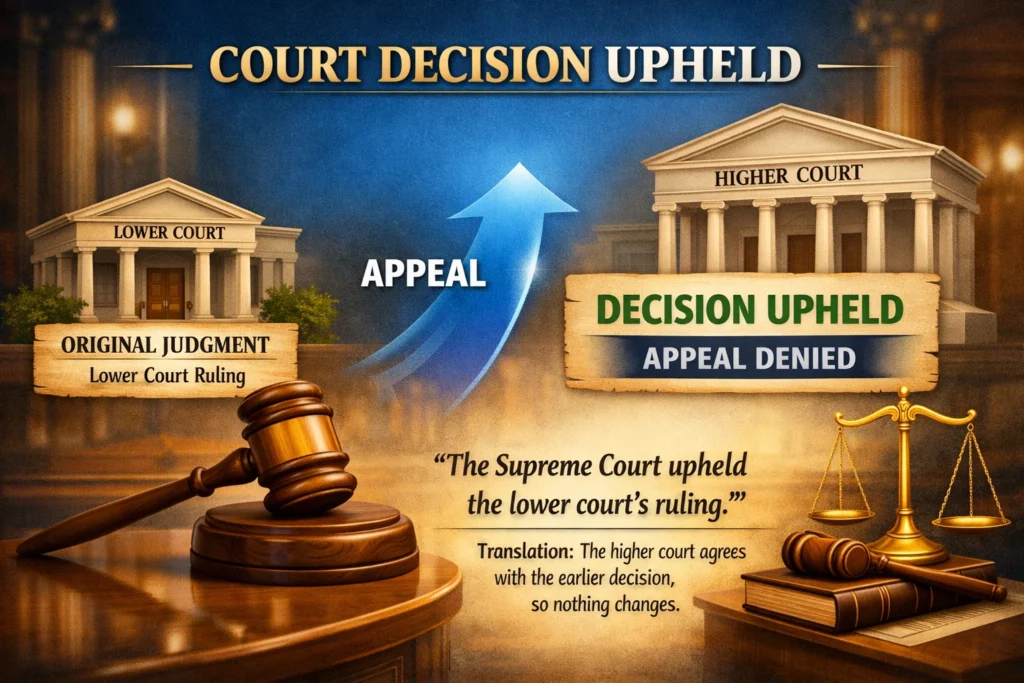
When a court says a decision is upheld, it means:
- The original judgment was correct
- The appeal is denied
- The decision remains unchanged
Example in Plain English
- “The Supreme Court upheld the lower court’s ruling.”
👉 Translation: The higher court agrees with the earlier decision, so nothing changes.
Real-World Usage of “Upheld”
You’ll commonly see “upheld” in:
- News headlines
- Legal documents
- Court judgments
- Academic law discussions
Common Contexts
- Criminal cases (convictions upheld)
- Civil disputes (damages upheld)
- Constitutional rulings (laws upheld)
Examples of “Upheld” in Different Contexts
Here’s how the word works in real-life scenarios:
Friendly/Neutral Tone
- “The judge upheld the original decision after reviewing the appeal.”
- “Good news for them the ruling was upheld!”
Formal/Professional Tone
- “The appellate court upheld the trial court’s judgment.”
- “The decision was upheld due to lack of sufficient evidence for reversal.”
Negative or Disappointing Tone
- “His appeal failed the conviction was upheld 😕”
- “Unfortunately, the fine was upheld, so you still have to pay.”
Example Table: How “Upheld” Works in Legal Situations
| Scenario | Original Decision | Appeal Outcome | Result |
|---|---|---|---|
| Criminal Case | Guilty verdict | Upheld | Person remains convicted |
| Civil Case | Compensation awarded | Upheld | Payment still required |
| Law Challenge | Law declared valid | Upheld | Law stays in effect |
| Employment Dispute | Employee fired legally | Upheld | Employer’s decision stands |
Comparison: “Upheld” vs Similar Legal Terms
Legal language can be tricky because many terms sound similar but mean different things. Here’s a helpful comparison:
| Term | Meaning | Outcome |
|---|---|---|
| Upheld | Decision stays the same | No change |
| Overturned | Decision is reversed | Opposite result |
| Modified | Decision is changed slightly | Partial change |
| Dismissed | Case or appeal is rejected | No further action |
| Remanded | Case sent back to lower court | Needs further review |
Quick Tip:
- If you see “upheld”, think: ✅ “Still stands”
- If you see “overturned”, think: ❌ “Changed completely”
Usage Tips: When and How to Use “Upheld”
If you’re writing or speaking about legal matters, here’s how to use “upheld” correctly:
Correct Usage
- “The court upheld the decision.”
- “The ruling was upheld on appeal.”
Common Mistakes to Avoid
- ❌ “The court upheld the appeal” (incorrect)
- ✅ “The court upheld the ruling” (correct)
Simple Rule
👉 You uphold a decision, not an appeal.
Alternate Meanings of “Upheld”
While “upheld” is most common in legal contexts, it can also be used in everyday language.
General Meaning
- To support or maintain something (values, rules, standards)
Examples
- “She upheld her promise.”
- “The company upheld its reputation for quality.”
However, in court-related discussions, the meaning is always tied to legal decisions staying in place.
Polite or Professional Alternatives
If you want to avoid repeating “upheld,” here are some alternatives depending on context:
Legal Alternatives
- “Confirmed”
- “Affirmed” (very common in legal writing)
- “Maintained”
- “Sustained”
Example
- “The court affirmed the lower court’s ruling.”
(Same meaning as upheld)
Why “Upheld” Is Important in Legal Systems
Understanding this term is essential because it tells you:
- Whether an appeal succeeded or failed
- Whether a decision is final
- Whether legal precedent remains unchanged
In many cases, when a higher court upholds a decision, it strengthens that ruling as a precedent meaning it can influence future cases.
FAQs:
1. What does “upheld” mean in simple terms?
It means the court agrees with an earlier decision and keeps it unchanged.
2. Does upheld mean you won or lost?
It depends on your position:
- If you supported the original decision → you won
- If you appealed → you lost
3. What happens after a decision is upheld?
The ruling stays in effect, and usually, no further appeals are possible (unless taken to a higher court).
4. Is upheld the same as approved?
Not exactly. “Approved” is general, while “upheld” specifically refers to legal confirmation of a prior ruling.
5. What is the opposite of upheld?
The opposite is overturned, meaning the decision is reversed.
6. Can a Supreme Court decision be upheld?
Yes, but only if reviewed in a different context or jurisdiction. Typically, Supreme Court decisions are final.
7. What does “conviction upheld” mean?
It means the guilty verdict remains valid, even after appeal.
8. Is “upheld” good or bad?
It’s neutral it simply means the decision didn’t change. Whether it’s good or bad depends on your perspective.
Conclusion:
In simple legal terms, “upheld” means that a court has agreed with a previous decision and decided to keep it unchanged. It usually happens during an appeal, where a higher court reviews a lower court’s ruling and finds no reason to alter it.
The most important thing to remember is:
- Upheld = the original decision stands
- It shows the appeal was not successful
- It is different from “overturned,” which means the decision is changed
- It helps maintain consistency and stability in the legal system
So, whenever you come across the word “upheld” in a court case, think of it as a confirmation that the original ruling has been reviewed and it still holds strong.
Discover More Related Articles:
- OG Mean | Original Gangster or something else In 2026
- TS Mean in Text | Online Chat & Internet Slang Breakdown In 2026
- What Does ASL Mean | American Sign Language & Its Importance In 2026

Ryan Thompson is an experienced content writer specializing in slang terms, texting abbreviations, and word meanings. He writes for meanvoro.com, where he creates accurate and easy-to-understand language content for readers.