
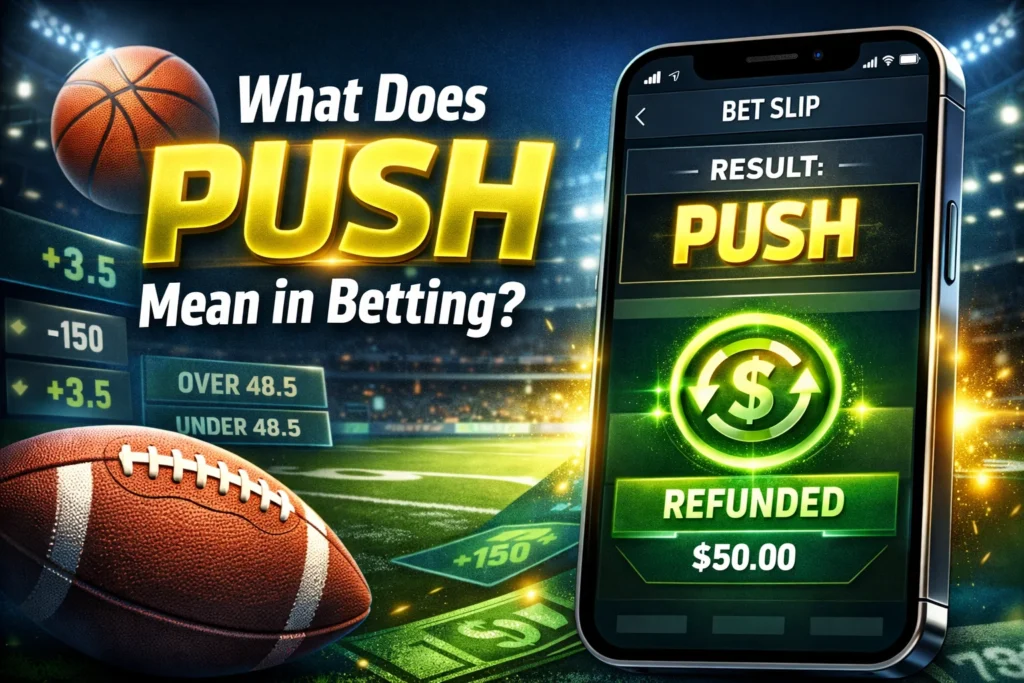
Definition
A push in betting occurs when a wager results in a tie between the bettor and the sportsbook line, meaning no one wins or loses and the original stake is simply returned to the bettor.
If you’ve ever placed a sports bet and suddenly seen the word “push” appear instead of “win” or “loss,” you’re not alone in feeling confused.
It sounds like something went wrong but in reality, a push is actually a neutral outcome in betting. It’s one of those terms that beginners often misunderstand, especially in sports like football, basketball, or baseball where point spreads and totals are involved.
Understanding what a push means is important because it directly affects:
- Your winnings
- Your betting strategy
- How sportsbooks handle refunds
Once you understand it, betting becomes a lot clearer and less frustrating.
Let’s break it down step by step.
In simple terms:
👉 A push = your bet neither wins nor loses
👉 Your money = refunded (stake back)
👉 Profit = $0
What Does Push Mean in Betting?
A push in betting happens when the final result of a game matches the sportsbook’s betting line exactly.
So instead of:
- You winning the bet
- Or losing the bet
You get:
- A tie (push)
- Your money returned
Example:
If you bet on:
- Team A +3.5 points
And the final score:
- Team A loses by exactly 3 points or wins outright → you win
- Team A loses by 4+ points → you lose
- Team A loses by exactly 3.5 points (rare due to half points) → push situation depends on line rules, but usually avoids push
- BUT if line is a whole number like +3 and they lose by exactly 3 → push
Why Push Happens in Betting
Pushes mainly happen because sportsbooks set precise lines (spreads or totals) to balance action between both sides.
A push occurs when:
- The result lands exactly on the betting line
- No edge exists for either side
This is most common in:
- Point spreads (NFL, NBA)
- Over/under totals
- Handicap betting (soccer)
Origin and Popularity of the Term “Push”
The term “push” comes from early gambling language in the U.S. sportsbooks during the rise of organized betting in the 20th century.
It was used to describe situations where:
- The bet is “pushed back” to the player
- No money is exchanged as profit or loss
Today, it remains a standard betting term across:
- Online sportsbooks
- Casinos
- Betting apps
- Sports analytics platforms
Its popularity increased even more with mobile betting apps, where users frequently see “push” in their bet slips.
How a Push Works in Real Betting Situations
Let’s make it clearer with real-world examples.
🏈 Example 1: NFL Point Spread
- You bet: Dallas Cowboys -7
- Final score: Cowboys win by exactly 7 points
👉 Result: PUSH
👉 Your money is refunded
🏀 Example 2: NBA Betting
- You bet: Lakers -5
- Final score: Lakers win by 5
👉 Result: PUSH
⚽ Example 3: Soccer Handicap
- You bet: Team A -1 handicap
- Team A wins by exactly 1 goal
👉 Result: PUSH
Push vs Win vs Loss
| Outcome | Meaning | What Happens to Your Money |
|---|---|---|
| Win | Your pick beats the spread/line | You win profit + original stake |
| Loss | Your pick loses | You lose your stake |
| Push | Tie with the betting line | Stake is refunded |
Push in Different Types of Bets
1. Point Spread Bets
Most common place for pushes.
- Occurs when margin of victory equals the spread
- Very common in NFL betting
2. Over/Under (Totals)
A push happens when:
- Total score = exactly the sportsbook line
Example:
- Over/Under: 45
- Final score: 24–21 = 45 total → PUSH
3. Moneyline Bets
Pushes are rare in moneyline betting because:
- There are usually no ties
- But in some sports (like soccer), draws are possible depending on bet type
4. Prop Bets
Pushes can occur if:
- A player exactly matches a statistical line
Example:
- Player points prop: 20.5
- Player scores exactly 20 → loss
- If line is 20 → possible push
What Happens When a Push Occurs?
When a push happens:
- Your original bet amount is returned
- No winnings are paid
- No loss is recorded
Most sportsbooks will show:
- “Push”
- “Void”
- “No action”
These terms usually mean the same thing.
Push vs Void vs No Action
| Term | Meaning | Same as Push? |
|---|---|---|
| Push | Tie result with line | Yes |
| Void | Bet canceled | Often yes |
| No Action | Bet removed/refunded | Yes |
👉 In most modern sportsbooks, these are treated similarly.
Examples of Push in Everyday Betting Language
Here are some natural ways bettors describe a push:
- “That bet pushed, so I got my money back.”
- “It didn’t win or lose, just a push.”
- “Man, that was a frustrating push 😅”
- “At least it wasn’t a loss pushed.”
Is a Push Good or Bad?
A push is neither good nor bad it’s neutral.
👍 Pros:
- You don’t lose money
- Risk is reduced over time
- Feels better than a loss
👎 Cons:
- No profit made
- Can feel frustrating if you were close to winning
Strategies to Avoid Pushes
Experienced bettors sometimes try to reduce push risk:
✔ Use Half-Point Spreads
Instead of:
- -3 (risk of push)
Use:
- -3.5 (no push possible)
✔ Avoid “key numbers” in football
Certain margins like:
- 3 points
- 7 points
Are common push zones.
✔ Bet alternative lines
Sportsbooks often offer:
- Alternate spreads
- Alternate totals
Common Misunderstandings About Push
❌ “Push means I lost”
No—it means no loss occurred.
❌ “Push means the game was canceled”
Not true. The game result still counts.
❌ “Push always refunds bonus bets”
Not always. Bonus bet rules vary by sportsbook.
Alternate Meanings of “Push”
While this article focuses on betting, “push” can also mean:
- To push someone physically
- To promote or advertise something (“push marketing”)
- To encourage effort (“push harder”)
But in betting, it strictly refers to a tie outcome with refund.
Polite or Professional Ways to Say “Push”
If you want a more formal tone, you can say:
- “The wager resulted in a refund”
- “The bet was graded as a tie”
- “The stake was returned due to a neutral outcome”
FAQs
1. What does push mean in sports betting?
A push means the bet ends in a tie with the sportsbook line, and your money is refunded.
2. Do I lose money on a push?
No, you do not lose money. Your original stake is returned.
3. Is a push considered a win?
No, a push is neither a win nor a loss.
4. Why did my bet say push?
It means the game result matched the betting line exactly.
5. Can parlays include a push?
Yes, but the pushed leg is usually removed, and the parlay recalculates.
6. Is push common in betting?
It happens occasionally, especially in point spread bets.
7. What is the difference between push and void?
They are very similar—both mean your bet is canceled/refunded.
8. How can I avoid a push?
Use half-point spreads or alternate lines to eliminate tie outcomes.
Conclusion:
A push in betting happens when your wager ends in a tie with the sportsbook’s line, meaning you neither win nor lose. In this case, your original stake is simply returned to you.
Understanding pushes helps you read bet results more clearly and manage expectations better when betting on sports.
It’s a neutral outcome commonly seen in point spread and over/under bets, especially when the final result lands exactly on the set number. While it doesn’t bring profit, it also avoids a loss, making it a “no harm, no gain” situation.
Discover More Related Articles:
- Hallelujah Mean in the Bible: A Guide for Christians in 2026
- RB Mean in Football: Responsibilities, Skills, and Famous Players (2026)

Ryan Thompson is an experienced content writer specializing in slang terms, texting abbreviations, and word meanings. He writes for meanvoro.com, where he creates accurate and easy-to-understand language content for readers.