Definition:
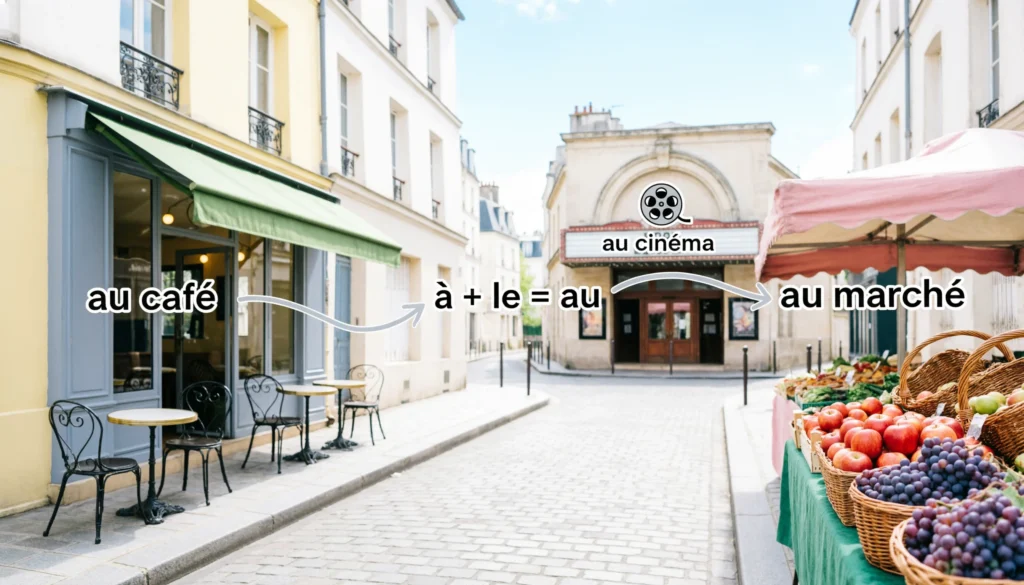
“Au” in French is a contraction of “à + le,” which means “to the” or “at the” when referring to masculine singular nouns.
If you’re learning French, you’ve probably seen “au” everywhere on signs, in conversations, and in textbooks. At first glance, it might seem like just another tiny word. But in reality, “au” is a core building block of French grammar.
Think of it like glue it connects places, actions, and meanings smoothly. Without it, your sentences would feel incomplete or awkward.
Whether you’re traveling, studying, or just curious about French, understanding “au” will help you speak more confidently and naturally.
👉 Example:
- Je vais au marché = “I am going to the market”
This small but powerful word is essential in everyday French, and once you understand it, your sentences will instantly sound more natural.
Origin of “Au” in French
“Au” comes from combining two simple French words:
- à = to / at
- le = the (masculine singular)
👉 When these two words come together, French grammar requires contraction:
| Original Words | Contraction | Meaning |
|---|---|---|
| à + le | au | to the / at the |
Why does this happen?
French avoids awkward pronunciation. Saying “à le” sounds clunky, so it becomes smoother as “au.”
When to Use “Au” in French
You use “au” when referring to masculine singular nouns with “à.”
Common Situations:
1. Talking About Going Places
- Je vais au cinéma → I go to the cinema 🎬
- Il va au bureau → He goes to the office
2. Talking About Being Somewhere
- Je suis au restaurant → I am at the restaurant 🍽️
3. Talking About Activities or Locations
- Elle joue au football → She plays football ⚽
- Nous sommes au parc → We are at the park 🌳
Simple Formula to Remember
👉 au = à + le (masculine singular)
If the noun is masculine and you want to say “to the” or “at the,” use au.
Examples of “Au” in Real-Life Context
Here are some easy examples with tone and context:
Friendly Tone 😊
- On va au café ? → Want to go to the café?
- Je suis au parc avec mes amis → I’m at the park with my friends
Neutral Tone 😐
- Il travaille au bureau → He works at the office
- Elle va au magasin → She goes to the store
Slightly Formal / Professional Tone 💼
- Je suis actuellement au bureau → I am currently at the office
- Veuillez vous présenter au comptoir → Please report to the counter
“Au” vs Similar French Words
French has several similar contractions, so it’s important to understand the differences.
Comparison Table
| Term | Full Form | Used With | Meaning | Example |
|---|---|---|---|---|
| au | à + le | Masculine singular | to the / at the | au marché |
| à la | — | Feminine singular | to the / at the | à la plage |
| à l’ | — | Vowel-start nouns | to the / at the | à l’école |
| aux | à + les | Plural nouns | to the / at the | aux enfants |
Quick Tip 💡
- Masculine → au
- Feminine → à la
- Plural → aux
Common Mistakes to Avoid
❌ Saying “à le”
- Incorrect: Je vais à le parc
- ✅ Correct: Je vais au parc
❌ Using “au” with feminine nouns
- Incorrect: au plage
- ✅ Correct: à la plage
❌ Forgetting contractions
French grammar requires these contractions skipping them makes your sentence sound unnatural.
Alternate Meanings of “Au”
While “au” mostly means “to the” or “at the,” it can appear in other contexts:
1. In Nationalities (Countries)
- Je vais au Canada → I go to Canada 🇨🇦
Used with masculine countries.
2. In Expressions
- au revoir → goodbye 👋
- au contraire → on the contrary
3. In Measurements or Rates
- 10 euros au kilo → 10 euros per kilo
Polite or Professional Alternatives
Sometimes, depending on context, you may want more polished expressions:
| Casual Phrase | Professional Alternative |
|---|---|
| Je vais au bureau | Je me rends au bureau |
| On va au café ? | Souhaitez-vous aller au café ? |
| Je suis au magasin | Je me trouve au magasin |
Practical Usage Tips
✔ Learn Gender First
Always know if a noun is masculine or feminine before using “au.”
✔ Listen to Native Speech
You’ll hear “au” constantly in real conversations this helps reinforce usage.
✔ Practice With Places
Start with common locations:
- au marché
- au parc
- au restaurant
✔ Think in Phrases
Instead of translating word-by-word, memorize chunks like:
- aller au (to go to)
- être au (to be at)
Example Table: “Au” in Everyday Sentences
| French Sentence | English Translation | Context |
|---|---|---|
| Je vais au marché | I go to the market | Daily life |
| Il est au travail | He is at work | Neutral |
| Nous allons au cinéma | We go to the cinema | Friendly |
| Elle reste au bureau | She stays at the office | Professional |
| Ils jouent au parc | They play at the park | Casual |
FAQs:
1. What does “au” literally mean in French?
“Au” literally means “to the” or “at the” and comes from the contraction à + le.
2. When should I use “au” instead of “à la”?
Use “au” for masculine nouns and “à la” for feminine nouns.
3. Is “au” formal or informal?
“Au” is neutral it works in both formal and informal situations.
4. Can “au” be used with countries?
Yes, it is used with masculine countries, such as:
- au Canada
- au Japon
5. What is the difference between “au” and “aux”?
- au = singular masculine
- aux = plural nouns
6. Why can’t we say “à le”?
French grammar requires contraction, so “à le” becomes “au.”
7. Is “au” used in spoken French?
Yes very commonly. It’s one of the most frequently used words in everyday conversation.
8. What is an easy way to remember “au”?
Think:
👉 Masculine noun + “to the” = au
Conclusion:
“Au” might be small, but it’s a must-know word in French. Once you understand it, your sentences become smoother and more natural.
“Au” is a small but essential part of French that helps you speak more naturally and correctly. It simply means “to the” or “at the” and is formed by combining à + le. You use it with masculine singular nouns, especially when talking about places, activities, or locations.
To master it quickly, remember this simple rule: 👉 Masculine noun + “to the” = au
Discover More Related Articles:
- “Sustain” Mean in a Court of Law: Sustain vs Overrule in 2026
- Rhythm Mean in Music: From Classical to Modern Songs in 2026

Ryan Thompson is an experienced content writer specializing in slang terms, texting abbreviations, and word meanings. He writes for meanvoro.com, where he creates accurate and easy-to-understand language content for readers.