
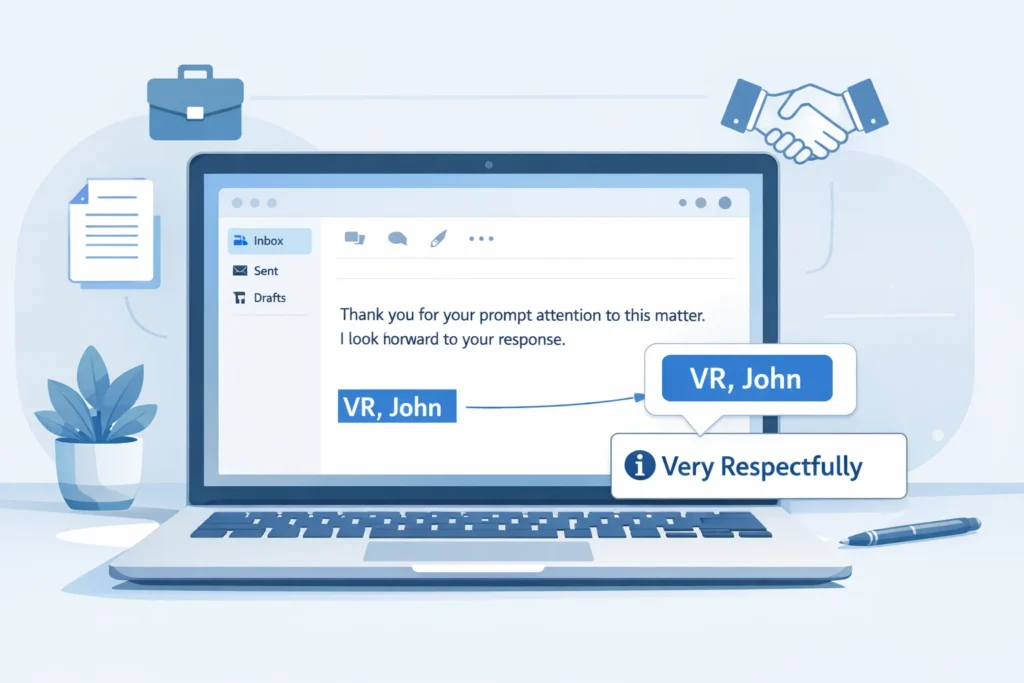
Definition:
“VR” in email stands for “Very Respectfully.”
It is a formal sign-off used at the end of an email to convey politeness, respect, and professionalism commonly used in military, government, and highly formal business communication.
Have you ever received an email that ended with “VR” and wondered what it meant?
At first glance, it looks like a simple two-letter abbreviation. Yet in professional communication, those two letters can carry a specific meaning and tone. While many people recognize common email sign-offs like “Best Regards” or “Sincerely,” “VR” often leaves recipients guessing.
The truth is, “VR” is widely used in certain professional and military environments, but it isn’t always appropriate for every situation. Using it without understanding the context can make your message seem overly formal, impersonal, or even confusing.
In this guide, we’ll explore what “VR” means in email, where it originated, when you should use it, and when it’s better to choose a different sign-off. We’ll also look at real-world examples and modern alternatives to help you communicate with confidence.
What Does V/R Meaning in Text?
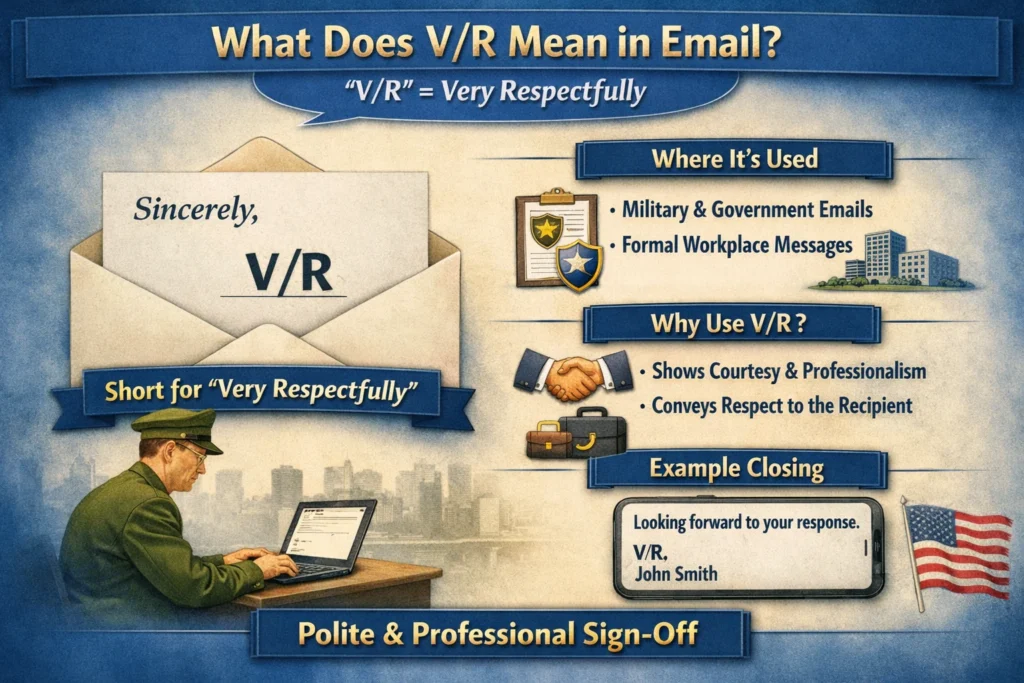
What does v/r mean in email is a short abbreviation that stands for “Very Respectfully.” It is commonly used in professional emails, military communication, and formal messages as a polite way to end a conversation or sign off a message.
People often use V/R to show courtesy, professionalism, and respect, especially in workplace or official communication.
Origin of “VR” in Email
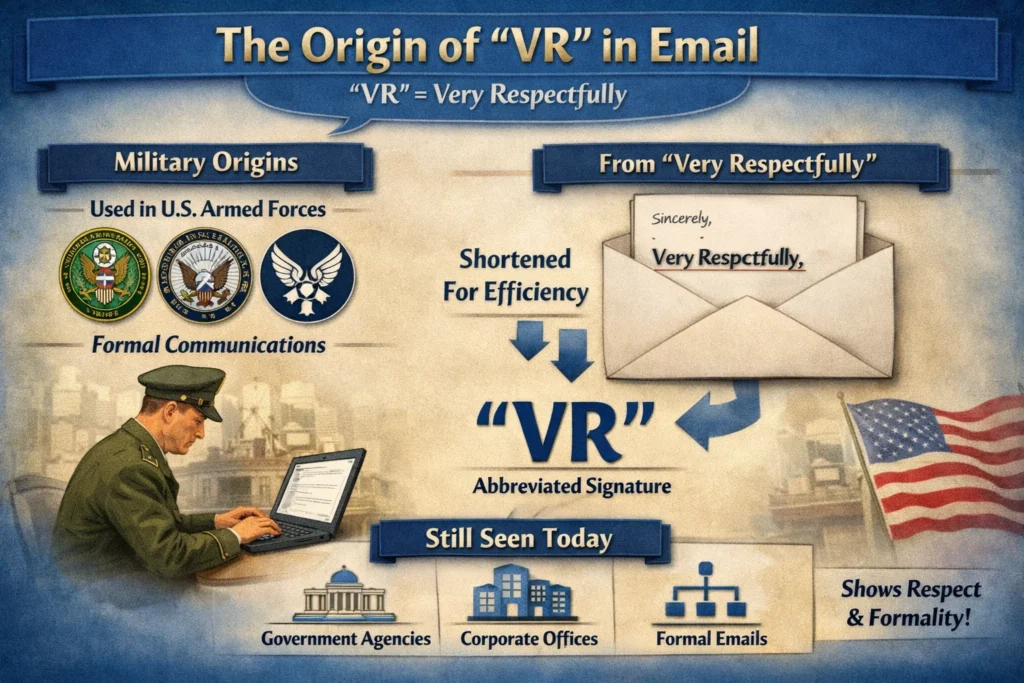
The abbreviation “VR” (Very Respectfully) originates from military communication traditions.
Where It Comes From:
- Used heavily in U.S. military emails
- Often seen in:
- Army, Navy, Air Force correspondence
- Government agencies
- Formal hierarchical communication
Why It Became Popular:
- Military communication emphasizes rank, respect, and clarity
- “Very Respectfully” became a standard closing to show deference to authority
- Over time, it was shortened to “VR” for efficiency
Modern Adoption:
Today, you might see “VR” used in:
- Government offices
- Corporate environments (especially traditional industries)
- Emails involving formal hierarchy
👉 However, it’s not commonly used in casual or modern business settings
What Does V/R Mean in Email?
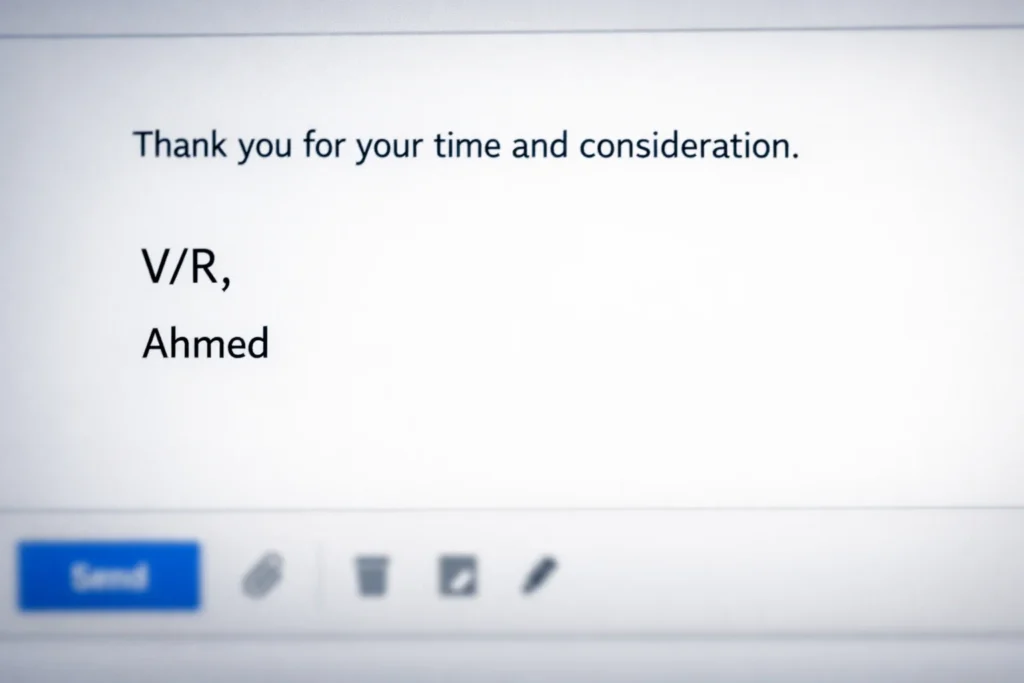
V/R is a professional email abbreviation that stands for “Very Respectfully” or “Very Respectfully Yours.” It is commonly used as a formal closing in emails, especially in military, government, and professional communication.
Where Is V/R Commonly Used?
V/R is often seen in:
- Military emails
- Government communication
- Formal workplace emails
- Professional business conversations
It is usually placed before the sender’s name at the end of an email.
Example of V/R in an Email
- V/R,
John Smith - Thanks for your help.
V/R,
Sarah
Tone of V/R in Emails
The tone of V/R is:
- Respectful
- Professional
- Formal
- Polite
It shows courtesy and professionalism in written communication.
Is V/R Still Used Today?
Yes, V/R is still commonly used in formal environments, especially in the military and government sectors. However, in casual workplaces, people may prefer simpler closings like:
- Best
- Regards
- Thanks
- Sincerely
V/R vs Regards
| Term | Meaning | Tone |
|---|---|---|
| V/R | Very Respectfully | Very formal |
| Regards | Respectful greeting | Professional but less formal |
| Best | Friendly closing | Casual-professional |
Should You Use V/R in Every Email?
Not always. V/R works best in formal or professional situations. In casual conversations or friendly emails, it may sound too formal.
What Does “V/R” Mean in an Email Sign-Off?
“v/r email sign off” is a professional email sign-off that stands for “Very Respectfully.” It is commonly used in military, government, and formal workplace communication to show politeness and respect at the end of an email.
People often use “V/R” when communicating with:
- Senior officers or managers
- Government officials
- Professional colleagues
- Clients in formal settings
Example:
- V/R,
John Smith
How “VR” Is Used in Emails
“VR” is typically placed at the end of an email, just before your name.
Basic Format:
Thank you for your time and consideration.VR,
[Your Name]
Tone:
- Highly formal
- Respectful
- Slightly traditional or rigid
Real-Life Examples of “VR” in Emails
1. Formal Professional Email (Appropriate Use)
Tone: Respectful & Professional
Dear Sir,I have completed the requested report and attached it for your review.VR,
Ahmed Khan
✔ Suitable for:
- Senior officials
- Formal workplace environments
- Government or military settings
2. Neutral Workplace Email (Borderline Use)
Tone: Polite but Slightly Over-Formal
Hi Manager,Please find the updated document attached.VR,
Sara
⚠️ Might feel:
- Too formal for modern teams
- Slightly outdated in casual workplaces
3. Casual Email (Not Recommended)
Tone: Awkward or Mismatched
Hey,See you at lunch 😄VR,
Ali
❌ Problem:
- “VR” clashes with casual tone
- Feels unnatural
4. Hierarchical Communication (Best Use Case)
Tone: Respectful & Appropriate
Respected Sir,I request approval for the leave application submitted earlier.VR,
Muhammad Usman
✔ Ideal in:
- Strict organizational structures
- Formal approval processes
Tone Breakdown: What “VR” Communicates
| Tone Element | Meaning |
|---|---|
| Formality | Very high |
| Respect | Strong emphasis |
| Friendliness | Low |
| Modern Relevance | Moderate to low |
| Emotional Warmth | Minimal |
👉 In simple terms:
“VR” = Respectful but not warm or friendly
When Should You Use “VR” in Email?
✅ Use “VR” When:
- Writing to senior officials
- Communicating in government or military contexts
- Sending formal requests or reports
- Following an established organizational style
❌ Avoid “VR” When:
- Writing casual emails
- Messaging coworkers or peers
- Communicating in startups or modern workplaces
- Trying to sound friendly or approachable
Comparison: “VR” vs Other Email Sign-Offs
Choosing the right closing can change how your email feels.
Comparison Table
| Sign-Off | Meaning | Tone Level | Best Use Case |
|---|---|---|---|
| VR | Very Respectfully | Very Formal | Military, government |
| Regards | Standard closing | Neutral | General professional emails |
| Best regards | Polite & friendly | Balanced | Most business communication |
| Kind regards | Warm & respectful | Slightly friendly | Client communication |
| Sincerely | Formal | Traditional | Formal letters |
| Thanks | Appreciative | Casual | Informal workplace emails |
| Best | Short & modern | Casual-professional | Emails with colleagues |
“VR” vs “V/R” – What’s the Difference?
You might also see “V/R” instead of “VR”.
Explanation:
- VR = Very Respectfully
- V/R = Same meaning, just stylized differently
👉 “V/R” is more common in military emails, while “VR” is a simplified version.
Polite & Professional Alternatives to “VR”
If “VR” feels too stiff, here are better modern options:
Professional Alternatives:
- Best regards
- Kind regards
- Sincerely
- Respectfully
Friendly Professional Options:
- Best
- Thanks
- Warm regards
Example Replacement:
Instead of:
VR,
John
Use:
Best regards,
John
✔ More natural
✔ Widely accepted
✔ Works in most situations
Alternate Meanings of “VR”
While “VR” in emails means “Very Respectfully,” it can have other meanings depending on context:
| Context | Meaning |
|---|---|
| Technology | Virtual Reality |
| Gaming | VR headset experience |
| Medical | Ventricular Rate |
| Finance | Variable Rate |
👉 Always check context before assuming meaning!
Common Mistakes When Using “VR”
1. Using It in Casual Emails
Makes your message feel robotic or awkward
2. Overusing It
Can make communication feel too rigid
3. Mixing Tone
Example:
Hey bro 😂VR,
👉 Doesn’t match tone at all
4. Using It Without Understanding Context
Especially outside formal environments
Tips for Using Email Sign-Offs Effectively
- Match your sign-off to your relationship with the recipient
- Consider the industry and company culture
- Keep tone consistent throughout the email
- When unsure, use “Best regards” (safe option)
FAQs:
1. What does VR stand for in email?
It stands for Very Respectfully, a formal email closing used to show respect.
2. Is VR appropriate in business emails?
Yes but mainly in formal or traditional environments. It may feel outdated in modern workplaces.
3. What is the difference between VR and regards?
- VR = very formal
- Regards = neutral and widely accepted
4. Is VR used in casual emails?
No. It’s too formal and can feel awkward in casual conversations.
5. What does V/R mean in email?
It has the same meaning as VR just written in a different style.
6. Is VR outdated?
In many modern workplaces, yes. It’s less common outside formal settings.
7. What is a better alternative to VR?
Best regards or Kind regards are more versatile and widely used.
8. Can I use VR with coworkers?
Only if your workplace is highly formal. Otherwise, use simpler closings like “Best” or “Thanks.”
Conclusion:
“VR” (Very Respectfully) is a formal email sign-off that communicates strong respect and professionalism, especially in traditional, military, or government-style communication.
While it still has its place, it can feel too stiff or outdated in many modern workplaces. For most everyday emails, simpler alternatives like “Best regards,” “Kind regards,” or “Thanks” are more natural and widely accepted.
Bottom line: Use “VR” only when the situation truly calls for a high level of formality—otherwise, stick to more flexible and modern sign-offs.
Discover More Related Articles:
- What Does It Mean | Understanding Common Words & Phrases In 2026
- The Green Dot Mean on Snapchat | Online Status or Activity Indicator In 2026
- What Does SMH Mean | The Internet Slang You See Everywhere In 2026

Madison Taylor is an experienced content writer who focuses on researching and explaining word meanings, slang, and texting terms. She writes for meanvoro.com, creating clear and accurate to help readers understand language easily.