
Definiton:
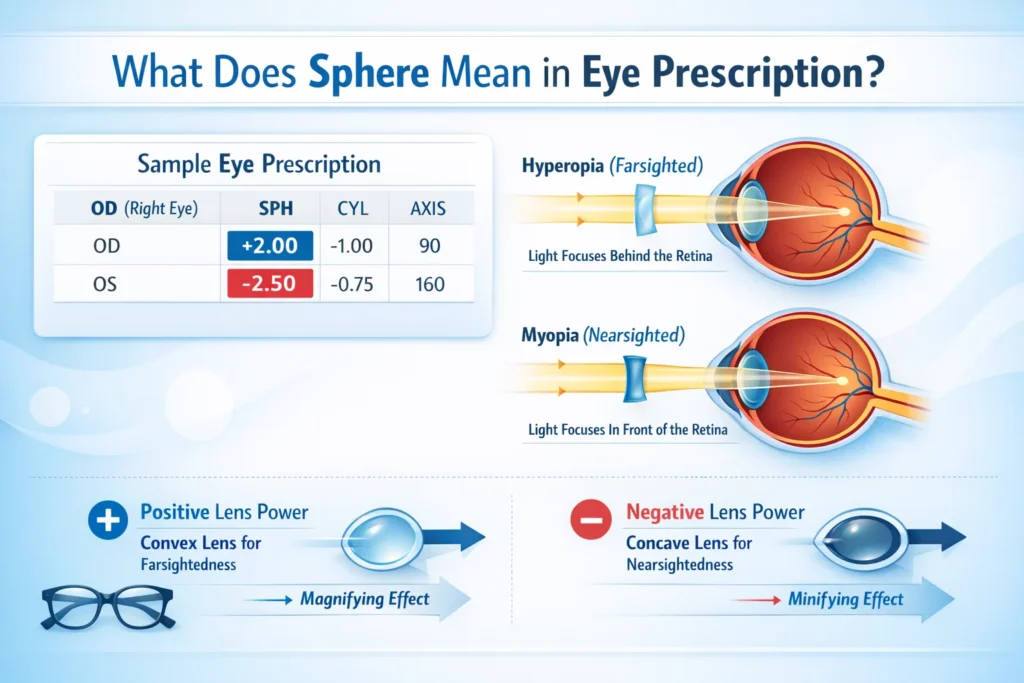
Sphere (SPH) in an eye prescription refers to the lens power needed to correct nearsightedness (myopia) or farsightedness (hyperopia).
It is measured in diopters (D) and is written as a positive (+) or negative (–) number.
Negative number (–) → Corrects nearsightedness
Positive number (+) → Corrects farsightedness
Have you ever looked at your eyeglass prescription and wondered what all those numbers and abbreviations mean? If you’ve seen “SPH” or “Sphere” on your eye prescription, you’re not alone this is one of the most common terms people find confusing.
Understanding this small abbreviation can actually tell you a lot about your vision. It explains whether you are nearsighted or farsighted and how strong your corrective lenses need to be.
In this complete guide, we’ll break down what sphere means in an eye prescription, how it works, why it matters, and how it compares to other prescription terms like cylinder and axis. By the end, you’ll be able to read your prescription with confidence.
For example:
| SPH Value | Meaning |
|---|---|
| -2.00 | Mild nearsightedness |
| -4.50 | Moderate nearsightedness |
| +1.25 | Mild farsightedness |
| +3.00 | Moderate farsightedness |
Understanding the Sphere in an Eye Prescription
The sphere value is the main number in most glasses prescriptions. It tells the optician how much lens power is required to focus light correctly onto the retina.
In simple terms:
- If the number is higher, your vision correction is stronger.
- If the number is lower, the correction is milder.
Eye doctors determine this value during a refraction test, when you look through different lenses and answer the classic question:
“Which is clearer, lens 1 or lens 2?”
The final number they choose becomes the SPH value in your prescription.
Origin and Background of the Term “Sphere”
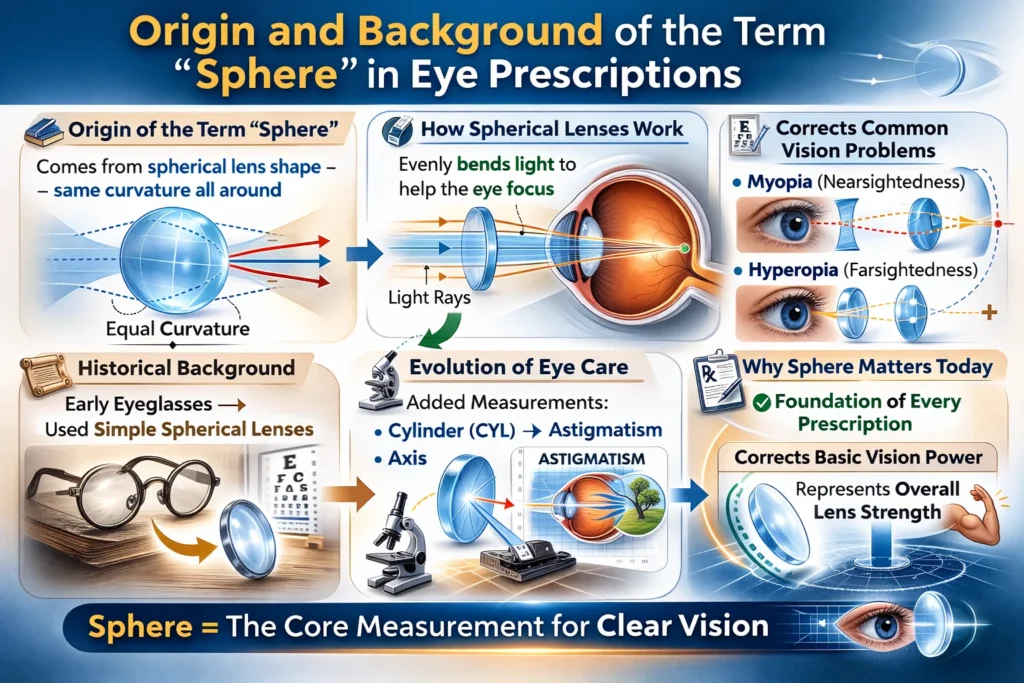
The word sphere comes from the concept of a spherical lens shape.
In optics, a spherical lens has the same curvature across its entire surface. This type of lens corrects general vision issues like:
- Myopia (nearsightedness)
- Hyperopia (farsightedness)
Historically, early eyeglasses used simple spherical lenses to correct vision. As eye science developed, additional measurements like cylinder (CYL) and axis were introduced to treat more complex conditions like astigmatism.
However, sphere remains the foundational measurement in nearly every prescription.
How the Sphere Value Is Measured
The sphere value is measured in diopters (D).
A diopter is the unit used to measure the focusing power of a lens.
What the numbers mean
| Sphere Value | Vision Condition | Explanation |
|---|---|---|
| 0.00 | Normal vision | No correction needed |
| -0.50 to -3.00 | Mild myopia | Slight difficulty seeing far objects |
| -3.25 to -6.00 | Moderate myopia | Clear near vision but blurry distance |
| -6.00 or more | Severe myopia | Strong correction required |
| +0.25 to +2.00 | Mild hyperopia | Slight difficulty focusing close |
| +2.25 to +5.00 | Moderate hyperopia | Reading may be harder |
| +5.00 or more | Strong hyperopia | Significant focusing issues |
What Does a Negative Sphere Mean?
A negative SPH number (–) indicates myopia, also known as nearsightedness.
People with myopia:
- Can see close objects clearly
- Have difficulty seeing distant objects
Example prescription
| Eye | SPH |
|---|---|
| Right (OD) | -2.50 |
| Left (OS) | -2.00 |
This means both eyes need minus lenses to correct distance vision.
Real-life example
A person with -2.50 SPH may struggle to read:
- Road signs
- Classroom boards
- TV subtitles
But they might still read a book comfortably without glasses.
What Does a Positive Sphere Mean?
A positive SPH number (+) indicates hyperopia, also called farsightedness.
People with hyperopia:
- See far objects more easily
- Struggle with close-up tasks
Example prescription
| Eye | SPH |
|---|---|
| Right (OD) | +1.75 |
| Left (OS) | +1.50 |
These lenses help bring near objects into clearer focus.
Real-life example
Someone with +1.75 SPH may experience difficulty with:
- Reading small text
- Using a smartphone
- Sewing or detailed work
Understanding “Plano” in Sphere
Sometimes a prescription shows PL or Plano in the sphere column.
Plano means zero correction is required.
Example:
| Eye | SPH |
|---|---|
| Right | Plano |
| Left | -1.50 |
This means:
- One eye has normal spherical vision
- The other eye needs correction.
Sphere vs Other Prescription Terms
Your prescription usually includes more than just SPH. Here’s how it compares to other common terms.
| Term | Meaning | Purpose |
|---|---|---|
| SPH (Sphere) | Lens power | Corrects myopia or hyperopia |
| CYL (Cylinder) | Astigmatism strength | Corrects uneven cornea shape |
| Axis | Direction of astigmatism | Lens orientation |
| Add | Reading power | For bifocal or progressive lenses |
| PD | Pupillary distance | Lens alignment |
Simple way to think about it
- Sphere → basic vision correction
- Cylinder + Axis → astigmatism correction
- Add → extra reading support
Example Eye Prescription Explained
Here’s what a typical prescription might look like.
| Eye | SPH | CYL | Axis |
|---|---|---|---|
| Right (OD) | -2.25 | -0.75 | 180 |
| Left (OS) | -2.00 | -0.50 | 170 |
Explanation:
- Sphere corrects nearsightedness
- Cylinder and axis correct astigmatism.
Real-World Usage of Sphere in Eye Care
Optometrists and opticians use the sphere value when designing corrective lenses.
It affects:
- Eyeglasses
- Contact lenses
- Laser eye surgery planning
Situations where SPH matters
- Ordering glasses online
- Buying contact lenses
- Checking prescription changes
- Understanding vision problems
Without the correct sphere value, your lenses won’t focus light properly.
How Sphere Changes Over Time
Your sphere number may change throughout life.
Common reasons include:
1. Age
Children often develop myopia during school years.
2. Eye strain
Long screen time can contribute to vision changes.
3. Natural aging
Adults over 40 may develop presbyopia, requiring reading support.
4. Genetics
Family history can influence your vision.
Regular eye exams help monitor these changes.
Common Misconceptions About Sphere
Myth 1: A higher number means worse eyesight
Not always. It simply means stronger correction is required.
Myth 2: Sphere and astigmatism are the same
They are different measurements.
Myth 3: Sphere never changes
Vision often changes gradually over time.
Tips for Reading Your Eye Prescription
When looking at your prescription:
✔ Check the SPH column first
✔ Look for plus (+) or minus (–) signs
✔ Compare values between both eyes
✔ Notice if CYL or Axis are included
If the numbers differ between eyes, that’s normal.
Alternate Meanings of “Sphere”
Although this article focuses on eye prescriptions, the word sphere has other meanings.
| Context | Meaning |
|---|---|
| Geometry | A perfectly round 3D shape |
| Social context | Area of influence |
| Astronomy | Celestial body |
However, in optometry, sphere specifically refers to lens power.
Professional or Polite Alternatives
In clinical discussions, doctors may use slightly different terminology:
| Term | Meaning |
|---|---|
| Spherical power | Same as SPH |
| Lens power | General term |
| Refractive correction | Overall vision correction |
All refer to the same concept of correcting light focus in the eye.
FAQs:
1. What does SPH mean in an eye prescription?
SPH stands for sphere, which indicates the lens power needed to correct common vision problems like nearsightedness or farsightedness. It is measured in diopters and appears as a positive (+) or negative (–) number on your prescription.
2. Is a higher sphere number worse?
Not necessarily. A higher sphere number simply means stronger vision correction is required. It does not always mean that your eye health is worse.
3. What does a negative sphere mean?
A negative sphere value indicates nearsightedness (myopia). People with myopia can usually see nearby objects clearly but may struggle to see things that are far away.
4. What does a positive sphere mean?
A positive sphere value indicates farsightedness (hyperopia). This means distant objects may appear clearer, while close-up tasks like reading can be more difficult.
5. What does 0.00 sphere mean?
A sphere value of 0.00 means that no spherical correction is needed for that eye. Your basic distance vision may be normal in terms of spherical power.
6. Can sphere change over time?
Yes, the sphere value in your prescription can change over time. Factors like aging, genetics, screen use, and overall eye health can affect your vision and require updated lens power.
7. Is sphere the same as astigmatism?
No, sphere and astigmatism are different measurements. Sphere corrects nearsightedness or farsightedness, while astigmatism is corrected using the cylinder (CYL) and axis values in a prescription.
8. Do contact lenses use the same sphere value?
Contact lenses often use a similar sphere value, but the prescription may not be exactly the same as glasses. Eye doctors adjust contact lens prescriptions to fit the shape and position of the lens on the eye.
Conclusion
Understanding what sphere means in an eye prescription makes it much easier to interpret your vision test results.
To recap:
- Sphere (SPH) measures the lens power needed to correct basic vision problems.
- Negative values correct nearsightedness.
- Positive values correct farsightedness.
- The number is measured in diopters, which determine how strong your lenses must be.
While other measurements like cylinder and axis help correct astigmatism, the sphere value remains the core part of nearly every glasses prescription.
If you’re unsure about your prescription, the best step is to ask your optometrist to explain each number. Understanding these details helps you make better decisions when buying glasses or contact lenses.
Discover More Related Articles:

Madison Taylor is an experienced content writer who focuses on researching and explaining word meanings, slang, and texting terms. She writes for meanvoro.com, creating clear and accurate to help readers understand language easily.