
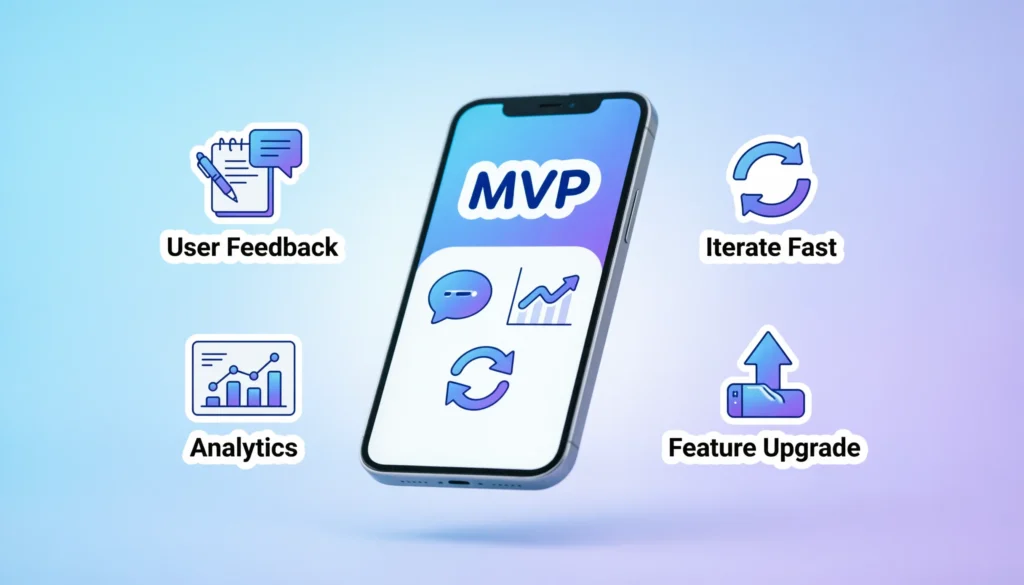
Definition
MVP in software development stands for “Minimum Viable Product.”
It refers to the simplest version of a product that includes only the essential features needed to solve a core problem for early users while allowing developers to collect feedback and improve the product.
If you’ve ever read about startups, product launches, or agile development, you’ve probably seen the term MVP. It appears in conversations about launching apps quickly, validating ideas, and building successful tech products.
But what does MVP mean in software development, and why do startups, developers, and product managers rely on it so much?
In simple terms, MVP is about building the smallest possible version of a product that still delivers value to users. Instead of spending months or years developing a complex system, teams release a basic version first, gather feedback, and improve it over time.
This approach has helped companies like Airbnb, Dropbox, and Facebook validate ideas quickly and grow efficiently.
Let’s break down exactly what MVP means, where it came from, how it’s used in software development, and why it’s one of the most important concepts in modern product development.
The goal of an MVP is to test an idea quickly, reduce development risk, and learn from real user behavior before building a full-featured product.
What Is an MVP in Software Development?
An MVP (Minimum Viable Product) is a product version with just enough functionality to be usable and valuable to early adopters.
Instead of launching a fully polished product with dozens of features, teams release a basic but functional version that focuses on the core value.
Key characteristics of an MVP
An MVP usually includes:
- The core problem-solving feature
- A simple user interface
- Enough functionality for real users to test
- A system for collecting feedback
It intentionally excludes extra features that are not essential for the initial launch.
Example
Imagine a team building a food delivery app.
A full product might include:
- Restaurant listings
- Payment integration
- Delivery tracking
- Reviews and ratings
- Coupons
- Loyalty programs
But an MVP might only include:
- Restaurant list
- Order placement
- Basic payment
That’s enough to test if users actually want the service.
The Origin of the MVP Concept
The term Minimum Viable Product became widely known through the Lean Startup methodology, developed by entrepreneur Eric Ries.
In his book The Lean Startup, Ries explains that startups should:
- Build a basic version of the product
- Measure user behavior
- Learn from feedback
- Improve the product
This cycle is often called:
Build → Measure → Learn
The MVP approach allows companies to avoid wasting time and money building features that users may not need.
Why MVP Is So Popular in Software Development
The MVP approach is extremely popular among startups and agile teams because it solves a common problem:
Building too much before validating the idea.
Here are the main reasons developers use MVPs.
1. Faster Product Launch
Instead of waiting a year to launch a complete product, teams can release an MVP in weeks or months.
2. Lower Development Costs
Building fewer features means less time, fewer developers, and lower expenses.
3. Real User Feedback
Users provide real-world feedback that helps shape the product.
4. Reduced Risk
If the product fails, companies lose far less money and time.
5. Better Product Decisions
Developers can prioritize features users actually want.
Real-World Examples of MVPs
Many successful tech companies started with simple MVPs.
| Company | Original MVP | What It Looked Like |
|---|---|---|
| Airbnb | Simple website | Listed apartments with photos |
| Dropbox | Demo video | Explained how file syncing works |
| Basic social network | Only for Harvard students | |
| Amazon | Online bookstore | Sold only books |
| Uber | Basic ride-hailing | Available in one city |
These MVPs focused on one core value proposition.
After proving demand, the companies expanded their products.
Key Features of a Good MVP
Not every simple product is an MVP. A successful MVP includes several important qualities.
1. Solves a Core Problem
The MVP must solve one clear problem.
2. Provides Immediate Value
Users should feel that the product is useful even in its basic form.
3. Allows Learning
The product must allow teams to collect user insights.
4. Simple but Functional
It should work reliably even if it lacks advanced features.
MVP vs Prototype vs Beta
People often confuse MVP with other product development terms.
Here’s how they differ.
| Term | Purpose | Audience | Functionality |
|---|---|---|---|
| Prototype | Test design concepts | Internal teams | Often incomplete |
| MVP | Validate product idea | Real users | Core features only |
| Beta Version | Test near-finished product | Selected users | Almost full features |
Simple explanation
- Prototype → concept demonstration
- MVP → first real product version
- Beta → almost finished product
How MVP Is Used in Agile Development
Agile development focuses on small iterations and continuous improvement, which aligns perfectly with MVP strategies.
Typical MVP workflow:
- Identify the core problem
- Define the smallest feature set
- Build the MVP
- Release to early adopters
- Collect feedback
- Improve through iterations
This approach ensures the product evolves based on real user needs rather than assumptions.
Example Scenarios of MVP Usage
Below are some typical situations where teams use an MVP approach.
| Scenario | MVP Strategy | Result |
|---|---|---|
| Startup idea validation | Launch basic version | Test demand |
| Mobile app development | Release core feature first | Gather feedback |
| SaaS product launch | Offer limited features | Improve gradually |
| New marketplace | Test with small audience | Validate business model |
How Teams Decide What Goes Into an MVP
Choosing the right features is critical.
Product teams often use feature prioritization frameworks such as:
MoSCoW Method
Features are categorized into:
- Must-have
- Should-have
- Could-have
- Won’t-have (for now)
Only Must-have features go into the MVP.
User Story Mapping
Teams identify the minimum user journey needed to deliver value.
Common Misconceptions About MVP
Many people misunderstand what an MVP actually is.
Myth 1: MVP Means a Low-Quality Product
Reality:
An MVP should be simple but high quality.
Myth 2: MVP Means Launching Too Early
Reality:
It means launching when the product can deliver value, even if it’s basic.
Myth 3: MVP Is Only for Startups
Reality:
Large companies also use MVPs to test new products.
Alternate Meanings of MVP
Although MVP usually means Minimum Viable Product in software development, the abbreviation can have other meanings depending on context.
| Field | Meaning |
|---|---|
| Sports | Most Valuable Player |
| Business | Minimum Viable Product |
| Gaming | Most Valuable Player |
| Microsoft ecosystem | Most Valuable Professional |
Understanding the context helps determine the correct meaning.
Professional Alternatives to the Term MVP
In professional discussions, teams sometimes use related phrases.
Common alternatives include:
- Initial product version
- Core product release
- Early product iteration
- Pilot version
- First product launch
However, MVP remains the most widely used term in startups and tech companies.
Practical Tips for Building a Successful MVP
If you’re planning to develop a product, these tips can help.
Focus on the core problem
Ask yourself:
What is the one problem this product must solve?
Avoid feature overload
Extra features can delay launch and increase costs.
Collect user feedback early
Use surveys, analytics, and user interviews.
Iterate quickly
The real power of MVP lies in continuous improvement.
FAQs:
1. What does MVP stand for in software development?
MVP stands for Minimum Viable Product, which refers to the simplest version of a software product that includes only the core features necessary to solve a problem for early users while allowing developers to gather feedback.
2. Why is an MVP important in software development?
An MVP helps companies test product ideas quickly, reduce development costs, and understand user needs before building a full-featured product.
3. What features should be included in an MVP?
An MVP should include only the essential features required to deliver the main value of the product. Non-essential features are usually added later after user feedback.
4. Is an MVP the same as a prototype?
No, they are different. A prototype is mainly used to test a concept or design, while an MVP is a working product that real users can interact with.
5. How long does it take to build an MVP?
The development time varies depending on the complexity of the project, but many MVPs are built within a few weeks to a few months.
6. Who typically uses the MVP approach?
Startups, software developers, product managers, and even large tech companies use MVP strategies to test ideas and launch products efficiently.
7. What happens after launching an MVP?
After launch, teams collect user feedback, analyze usage data, fix issues, and gradually add new features through updates and iterations.
8. Can an MVP become the final product?
An MVP usually evolves into a full product over time. Developers continuously improve it based on user feedback and market demand.
Conclusion
Understanding what MVP means in software development is essential for anyone involved in modern product creation.
An MVP (Minimum Viable Product) allows companies to launch quickly, validate ideas with real users, and improve products based on actual feedback.
Instead of spending months building complex systems, teams focus on delivering the smallest version that still provides value.
Whether you’re a startup founder, product manager, or developer, adopting an MVP mindset can help you build smarter products and increase your chances of success.
Discover More Related Articles:

Ryan Thompson is an experienced content writer specializing in slang terms, texting abbreviations, and word meanings. He writes for meanvoro.com, where he creates accurate and easy-to-understand language content for readers.