Definition:
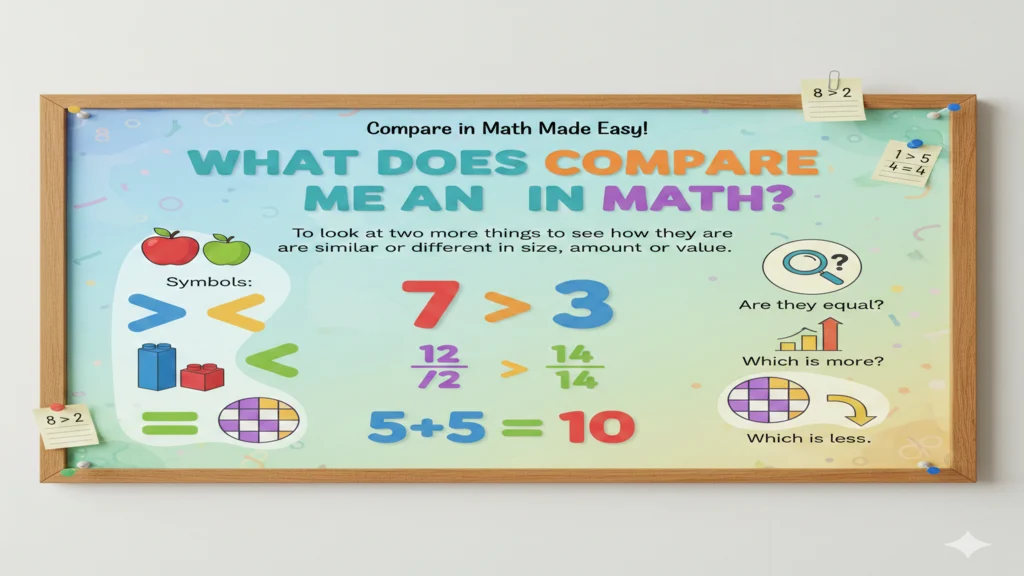
In math, “compare” means to examine two or more numbers, quantities, or objects to determine their relationship, such as which is greater, smaller, or equal.
Comparing numbers is one of the most fundamental skills in mathematics, used from early education through advanced calculations. But understanding what it truly means to compare and how it works in different contexts can make math feel less like a puzzle and more like a toolkit for everyday life.
Whether you’re a student, teacher, or lifelong learner, grasping how to compare numbers and quantities is essential. Let’s break it down step by step.
Origin of the Term “Compare” in Math
The word “compare” comes from the Latin comparare, meaning “to pair together” or “to match.” In math, it has been used historically to describe the process of examining numbers and quantities side by side to identify differences or similarities.
Over time, “compare” became a cornerstone term in mathematics education because it introduces critical thinking: not only do students calculate, but they also evaluate and reason about relationships between numbers.
Why Comparing Matters in Math
Comparing is more than just checking which number is bigger or smaller. It forms the basis for many mathematical operations and problem-solving skills:
- Decision making: Choosing between quantities or options (e.g., budgeting).
- Ordering numbers: From least to greatest or vice versa.
- Understanding inequalities: Using symbols like
<,>, and=to express relationships. - Measurement: Comparing lengths, weights, volumes, or time.
- Data analysis: Identifying patterns in graphs, tables, or datasets.
📌 Pro tip: Even adults use comparison in daily life without realizing it like comparing prices, distances, or ratings before making a choice!
How to Compare in Math
There are several ways to compare numbers and quantities:
1. Using Symbols
| Symbol | Meaning | Example |
|---|---|---|
> | Greater than | 7 > 5 ✅ |
< | Less than | 3 < 8 ✅ |
= | Equal to | 4 = 4 ✅ |
≥ | Greater than or equal to | 6 ≥ 6 ✅ |
≤ | Less than or equal to | 2 ≤ 5 ✅ |
2. Using Words
- “Is greater than” → 10 is greater than 6.
- “Is less than” → 2 is less than 7.
- “Is equal to” → 5 is equal to 5.
3. Using Visuals or Objects
- Number lines: Place numbers on a line to see which is bigger.
- Counters or blocks: Physically counting objects and comparing piles.
- Charts and graphs: Compare data points visually for quick understanding.
Examples of Comparing Numbers
Friendly Examples
- 8 🍎 vs. 5 🍎 → 8 apples are greater than 5 apples.
- 12 km 🚗 vs. 15 km 🚶 → 12 km is less than 15 km.
Neutral Examples
- 20 vs. 20 → 20 is equal to 20.
- 50 students in Class A vs. 45 students in Class B → Class A has more students.
Negative/Dismissive Tone Example
- Comparing 1 cent 💰 to $100 → well… there’s really no competition. 😅
Comparing Fractions, Decimals, and Percentages
Comparing numbers isn’t limited to whole numbers it also applies to fractions, decimals, and percentages:
| Type | Example 1 | Example 2 | Comparison |
|---|---|---|---|
| Fraction | 3/4 | 2/3 | 3/4 > 2/3 |
| Decimal | 0.75 | 0.67 | 0.75 > 0.67 |
| Percentage | 75% | 60% | 75% > 60% |
💡 Tip: Convert fractions to decimals or percentages when comparing across different formats.
Comparison With Related Terms
It’s helpful to differentiate “compare” from similar math concepts:
| Term | Difference from Compare | Example |
|---|---|---|
| Contrast | Focuses on differences | 7 vs. 5 → 7 is larger; 5 is smaller |
| Evaluate | Determines value/result | Evaluate 3 + 4 = 7 |
| Order | Arrange in sequence | 2, 5, 7, 10 from smallest to largest |
| Rank | Assign position based on size | Student scores: 1st, 2nd, 3rd |
Alternate Meanings of Compare
Although “compare” in math usually refers to numbers and quantities, it can have other meanings:
- Literature or writing: To examine similarities and differences in texts or ideas.
- Everyday speech: To liken one thing to another (e.g., “You can’t compare apples to oranges 🍊🍎”).
In math, we stick mostly to the numerical or measurable sense, but understanding the broader usage helps with word problems and real-world contexts.
Polite or Professional Alternatives
Sometimes, you might want to use a more formal or professional tone instead of just saying “compare”:
- Analyze differences – “Let’s analyze the differences between these two datasets.”
- Evaluate – “Evaluate which option has the better outcome.”
- Assess relative sizes – “Assess the relative sizes of these quantities.”
- Examine relationships – “Examine the relationship between the variables.”
Tips for Teaching or Learning How to Compare
- Start small: Begin with whole numbers before moving to fractions and decimals.
- Use visuals: Number lines, blocks, or charts make abstract comparisons concrete.
- Practice daily: Compare prices, distances, or scores in real life.
- Incorporate games: Friendly competitions or interactive apps make learning fun.
- Explain reasoning: Ask students why one number is larger, smaller, or equal.
Common Mistakes to Avoid
- Confusing the symbols
<and> - Forgetting to convert fractions or decimals before comparing
- Relying only on intuition without checking calculations
- Ignoring context in word problems
FAQs:
- What does compare mean in math for kids?
It means looking at numbers or objects to see which is bigger, smaller, or the same. - How do you compare numbers quickly?
Use number lines, place value, or convert fractions/decimals to the same format. - What symbols are used to compare numbers?
>,<,=,≥, and≤are the standard comparison symbols. - Is comparing the same as ordering?
Not exactly. Comparing checks relationships, while ordering arranges numbers in sequence. - Can you compare fractions and decimals together?
Yes! Convert fractions to decimals or percentages first to make comparison easy. - Why is comparing important in math?
It helps with problem-solving, understanding inequalities, and making real-world decisions. - Are there non-numerical ways to compare in math?
Yes, objects, lengths, weights, and visual data can all be compared. - What’s the difference between compare and contrast?
Compare looks at both similarities and differences; contrast focuses only on differences.
onclusion
Comparing in math is more than just checking which number is bigger or smaller it’s a foundational skill that strengthens critical thinking and problem-solving. From whole numbers to fractions, decimals, and percentages, knowing how to compare helps you make sense of data, solve real-world problems, and communicate ideas clearly.
By using symbols, visual tools, and practical examples, anyone can master the art of comparison. Remember to start simple, practice regularly, and always consider context. With these strategies, comparing numbers becomes intuitive, fun, and useful both in the classroom and everyday life.
Discover More Related Articles:
- Biblical Meaning of Defiled: What It Really Means According to Scripture (2026)
- The Meaning of the Rainbow in the Bible : Explained for Christians (2026)

Madison Taylor is an experienced content writer who focuses on researching and explaining word meanings, slang, and texting terms. She writes for meanvoro.com, creating clear and accurate to help readers understand language easily.