Abracadabra does not directly mean anything in modern Hebrew.
However, many scholars believe it may derive from Aramaic or related Semitic roots, possibly meaning “I create as I speak” or “it will be created as it is spoken.”
While often associated with Hebrew mysticism, the word most likely comes from ancient Aramaic rather than biblical Hebrew.
Ever said “abracadabra!” while pretending to pull a rabbit out of a hat? 🎩✨
It sounds playful, mysterious, and a little magical. But here’s the question that sparks real curiosity:
What does abracadabra mean in Hebrew?
Let’s uncover the truth behind this ancient word including whether it’s truly Hebrew, where it came from, and what it originally meant.
The Origin of “Abracadabra”
To understand whether abracadabra is Hebrew, we need to travel back in time.
📜 First Recorded Use
The earliest known written appearance of the word comes from:
- Quintus Serenus Sammonicus (2nd–3rd century CE)
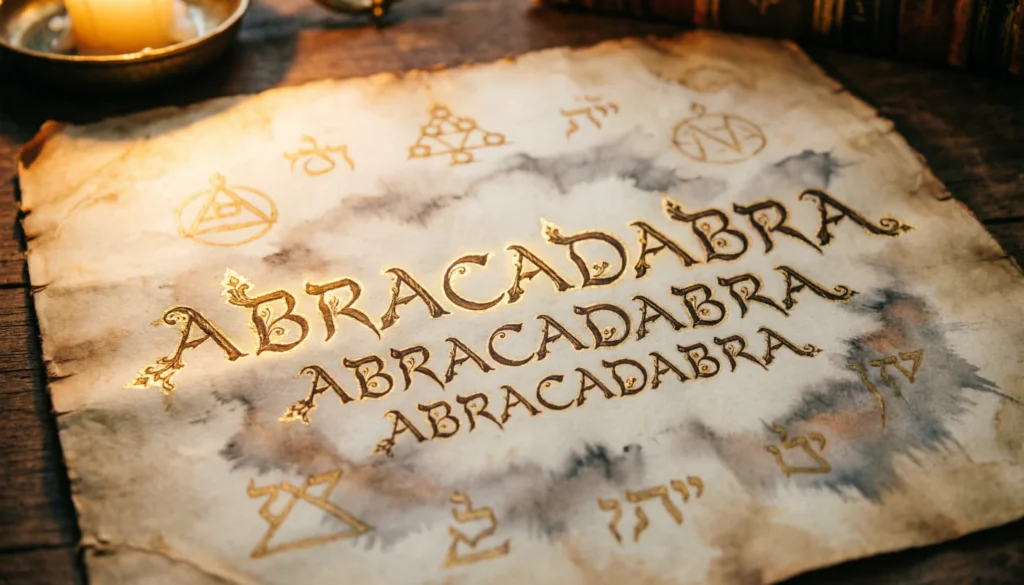
He recommended writing “abracadabra” in a triangular form as a charm to ward off illness, particularly fevers.
Example of how it was written:
ABRACADABRA
ABRACADABR
ABRACADAB
...
A
This was believed to gradually “shrink” the illness away.
Is Abracadabra Actually Hebrew?
Short answer: Not exactly.
There is no direct translation of “abracadabra” in modern Hebrew (עברית).
However, scholars often connect it to Semitic language roots, particularly Aramaic.
The Aramaic Theory
Many linguists suggest it may come from:
“Avra ke-davra” (אברא כדברא)
Which can be interpreted as:
- “I create as I speak”
- “It will be created in my words”
- “I create like the word”
Aramaic was closely related to Hebrew and was widely spoken in the ancient Near East including during the time of Jewish mysticism.
Connection to Jewish Mysticism
Some people associate abracadabra with:
- Kabbalah (Jewish mystical tradition)
- Sacred names of God
- Mystical word power
However:
- The word does not appear in the Hebrew Bible.
- It is not a traditional Jewish prayer or sacred Hebrew phrase.
- It is more likely a magical incantation adopted across cultures.
Still, the idea that words create reality does exist in Jewish thought especially in the concept that God created the world through speech.
For example:
In Genesis, God says “Let there be light,” and light appears.
That philosophy may explain why people connect abracadabra to Hebrew spirituality.
What Does Abracadabra Mean Literally?
Since there’s no formal Hebrew dictionary definition, here are the main interpretations scholars suggest:
| Theory | Language | Meaning |
|---|---|---|
| Avra ke-davra | Aramaic | I create as I speak |
| Abra + cadabra | Possible Hebrew/Aramaic mix | I will create as I speak |
| Magical incantation | Latin usage | Protective charm word |
Most experts agree the “I create as I speak” meaning is the most accepted explanation.
How Did Abracadabra Become Popular?
Originally a medical charm, the word evolved over centuries.
From Healing Charm to Magic Show Catchphrase
- Used in ancient Rome as a protective amulet
- Adopted into medieval magic traditions
- Eventually became associated with stage magicians
Today, when someone says “abracadabra,” it usually means:
- ✨ Something magical is about to happen
- 🎭 A playful trick is being performed
- 😄 A lighthearted joke about “instant results”
Real-World Usage Today
In modern conversation, “abracadabra” is typically:
- Playful
- Theatrical
- Not religious
- Not taken literally
Example Contexts
Friendly / Playful Tone
“I cleaned my room abracadabra! It’s spotless!” ✨
Joking Tone
“You think money appears by abracadabra?” 😅
Sarcastic Tone
“Oh sure, just say abracadabra and fix everything.”
It’s rarely used seriously.
Is Abracadabra Used in Modern Hebrew?
In Israel today, the word “abracadabra” is recognized but only as:
- A borrowed magic word
- Something magicians say
- A children’s fantasy expression
It is not a native Hebrew word with grammatical meaning.
Comparison: Abracadabra vs Other Magical Words
Let’s compare it with similar phrases.
| Phrase | Origin | Meaning | Still Used? |
|---|---|---|---|
| Abracadabra | Aramaic/Latin tradition | I create as I speak (theory) | Yes |
| Alakazam | Likely Arabic influence | Nonsense magical word | Yes |
| Hocus Pocus | Medieval Europe | Possibly parody of Latin mass | Yes |
| Open Sesame | From Arabian Nights | Command to open | Yes |
“Abracadabra” stands out because it likely has Semitic linguistic roots, unlike some others.
Alternate Meanings (If Any)
While mainly associated with magic, abracadabra has also been:
- A band name
- A song title
- A metaphor for illusion or trickery
For example:
- Abracadabra
But in Hebrew language study, it has no alternate formal meaning.
Why Do People Think It’s Hebrew?
Several reasons:
- It sounds similar to Hebrew words.
- It comes from a region where Hebrew was spoken.
- Jewish mysticism emphasizes the power of spoken words.
- The Aramaic phrase resembles Hebrew structure.
But linguistically speaking:
It’s closer to Aramaic than Hebrew.
The Power of Words Concept
Even if abracadabra isn’t Hebrew, the idea behind it connects strongly to biblical themes.
In Hebrew thought:
- Words have creative power.
- Speech can bless or harm.
- God creates through speech.
So while the word itself isn’t Hebrew scripture, the philosophy aligns with ancient Semitic traditions.
Example
| Situation | Meaning | Tone |
|---|---|---|
| Magic show | Performing a trick | Playful |
| Parenting | Pretending to fix something | Silly |
| Sarcasm | Mocking unrealistic expectations | Dismissive |
| Writing | Symbol of illusion | Neutral |
Usage Tips
If you’re using “abracadabra” in writing or conversation:
✔ Use it playfully
✔ Don’t use it in serious religious discussion
✔ Understand it’s symbolic, not literal
✔ Avoid assuming it’s traditional Hebrew
FAQs
1. What does abracadabra mean in Hebrew exactly?
It does not have a direct meaning in modern Hebrew. It is believed to come from Aramaic, meaning “I create as I speak.”
2. Is abracadabra found in the Hebrew Bible?
No, it does not appear in the Hebrew Bible.
3. Is abracadabra a Jewish word?
Not officially. It may have Semitic roots but is not part of formal Jewish liturgy or scripture.
4. What language is abracadabra originally from?
Most scholars believe it comes from Aramaic, later adopted into Latin magical traditions.
5. Does abracadabra mean “I will create as I speak”?
Yes, that is the most widely accepted interpretation of its root phrase.
6. Why did people write abracadabra in a triangle?
Ancient physicians believed shrinking the word symbolically shrank illness.
7. Is abracadabra used in Israel today?
Yes, but only as a magic word in entertainment.
8. Is abracadabra connected to Kabbalah?
There is no direct textual evidence linking it to classical Kabbalistic teachings.
Conclusion
So, what does abracadabra mean in Hebrew?
Technically nothing in modern Hebrew.
But historically, it likely stems from an Aramaic phrase meaning:
“I create as I speak.”
It began as a healing charm, evolved through ancient Rome, and eventually became the world’s most famous magic word.
Today, it’s playful, theatrical, and symbolic not religious or scriptural.
If you’re writing about it, teaching about language roots, or just curious about its origins, remember:
The magic isn’t in the word itself.
It’s in the history behind it. ✨
Discover More Related Articles:
- Lamentation Mean in the Bible: Why It Matters for Christians in 2026
- Adam Mean in the Bible: Symbolism, and Impact in 2026

Madison Taylor is an experienced content writer who focuses on researching and explaining word meanings, slang, and texting terms. She writes for meanvoro.com, creating clear and accurate to help readers understand language easily.