

Definition
VOC in paint stands for Volatile Organic Compounds.
These are carbon-based chemicals that evaporate into the air at room temperature and are released from paint during application and drying, potentially affecting indoor air quality, health, and the environment.
If you have ever opened a can of paint and noticed a strong chemical smell, you have already experienced VOC Paint Meaning in action. The term appears on paint labels, product descriptions, and home-improvement guides, but many people still wonder what it really means and why it matters.
Understanding what VOC means in paint helps you make healthier choices for your home, workplace, and environment.
Whether you are painting a bedroom, office, or nursery, this guide explains everything clearly and practically.
What Are VOCs in Paint?
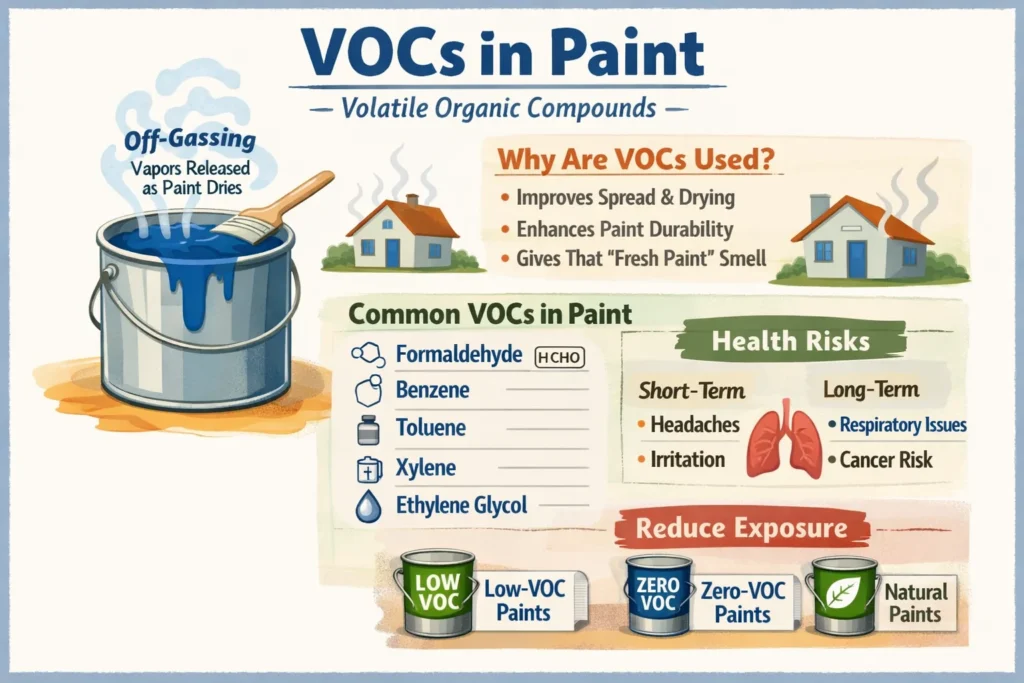
VOCs are chemicals added to paint to improve performance. They help paint spread smoothly, dry evenly, and last longer. However, as paint dries, these compounds escape into the air, a process known as off-gassing.
That familiar “fresh paint smell” is actually VOCs being released into your indoor air.
Common VOCs Found in Paint
Some commonly found VOCs include:
- Formaldehyde
- Benzene
- Toluene
- Xylene
- Ethylene glycol
Not all paints contain the same compounds, and modern formulas are much safer than older ones, but VOC exposure can still be a concern, especially indoors.
Origin and Popularity of the Term VOC
The term VOC comes from chemistry and environmental science. It became widely used in the paint industry during the late 20th century when researchers began studying indoor air pollution more closely.
As people started spending more time indoors, scientists discovered that everyday products such as paint, cleaners, and furniture could significantly affect air quality. Governments and environmental agencies responded by introducing VOC regulations and labeling requirements.
Today, VOC levels are a major selling point for paint brands, especially as consumers look for healthier and more eco-friendly options.
Why VOCs Are Used in Paint
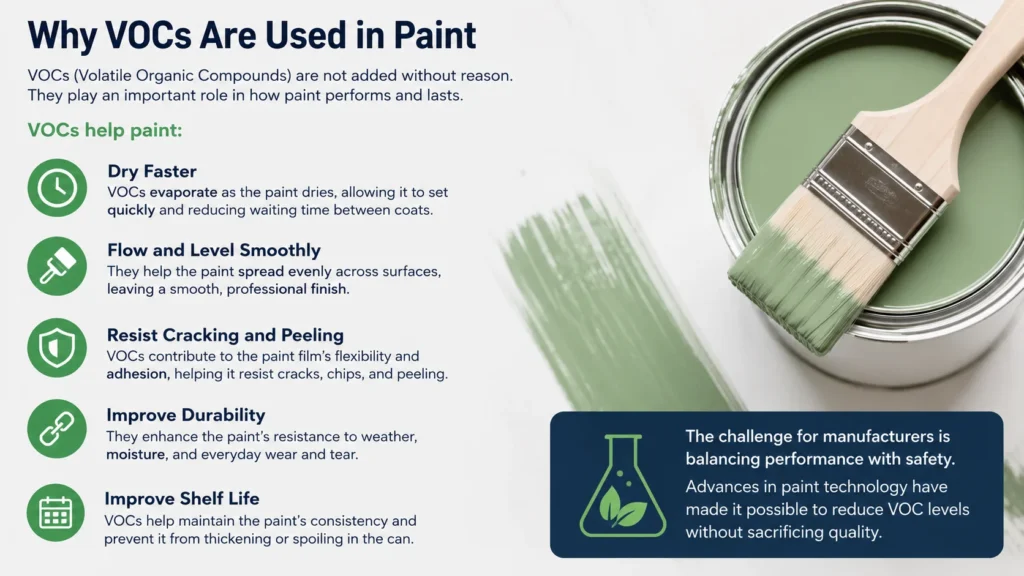
VOCs are not added without reason. They help paint:
- Dry faster
- Flow and level smoothly
- Resist cracking and peeling
- Improve durability and shelf life
The challenge for manufacturers is balancing performance with safety. Advances in paint technology have made it possible to reduce VOC levels without sacrificing quality.
How VOCs Are Released From Paint
VOCs are released at several stages:
- During application, when fumes are strongest
- While the paint is drying, usually over several hours
- After curing, when low-level emissions may continue for days or weeks
This is why good ventilation is important, even when using low-VOC or zero-VOC paints.
VOC Levels Explained
VOC content is measured in grams per liter. Lower numbers mean fewer emissions.
VOC Level Guide
| VOC Category | Typical Range | What It Means |
| High VOC | 250–450 g/L | Strong odor, higher health risk |
| Low VOC | Under 50 g/L | Safer for indoor use |
| Zero VOC | Under 5 g/L | Minimal emissions |
Note that zero-VOC paint is not always completely free of VOCs. Color additives can introduce small amounts, even if the base paint is labeled zero-VOC.
Health Effects of VOCs in Paint
Short-Term Effects
Exposure to high levels of VOCs can cause:
- Headaches
- Eye, nose, or throat irritation
- Dizziness
- Nausea
- Fatigue
These effects are usually temporary and fade once exposure stops.
Long-Term Effects
Long-term or repeated exposure may contribute to:
- Respiratory issues
- Worsening asthma symptoms
- Allergic reactions
- Reduced indoor air quality
Children, older adults, and people with respiratory conditions are more sensitive to VOC exposure.
Environmental Impact of VOCs
VOCs do not only affect indoor spaces. Outdoors, they react with sunlight to form ground-level ozone, a major component of smog.
Environmental concerns include:
- Increased air pollution
- Contribution to climate change
- Harm to plants and ecosystems
This is one reason why many regions regulate VOC levels in paints and coatings.
VOC Regulations and Standards
VOC limits vary by country and region. Many governments set strict caps on VOC content to protect public health.
Common regulatory influences include:
- Environmental protection agencies
- Green building standards
- Indoor air quality guidelines
Paints labeled low-VOC or zero-VOC usually meet or exceed these standards
Examples
Friendly Tone
“I chose a low-VOC paint so my house would not smell strong, and it was much more comfortable to paint.”
Neutral Tone
“This paint contains low VOC levels and meets indoor air quality standards.”
Negative or Dismissive Tone
“That paint is high-VOC. I would not use it in a bedroom because the fumes are too strong.”
VOC vs Related Terms
Many people confuse VOCs with similar concepts. Here is a clear comparison.
Comparison of VOC and Low-VOC Paint
- VOC refers to the chemicals themselves
- Low-VOC means the paint contains fewer of those chemicals
Difference Between VOC and Zero-VOC Paint
- Zero-VOC paints contain extremely low levels
- They may still release trace VOCs from pigments
Comparison of VOC and Odor-Free Paint
- Odor-free does not always mean VOC-free
- Some VOCs are odorless
Difference Between VOC and Eco-Friendly Paint
- Eco-friendly paint may include low VOCs, natural ingredients, or sustainable packaging
- Always check the label for actual VOC content
Alternate Meanings of VOC
Outside the paint industry, VOC can mean different things depending on the context:
- In science: Volatile Organic Compounds in general chemistry
- In business or education: Voice of the Customer
- In technology: Virtual Organization Community
In paint and home improvement, VOC almost always refers to chemical emissions.
Polite and Professional Alternatives to High-VOC Paint
Instead of saying “toxic paint,” professionals often say:
- Low-VOC paint
- Low-emission coating
- Environmentally responsible paint
- Indoor air-safe paint
These terms sound more neutral and informative, especially in professional settings.
How to Choose Low-VOC or Zero-VOC Paint
When shopping for paint, look for:
- VOC content listed on the label
- Certifications related to indoor air quality
- Water-based or latex paints instead of oil-based
- Reputable brands known for eco-friendly products
Also remember to ventilate the room well, regardless of VOC level.
FAQs
1. What does VOC mean in paint?
VOC stands for Volatile Organic Compounds, which are chemicals released into the air as paint dries.
2. Are VOCs dangerous?
High levels can affect health and air quality, especially in poorly ventilated spaces.
3. Is low-VOC paint completely safe?
Low-VOC paints are much safer but still benefit from good ventilation.
4. Does zero-VOC paint contain no chemicals?
Zero-VOC paints contain extremely low levels, but pigments may add small amounts.
5. Can VOCs cause headaches?
Yes, short-term exposure may cause headaches or dizziness in some people.
6. Are VOCs only found in paint?
No, they are also found in cleaners, furniture, and some building materials.
7. Is VOC paint bad for children?
Children are more sensitive, so low-VOC or zero-VOC paint is recommended.
8. How long do VOCs last after painting?
Strong emissions last hours to days, while low-level off-gassing can continue longer.
Conclusion:
Understanding what VOC means in paint helps you make healthier and smarter choices. VOCs are responsible for paint fumes and can affect both indoor air quality and the environment.
Fortunately, modern low-VOC and zero-VOC paints offer safer alternatives without sacrificing performance.
By reading labels, choosing the right products, and ventilating properly, you can enjoy a freshly painted space without unnecessary exposure.
Discover More Related Articles:

Ryan Thompson is an experienced content writer specializing in slang terms, texting abbreviations, and word meanings. He writes for meanvoro.com, where he creates accurate and easy-to-understand language content for readers.