
In Hebrew, “Lamech” (לֶמֶךְ) is a biblical name that carries historical and spiritual significance. The name is traditionally understood to mean “powerful” or “strong”, though some interpretations suggest “the mighty” or “one who is persistent.”
Have you ever wondered about the meaning behind biblical names? One name that carries both mystery and significance is Lamech. Found in the Book of Genesis, Lamech is not just a name it represents strength, power, and a fascinating story of lineage and prophecy.
Whether you are studying the Bible, exploring Hebrew names, or simply curious about their meanings, understanding Lamech opens a window into ancient history and spiritual symbolism.
From his role as a descendant of Cain to his prophetic connection as Noah’s father, the name Lamech offers insight into the themes of strength, perseverance, and destiny in biblical narratives.
Origin and Popularity of “Lamech”
The name Lamech originates from ancient Hebrew texts, primarily found in the Book of Genesis. It is a masculine given name appearing in the genealogies of the Bible, making it significant in Jewish and Christian traditions.
Its popularity in modern times is rare but still carries weight in religious and historical contexts. Parents seeking a meaningful biblical name may choose Lamech for its spiritual and symbolic strength.
Meaning of Lamech in Hebrew
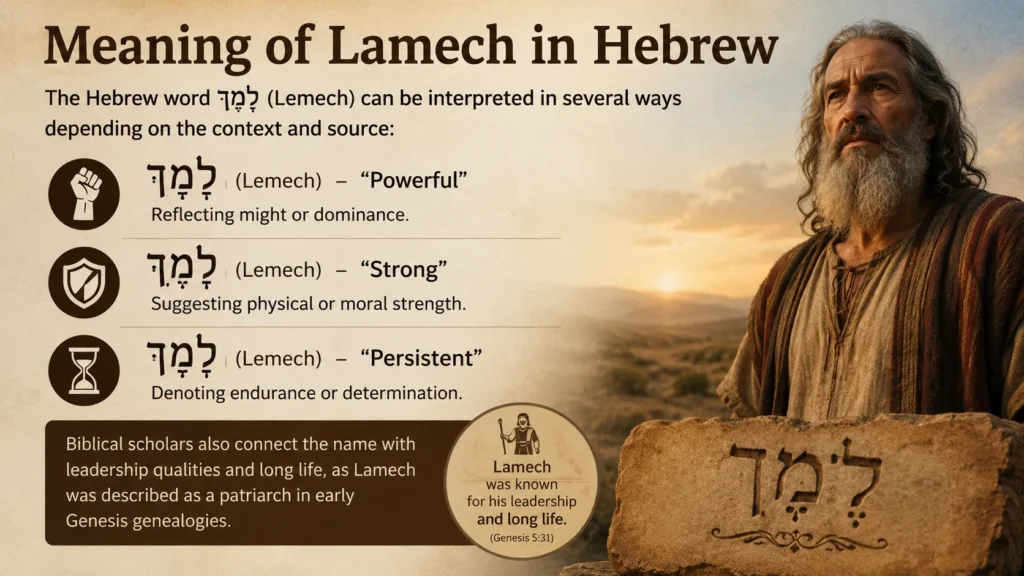
The Hebrew word לֶמֶךְ can be interpreted in several ways depending on the context and source:
- “Powerful” – Reflecting might or dominance
- “Strong” – Suggesting physical or moral strength
- “Persistent” – Denoting endurance or determination
Biblical scholars also connect the name with leadership qualities and long life, as Lamech was described as a patriarch in early Genesis genealogies.
Lamech in the Bible
1. Lamech, Descendant of Cain
Lamech appears in Genesis 4:18–24 as a descendant of Cain. This Lamech is notable for a few key points:
- He had two wives, Adah and Zillah, highlighting early societal structures
- He is associated with the first poetic declaration of vengeance, emphasizing a bold, assertive character
Example Verse:
“I have slain a man for wounding me, a young man for striking me; if Cain is avenged seven times, then Lamech seventy-seven times.” (Genesis 4:23–24)
This highlights strength and assertiveness but also shows a complex, morally ambiguous figure.
2. Lamech, Descendant of Seth
Another Lamech appears in Genesis 5:25–31, in the lineage of Seth. This Lamech is the father of Noah and is associated with prophecy:
- He speaks of Noah’s future role: “He will comfort us concerning our work and the toil of our hands because of the ground the Lord has cursed.”
- Represents hope, continuity, and spiritual leadership
Alternate Meanings and Interpretations
While the primary meaning of Lamech is powerful or strong, interpretations vary:
- Some scholars associate it with “the mighty hunter”, linking it to early Genesis motifs
- Others suggest “lamenter” due to linguistic roots, though this is less common
- In mystical traditions, Lamech can symbolize divine protection and longevity
Comparison With Similar Biblical Names
| Name | Meaning | Key Difference From Lamech |
|---|---|---|
| Cain | Acquired or possessed | Cain is associated with sin and exile, while Lamech emphasizes power or persistence |
| Seth | Appointed | Seth represents continuity and righteousness; Lamech (Seth’s line) continues this but with prophetic undertones |
| Methuselah | Man of the dart / his death shall bring | Methuselah emphasizes longevity; Lamech focuses on strength and leadership |
Usage Tips
- Pronunciation: Lah-mech (lə-MEKH)
- Tone: Historically strong, spiritually significant, neutral to positive depending on context
- Modern Usage: Rare as a given name but respected in religious communities
- Professional/Polite Use: In modern Hebrew, the name is primarily historical or literary. It can be referenced in religious teaching or biblical studies without needing informal variations.
Common Mistakes to Avoid
- Mispronunciation
- Incorrect: Lay-mech or Lameck
- Correct: Lah-mech (lə-MEKH)
- Confusing Biblical Lamech figures
- There are two Lamechs in Genesis: Cain’s descendant and Seth’s descendant. Context matters.
- Assuming negative connotations
- Only Cain’s descendant Lamech is associated with violence; Seth’s Lamech has a positive, prophetic role
FAQs
1. What does Lamech mean in Hebrew?
It generally means powerful, strong, or mighty.
2. Is Lamech a biblical name?
Yes, appearing in Genesis as a descendant of both Cain and Seth.
3. How is Lamech pronounced?
Lah-mech (lə-MEKH).
4. Was Lamech good or bad?
Cain’s Lamech is morally complex and assertive; Seth’s Lamech is righteous and prophetic.
5. Is Lamech used today?
Rarely as a modern given name, mostly in religious, historical, or literary contexts.
6. Can Lamech be a girl’s name?
Traditionally masculine in the Bible; rarely used for girls.
7. Are there symbolic meanings for Lamech?
Yes. Strength, endurance, prophetic insight, and leadership.
8. Who is the most famous Lamech in the Bible?
Lamech, father of Noah (Seth’s lineage), due to his prophetic statement about his son.
Conclusion:
Lamech is a significant biblical name that symbolizes strength, leadership, and spiritual insight. Understanding its two biblical appearances helps you grasp its complexity:
- Cain’s descendant: assertive, morally ambiguous, bold
- Seth’s descendant: prophetic, righteous, father of Noah
When used today, the name carries historical depth and spiritual meaning, making it a strong choice for religious or literary contexts.
Pro Tips:
- Pronounce it correctly as Lah-mech
- Understand the context of each biblical figure
- Recognize its symbolic meanings in genealogy and prophecy
Discover More Related Articles:
- JOI Mean in Porn | Understanding the Adult Content Slang Term In 2026
- The Root Tele Mean in Television | Understanding the Word’s Origin In 2026
- Closed Circle Mean in Math |The Symbol Most Students Misunderstand In 2026

Madison Taylor is an experienced content writer who focuses on researching and explaining word meanings, slang, and texting terms. She writes for meanvoro.com, creating clear and accurate to help readers understand language easily.