
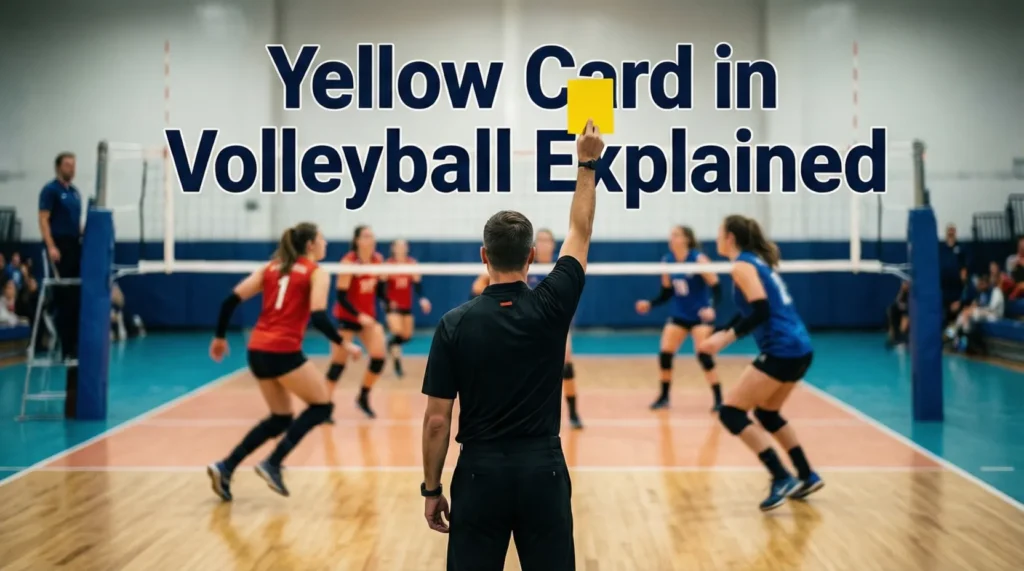
In volleyball, a yellow card is an official warning given by the referee to a player, coach, or team for minor misconduct or unsporting behavior.
It does not result in an immediate point or penalty, but it serves as a formal notice that continued behavior may lead to harsher sanctions like a red card.
Ever watched a Yellow Card Mean in Volleyball match and seen the referee flash a yellow card and wondered, “What exactly does that mean?”
You’re not alone. Yellow cards in volleyball can feel confusing, especially since they don’t work exactly the same way as in soccer or other sports.
In this guide, we’ll break it all down in a clear, friendly, and easy-to-understand way from the official definition to real-game examples, comparisons, FAQs, and practical tips. Whether you’re a player, coach, fan, or student, this article has you covered.
Understanding Yellow Cards in Volleyball
Before we dive deeper, here’s a simple breakdown:
- Yellow card = Warning
- No point awarded to the opponent
- Recorded by the referee
- Signals that behavior must stop
- Repeated misconduct can escalate to a red card
Think of it as volleyball’s version of: “That’s your official warning next time won’t be so friendly.”
Why Yellow Cards Exist in Volleyball
Volleyball is fast-paced and emotional. Referees need a way to:
- Control player behavior
- Maintain sportsmanship
- Prevent arguments from escalating
- Keep the game flowing smoothly
The yellow card is a preventive tool, not a punishment designed to calm things down before the situation gets worse.
Origin of the Yellow Card in Volleyball
The use of yellow cards in volleyball comes from the sport’s alignment with international officiating standards, especially under organizations like:
- FIVB (Fédération Internationale de Volleyball)
- USA Volleyball (USAV)
- NCAA
- High school federations
These governing bodies adopted card systems to create:
- Consistency across matches
- Clear visual signals
- Fair disciplinary processes
The color-coded card system (yellow → red) mirrors other sports but is applied differently in volleyball.
When Is a Yellow Card Given in Volleyball?
A referee may issue a yellow card for minor misconduct. This includes behavior that’s inappropriate but not severe enough to immediately penalize the team.
Common Reasons for a Yellow Card
- Arguing with the referee
- Excessive complaining about calls
- Delaying the game intentionally
- Mild unsporting behavior
- Disrespectful gestures or language
- Repeated minor rule violations
A yellow card can be given to players, coaches, substitutes, or even the entire team.
What a Yellow Card Does and Does Not Do
What a Yellow Card Does
- Serves as an official warning
- Gets recorded on the scoresheet
- Signals that behavior must improve
How a Yellow Card Affects the Game
- Does not give the opponent a point
- Does not remove a player
- Does not stop the match
Yellow Card vs Red Card in Volleyball
This is where many people get confused. Let’s clarify.
Comparison Table: Volleyball Cards Explained
| Card Color | Meaning | Result | Impact on Score |
|---|---|---|---|
| Yellow Card | Warning for minor misconduct | Formal warning | No point awarded |
| Red Card | Penalty for serious or repeated misconduct | Punishment | Opponent gains a point |
| Yellow + Red | Expulsion | Player/coach must leave area | Opponent gains a point |
| Double Red | Disqualification | Player/coach removed from match | Opponent gains a point |
Examples of Yellow Cards in Real Volleyball Situations
Neutral Example
A player questions a line call loudly after the whistle.
Referee shows a yellow card to warn the player to stop arguing.
Friendly Context
A coach reacts emotionally but quickly calms down.
Yellow card is issued as a reminder to keep communication respectful.
Negative Context
A player repeatedly claps sarcastically at the referee’s decision.
Yellow card is shown. Another incident could mean a red card.
Tone and Intent Behind a Yellow Card
Yellow cards aren’t meant to embarrass or punish they’re about control and prevention.
Referees use them to say:
- “Enough.”
- “Respect the game.”
- “Let’s move on.”
It’s a professional boundary, not a personal attack.
Does a Yellow Card Carry Over?
This depends on the league or tournament:
- Single match: Yellow cards typically reset each match
- Tournaments: Accumulated misconduct may lead to suspensions
- Professional leagues: Cards may be tracked across matches
Always check the specific rulebook being used.
Alternate Meanings of Yellow Cards
Outside volleyball, yellow cards can mean different things:
- Soccer: A caution that can lead to suspension if accumulated
- Motorsports: A signal for caution or slowed racing
- Schools: Behavioral warning
In volleyball, the meaning is specific: Official warning for minor misconduct.
Polite or Professional Alternatives to a Yellow Card
Before issuing a yellow card, referees may try:
- Verbal warning
- Calm hand signals
- Eye contact or gestures
From a player or coach perspective, better alternatives include:
- Respectful clarification
- Calm communication
- Letting the captain speak to the referee
These can prevent a yellow card altogether.
Usage Tips for Players and Coaches
How to Avoid a Yellow Card
- Let captains communicate with referees
- Control emotional reactions
- Accept calls even if you disagree
- Focus on the next play, not the last one
What to Do If You Get One
- Reset your mindset
- Don’t argue the warning
- Encourage teammates to stay calm
A yellow card doesn’t hurt your score but your reaction afterward might.
FAQs
1. Does a yellow card give the other team a point?
No. A yellow card is only a warning and does not affect the score.
2. Can a coach receive a yellow card?
Yes. Coaches can receive yellow cards for misconduct or unsporting behavior.
3. What happens if you get two yellow cards?
Repeated misconduct escalates to a red card, resulting in a point penalty.
4. Is a yellow card serious?
It’s a formal warning—not serious on its own, but it becomes serious if behavior continues.
5. Can a team receive a yellow card instead of an individual?
Yes. Referees can issue a team warning if misconduct involves multiple members.
6. Does a yellow card stay on record after the match?
Typically no, but tournament rules may track repeated misconduct.
7. Can referees skip a yellow card and give a red card immediately?
Yes. Severe misconduct can result in an immediate red card.
8. Is a yellow card the same in indoor, beach, and school volleyball?
The concept is the same, but exact rules can vary by league and level.
Conclusion:
A yellow card in volleyball is a formal warning issued by the referee for minor misconduct or unsporting behavior. While it does not affect the score, it serves as an important signal to players, coaches, and teams to adjust their behavior before more serious penalties, like a red card, are given.
Understanding the purpose and proper response to a yellow card helps maintain fair play, sportsmanship, and a smooth flow of the game.
Players and coaches who stay calm, communicate respectfully, and focus on the match can avoid warnings and keep their team in the game.
Search More Related Articles :
- BOT Mean in Baseball: Complete Guide for Fans & Players (2026)
- GIR Mean in Golf: Tips to Hit More Greens in Regulation (2026)

Madison Taylor is an experienced content writer who focuses on researching and explaining word meanings, slang, and texting terms. She writes for meanvoro.com, creating clear and accurate to help readers understand language easily.