
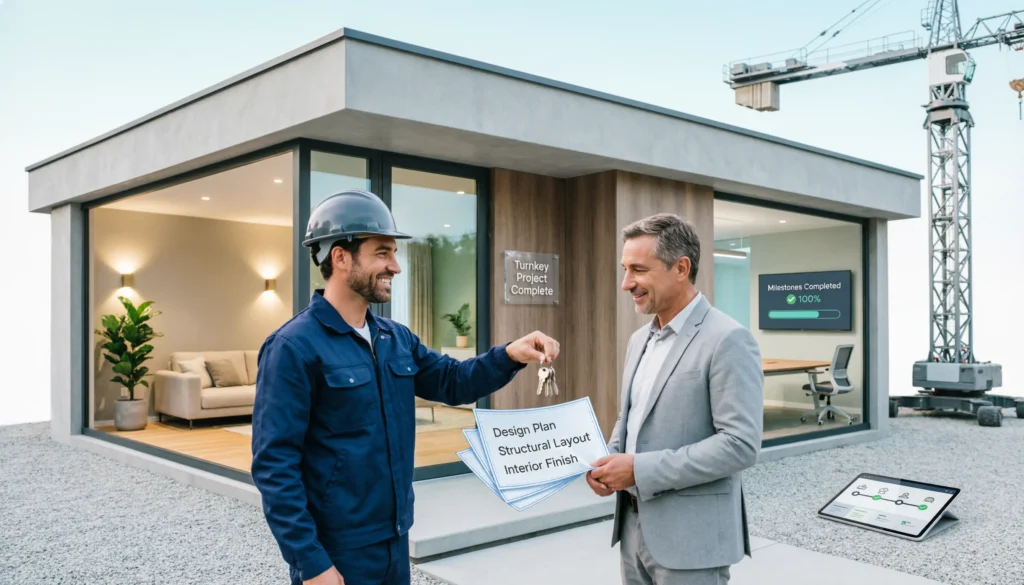
In construction, “turnkey” refers to a project delivery method where the contractor handles the entire project from start to finish, including design, planning, construction, and final handover.
The client receives a fully completed and operational facility, ready to “turn the key” and use immediately, with minimal involvement in day-to-day construction decisions.
Turnkey projects are popular in commercial, residential, and industrial construction because they simplify the process for clients, reduce risks, and ensure accountability by having a single point of responsibility.
Origin of “Turnkey” in Construction
The term “turnkey” originates from the idea that a client only needs to turn the key to access a completed product.
- Originally used in industrial and real estate contexts, it later became standard in construction, manufacturing, and IT projects.
- In construction, turnkey projects emphasize completeness and readiness for immediate use, eliminating the need for the client to manage multiple contractors or suppliers.
Key Concept: The contractor is fully responsible for delivering a functional facility, often including interiors, fixtures, and systems, depending on the agreement.
Why Turnkey Projects Are Popular
Turnkey construction is favored for several reasons:
- Single Point of Contact: The client works with one contractor, simplifying communication.
- Time Efficiency: Contractors manage all phases, reducing delays between design, procurement, and construction.
- Predictable Budget: Many turnkey contracts are fixed-price, reducing cost surprises.
- Stress Reduction: Clients don’t need to coordinate multiple teams or track minor construction details.
Turnkey projects are particularly common in:
- Residential housing developments
- Commercial buildings (offices, retail stores)
- Industrial facilities and warehouses
- Schools, hospitals, and hospitality projects
How Turnkey Construction Works
Step-by-Step Process
- Planning and Design
The contractor works with the client to finalize blueprints, materials, and schedules. - Permits and Approvals
The contractor obtains all required permits and ensures regulatory compliance. - Construction Phase
Includes site preparation, foundation, structure, roofing, and interior finishing. - Systems Installation
Electrical, plumbing, HVAC, and technology systems are installed and tested. - Final Handover
The completed building is inspected, approved, and handed over to the client fully operational.
Tip: Clients can request customizable turnkey solutions, where they specify finishes, fixtures, or interior design preferences while leaving construction management to the contractor.
Examples of Turnkey in Construction
| Project Type | Turnkey Description | Client Benefit |
|---|---|---|
| Residential Housing | A builder constructs the home fully furnished with kitchen, bathrooms, flooring, and lighting. | Move in immediately without additional work. |
| Commercial Office | Contractor delivers a fully operational office with partitions, IT wiring, HVAC, and furniture. | Saves time and simplifies coordination. |
| Industrial Facility | Complete factory or warehouse with machinery installation and operational testing. | Ready for production from day one. |
| Hospitality | Hotel constructed and equipped with furniture, lighting, and operational systems. | Fully functional upon handover. |
Turnkey vs Other Construction Methods
| Method | Description | Key Difference from Turnkey |
|---|---|---|
| Design-Bid-Build | Separate contracts for design and construction | Client must coordinate multiple parties |
| Construction Management (CM) | Client hires a manager to oversee contractors | Client retains more control, less “hands-off” |
| Design-Build | Contractor handles design and construction | Similar to turnkey but may not include full operational readiness |
| Turnkey | Contractor handles everything from design to ready-to-use completion | Client receives fully functional building with minimal involvement |
Quick Tip: Turnkey emphasizes complete operational readiness, not just building completion.
Advantages of Turnkey Projects
- Reduced Client Stress: Minimal supervision required
- Time Savings: Streamlined workflow with fewer delays
- Budget Certainty: Often fixed-price contracts
- Accountability: Single contractor responsible for all phases
- Consistency: Better integration of design, construction, and finishing
Disadvantages of Turnkey Projects
- Limited Control: Less flexibility for clients during construction
- Higher Initial Cost: May be more expensive than partial contracts
- Dependence on Contractor: Quality depends entirely on the contractor’s expertise
- Customization Limitations: Changes mid-project can be costly
FAQs
- What does turnkey mean in construction?
It means a contractor handles the entire project from start to finish, delivering a ready-to-use building. - Is turnkey construction more expensive?
Initial costs may be higher, but it reduces risks, delays, and coordination costs. - Who manages a turnkey project?
The contractor or developer is the main point of contact and responsible for all phases. - Can I customize a turnkey project?
Yes, clients can specify materials, finishes, and interior details, but changes during construction can be costly. - Is turnkey only for large projects?
No, it’s used in residential, commercial, and industrial projects of all sizes. - How long does a turnkey project take?
Duration depends on project size, complexity, and regulatory approvals. - What’s the difference between turnkey and design-build?
Design-build covers design and construction, but turnkey ensures the building is fully operational and ready for use. - Why is it called “turnkey”?
Because the client can literally “turn the key” and start using the building immediately upon handover.
Practical Tips for Clients Considering Turnkey Construction
- Vet the contractor carefully: Look for experience with turnkey projects.
- Clarify the scope: Make sure all inclusions, finishes, and operational systems are agreed upon.
- Ask about guarantees: Ensure warranties and maintenance plans are included.
- Plan your timeline: Turnkey projects streamline construction but still require realistic scheduling.
- Maintain occasional oversight: Even turnkey projects benefit from periodic client check-ins.
Conclusion
Turnkey construction simplifies the building process by allowing clients to receive a complete, operational facility without managing multiple contractors or phases.
It is ideal for those who value time efficiency, predictable costs, and minimal stress, whether in residential, commercial, or industrial projects.
Discover More Related Articles:
- Lamentation Mean in the Bible: Why It Matters for Christians in 2026
- Adam Mean in the Bible: Symbolism, and Impact in 2026

Ryan Thompson is an experienced content writer specializing in slang terms, texting abbreviations, and word meanings. He writes for meanvoro.com, where he creates accurate and easy-to-understand language content for readers.