
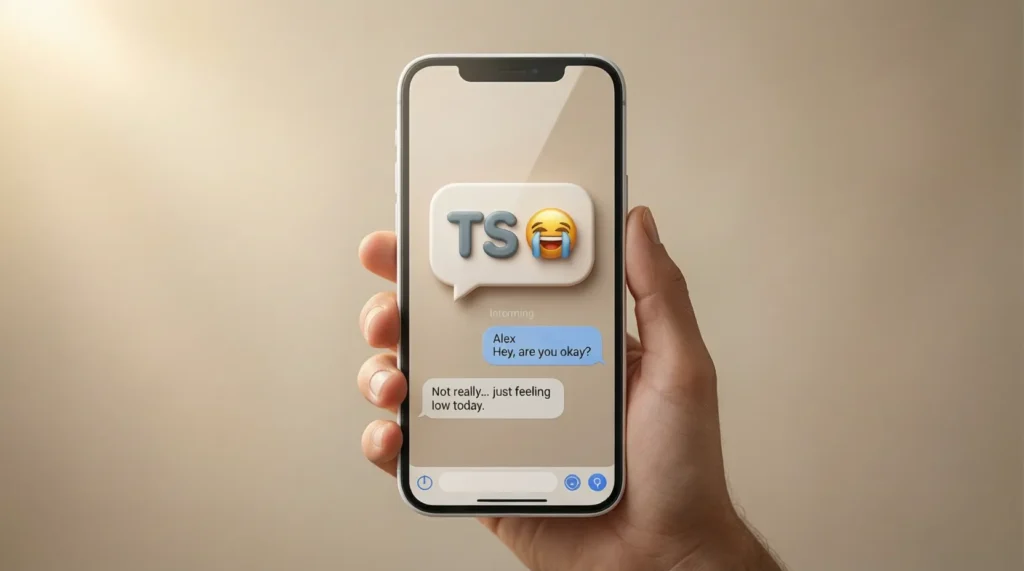
TS in a text message usually means “That’s Sad” or “Tough Situation.”
It’s a casual abbreviation used to acknowledge disappointing news, unfortunate events, or difficult circumstances.
If you’ve ever received a text that simply says “TS Meaning in Text Message” and wondered what it meant, you’re not alone. Texting slang moves fast, and short abbreviations like TS can feel confusing especially because their meaning depends heavily on context.
In this comprehensive guide, we’ll explain what TS means in a text message, how it’s commonly used, the tone it carries, and when it may come across as supportive or dismissive.
You’ll also find real-world examples, comparisons with similar slang, polite alternatives, FAQs, and practical tips to help you use (or interpret) TS correctly.
Quick Meaning Overview
- Most common meanings:
- That’s Sad
- Tough Situation
- That’s Sad
- Tone: Casual, sympathetic, or neutral
- Used in: Text messages, DMs, social media comments
- Formality: Informal only
What Does TS Mean in Text Message?
1. TS = “That’s Sad”
This is the most frequent meaning of TS in everyday texting. It’s a quick emotional reaction to something unfortunate or disappointing.
People often use it when:
- Responding quickly
- Keeping the conversation light
- They don’t want to type a longer reply
Tone:
- Mild sympathy
- Casual acknowledgment
- Can feel cold if used alone
Example:
“My favorite restaurant just closed.”
“TS 😔”
2. TS = “Tough Situation”
In more serious or personal conversations, TS can also mean Tough Situation. Here, it signals recognition of someone’s difficulty without offering detailed advice.
Common contexts include:
- Work or school stress
- Financial or personal struggles
- Relationship problems
Example:
“I might have to repeat the semester.”
“TS… hoping things improve.”
Origin and Evolution of TS in Texting
TS emerged naturally with the rise of SMS culture and online chat, where speed and brevity mattered.
Why TS Became Popular
- Faster than typing full sentences
- Fits quick replies and group chats
- Easy to pair with emojis
- Matches reaction-based digital communication
Unlike formal acronyms, TS evolved as a context-driven response, similar to slang like SMH or FR.
How Popular Is TS Today?
TS is still commonly used in:
- Casual texting
- Social media replies
- Group chats
However, many users now prefer emojis or longer responses when reacting to emotionally sensitive topics. As a result, TS is best suited for low-stakes or informal conversations.
How TS Is Used in Real Conversations
The meaning and tone of TS depend heavily on context, punctuation, and follow-up.
Supportive Use
Often includes emojis or additional reassurance.
“I didn’t get the promotion.”
“TS 😢 you deserve better.”
Neutral Use
Acknowledges information without strong emotion.
“The event got postponed.”
“TS, we’ll catch it next time.”
Dismissive or Dry Use
When used alone, it can feel indifferent.
“My phone stopped working.”
“TS.”
⚠️ Tip: If empathy matters, add a follow-up sentence.
TS Text Message Examples
Friendly
“My vacation plans fell through.”
“TS 😔 hope you can reschedule!”
Neutral
“They delayed the release date.”
“TS, it happens.”
Potentially Dismissive
“I failed the interview.”
“TS.”
Example
| Situation | Message | Meaning | Tone |
| Bad news | “My flight was canceled.” | That’s Sad | Sympathetic |
| Personal stress | “I’m behind on rent.” | Tough Situation | Supportive |
| Casual update | “The match got postponed.” | That’s Sad | Neutral |
| Repeated complaint | “My screen cracked again.” | That’s Sad | Possibly dismissive |
TS vs Similar Text Slang
Comparison of TS and SMH
- TS: Acknowledges sadness or difficulty
- SMH: Expresses disappointment or disbelief
Meaning Difference: TS vs RIP
- TS: Mild sympathy
- RIP: Stronger or more dramatic reaction
Usage Contrast Between TS and FR
- TS: Emotional acknowledgment
- FR: Agreement or emphasis
Alternate Meanings of TS
While uncommon in everyday texting, TS can also stand for:
- Timestamp (technical or forum discussions)
- TeamSpeak (gaming communities)
- Taylor Swift (fan conversations)
- Top Secret (non-casual usage)
These meanings depend entirely on context and audience.
When You Should Avoid Using TS
Avoid TS when:
- Communicating professionally
- Responding to serious emotional distress
- Writing academic or formal messages
In these cases, TS may come across as insensitive or vague.
Polite and Clear Alternatives to TS
Casual but Kind
- “That’s unfortunate.”
- “Sorry to hear that.”
- “That sucks.”
Supportive
- “That sounds really tough.”
- “I hope things get better.”
- “I’m here if you need to talk.”
Professional
- “I’m sorry to hear about this.”
- “That sounds challenging.”
- “I understand the situation.”
Best Practices for Using TS
- Use only in informal settings
- Add emojis for warmth
- Follow up with a supportive line
- Avoid using it as a standalone response to serious news
FAQs
1. What does TS mean in texting slang?
It usually means That’s Sad or Tough Situation.
2. Is TS rude in text messages?
Not inherently, but it can sound dismissive if used alone.
3. Can TS be supportive?
Yes, especially when paired with emojis or encouragement.
4. Is TS used on social media?
Yes, particularly in comments and replies.
5. Does TS mean the same thing everywhere?
Mostly, but context always matters.
6. Should I use TS in professional messages?
No, it’s best avoided in professional communication.
7. Can punctuation change the tone of TS?
Yes. “TS…” feels more empathetic than “TS.”
8. Is TS outdated slang?
It’s still used, though emojis and longer reactions are increasingly common.
Conclusion:
TS is a short, informal reaction that usually means “That’s Sad” or “Tough Situation.” While convenient, it relies heavily on context and tone.
Used thoughtfully, it works well in casual conversations but in emotional or professional situations, clearer wording is always the better choice.
Search More Related Articles :
- The Meaning of the Rainbow in the Bible : Explained for Christians (2026)
- VOC Paint Meaning: Low-VOC vs Traditional Paints Compared (2026)

Ryan Thompson is an experienced content writer specializing in slang terms, texting abbreviations, and word meanings. He writes for meanvoro.com, where he creates accurate and easy-to-understand language content for readers.