
Quick Answer:
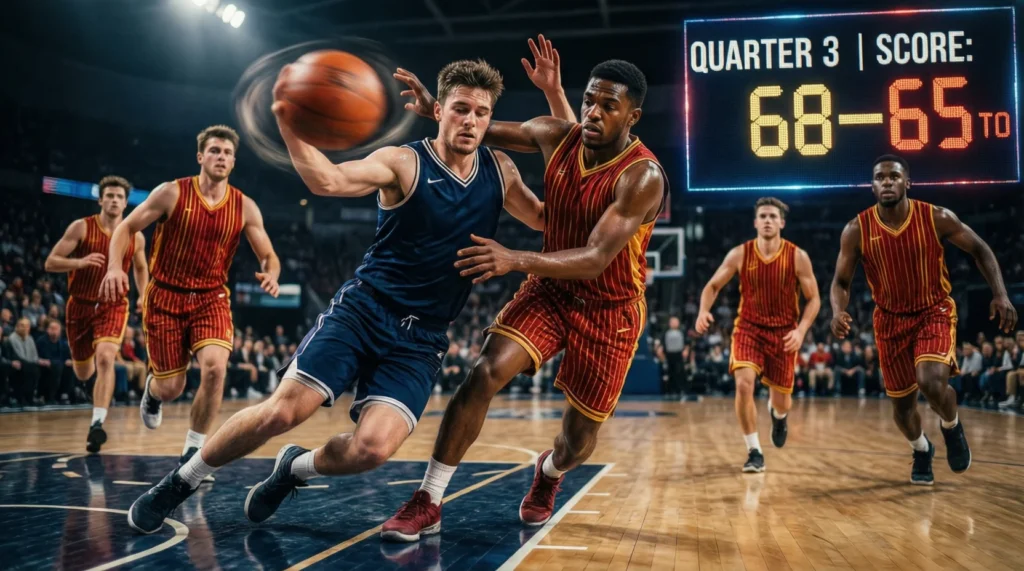
In basketball, “TO” stands for “Turnover”, which occurs when a player loses possession of the ball to the opposing team due to a mistake, violation, or interception.
Turnovers are tracked as a key statistic because they directly impact a team’s chance to score and can shift momentum during a game.
Understanding TO in Basketball: The Basics
Basketball is a fast-paced sport where every possession counts. The term TO, or turnover, is one of the fundamental stats recorded in every game. A turnover happens when a team gives the ball to the other side without attempting a shot. Common ways a turnover occurs include:
- Bad passes intercepted by opponents
- Traveling violations (moving without dribbling)
- Steals (opponent takes the ball away)
- Offensive fouls (illegal physical contact while possessing the ball)
Turnovers are not just numbers. They indicate team efficiency, decision-making, and pressure handling during a game.
Origin of “TO” in Basketball

The abbreviation “TO” comes from the statistical shorthand used in basketball scorekeeping. Early scorebooks used minimal letters to denote common stats:
| Abbreviation | Meaning | Purpose |
|---|---|---|
| PTS | Points | Tracks scoring |
| AST | Assists | Tracks passes leading to points |
| REB | Rebounds | Tracks missed-shot recoveries |
| TO | Turnover | Tracks lost possessions |
The term gained popularity in the 1980s and 1990s as basketball statistics became more detailed and widely reported. Today, “TO” is used in box scores, fantasy basketball, and analytics, making it a crucial metric for players, coaches, and fans.
Real-World Usage of TO in Basketball
In professional and amateur basketball, TO is everywhere:
- Coaches use it to correct mistakes and improve team strategy
- Players monitor their TO count to reduce careless errors
- Fans and analysts discuss it during commentary, highlighting efficiency or sloppy play
Example Phrases in Context:
- Friendly/Neutral:
- “LeBron only had 2 TOs in the first half, that’s solid ball control”
- Critical/Negative:
- “The team committed 18 TOs in the game—that’s too many”
- Analytical/Professional:
- “Reducing TOs is essential for maintaining a high offensive rating and game efficiency”
Examples
| Type of Turnover | Description | Example Scenario |
|---|---|---|
| Bad Pass | Pass intercepted by opponent | Player attempts a cross-court pass that gets stolen |
| Traveling | Moving without dribbling | Player pivots twice without dribbling, referee blows whistle |
| Steal | Opponent takes possession | Defender strips the ball during a drive to the basket |
| Offensive Foul | Illegal contact while holding the ball | Player charges into defender while trying to score |
| Shot Clock Violation | Fails to shoot within 24 seconds | Team hesitates and the clock expires |
These examples show how turnovers can happen from skill errors, miscommunication, or pressure defense.
TO vs Related Basketball Terms
It’s easy to confuse TO with other stats or abbreviations. Here’s a comparison:
| Abbreviation | Meaning | Difference from TO |
|---|---|---|
| AST | Assist | Positive stat; helps score points |
| PF | Personal Foul | Indicates fouls; not necessarily losing possession |
| STL | Steal | Defensive stat; often results in TO for the opponent |
| TO | Turnover | Always negative for the team losing possession |
Key Point: TO is strictly a negative possession stat, unlike assists or rebounds which are generally positive.
Alternate Meanings of TO
While in basketball TO always refers to Turnover, in other contexts “TO” can mean:
- Time Out – A short pause in play for strategy or rest
- Technical Offense – Less common; often shortened as Tech in stats
Tip: In basketball stats and box scores, TO = Turnover. If someone says “TO” in conversation about a live game, they are almost always referring to turnovers.
Polite or Professional Alternatives to Saying TO
In coaching or media commentary, “turnover” can be referred to more professionally:
- “Lost possession”
- “Unforced error”
- “Ball-handling mistake”
Example:
- Instead of saying: “He had too many TOs,” a coach might say:
- “We need to focus on minimizing lost possessions this quarter”
FAQs
1. What is a turnover in basketball?
A turnover is when a team loses possession of the ball to the other team without taking a shot.
2. How is TO tracked in basketball stats?
Each time a player or team loses possession due to a mistake or violation, a turnover is recorded in the box score as TO.
3. Does every lost possession count as a turnover?
No. Only mistakes like bad passes, traveling, offensive fouls, or steals count. Missed shots that rebound to your team do not count as turnovers.
4. Why are turnovers important in basketball?
Turnovers reduce scoring opportunities and often give the opponent fast-break chances. Fewer TOs generally mean more efficient play.
5. How can players reduce TOs?
- Improve passing accuracy
- Practice dribbling under pressure
- Avoid unnecessary risky plays
- Communicate with teammates
6. Can TO be a positive stat?
Not directly, but forcing a turnover (steal) as a defender is positive; it counts as a turnover for the opponent.
7. Is TO different in professional vs. casual games?
The definition is the same, but professional games track TOs more rigorously for analytics and strategy.
8. What’s the difference between a turnover and a foul?
A turnover occurs when possession is lost; a foul is a violation that may or may not cause a change in possession.
Practical Tips to Track and Reduce TOs
- Watch Your Passes: Avoid risky long or blind passes
- Control Your Dribble: Don’t travel or over-dribble under pressure
- Stay Aware of Defenders: Anticipate steals and double-teams
- Communicate: A well-timed call or signal reduces confusion turnovers
- Analyze Stats: Review your TO numbers after games to identify patterns
Conclusion
By focusing on smart ball handling, precise passing, and communication, players can minimize turnovers and maximize scoring opportunities. Remember: every possession counts, and fewer TOs often lead to more wins. 🏀
Search More Related Articles :
- BOT Mean in Baseball: Complete Guide for Fans & Players (2026)
- GIR Mean in Golf: Tips to Hit More Greens in Regulation (2026)

Ryan Thompson is an experienced content writer specializing in slang terms, texting abbreviations, and word meanings. He writes for meanvoro.com, where he creates accurate and easy-to-understand language content for readers.

