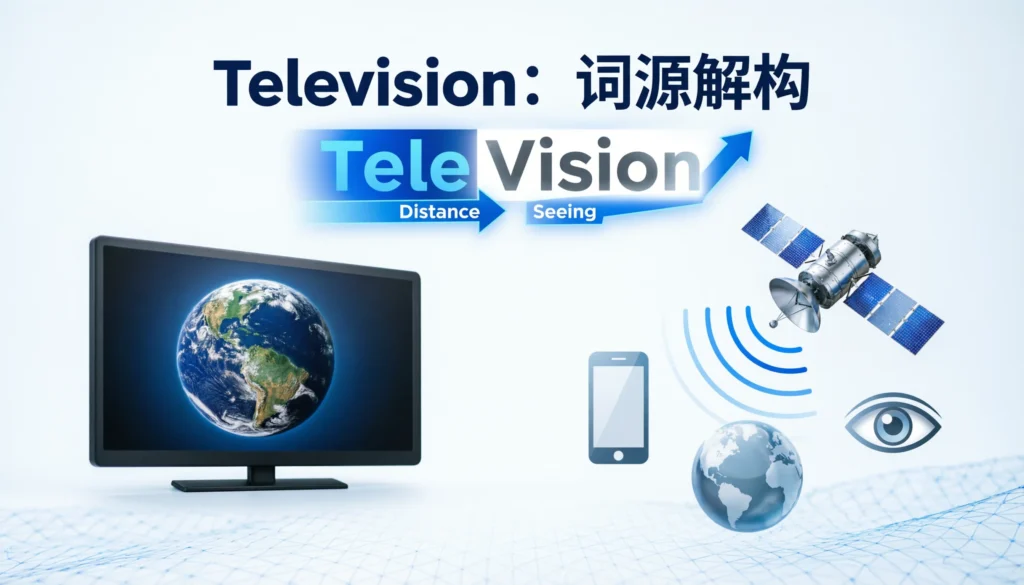
Definition:
The root “tele” means “far,” “distant,” or “at a distance.” It comes from the Greek word tēle, which means far away. In English, tele is used as a prefix in many words related to communication or actions that happen over long distances.
Have you ever wondered why the word “television” starts with “tele”? 🤔
At first glance, it might seem like just another tech word. But the truth is that television’s name actually explains how the technology works. The root tele tells us that the device allows people to see events happening far away, often in real time.
Understanding word roots like tele is helpful because it unlocks the meaning of many other words too, including:
- Telephone
- Telegraph
- Telepathy
- Teleport
- Telemedicine
Once you know that tele means “distance”, these words suddenly make much more sense.
In this guide, we’ll explore:
- The exact meaning of the root tele
- The origin of the word television
- Real-life examples
- Other words that use tele
- Comparisons with related prefixes
- Common FAQs people search online
By the end, you’ll clearly understand what the root tele means in television and why it’s used in so many English words.
What Does the Root Tele Mean in Television?
The root “tele” means “far,” “distant,” or “at a distance.” It comes from the Greek word “tēle,” which means far away. In the word television, tele refers to transmitting images and sound over long distances, while vision refers to seeing.
So, television literally means “seeing from far away.”
In simple terms:
| Word Part | Meaning |
|---|---|
| Tele | Far, distant |
| Vision | Seeing |
| Television | Seeing images from far away |
This root appears in many English words related to communication, technology, and distance, making it an important building block in modern language.
The Origin of the Root “Tele”
The prefix tele- comes from the Ancient Greek word “tēle” (τῆλε).
Greek Meaning
In Greek, tēle means:
- Far
- At a distance
- Remote
- From afar
Greek prefixes were widely adopted in scientific, technological, and academic English vocabulary.
How “Tele” Entered English
During the 18th and 19th centuries, scientists and inventors began creating new communication technologies. To describe them, they used Greek and Latin roots.
For example:
| Word | Year Popularized | Meaning |
|---|---|---|
| Telegraph | 1790s | Writing from a distance |
| Telephone | 1800s | Sound from a distance |
| Television | Early 1900s | Seeing from a distance |
These inventions all shared the same idea: sending information across long distances.
Breaking Down the Word “Television”
The word television combines two language roots.
| Part | Origin | Meaning |
|---|---|---|
| Tele | Greek | Far or distant |
| Vision | Latin | Seeing |
Literal Meaning
Television = Seeing from far away
The word describes a technology that transmits visual images and sound over long distances using signals.
Why This Name Was Chosen
Early inventors wanted a term that explained the technology clearly. The word television perfectly captured the idea of:
- Watching events
- Happening somewhere else
- Transmitted electronically
For example:
- Watching a football game played in another country
- Seeing live news from across the world
- Streaming a concert happening miles away
All of these represent seeing from a distance, which is exactly what tele means.
Real-World Usage of “Tele” Words
Once you recognize the tele prefix, you’ll start noticing it everywhere.
Here are some of the most common words using tele.
| Word | Meaning | Example |
|---|---|---|
| Telephone | Sound from far away | Calling someone across the country |
| Television | Seeing from far away | Watching live sports |
| Teleport | Move across distance instantly | Used in science fiction |
| Telemedicine | Medical care from a distance | Online doctor appointments |
| Teleconference | Meeting from a distance | Zoom meetings |
In each case, tele refers to distance or remote communication.
Examples of “Tele” in Everyday Context
Here are some practical examples showing how the concept of distance works in real life.
Example 1: Television
Sentence:
“We watched the Olympic opening ceremony live on television.”
Meaning:
The event happened far away, but technology allowed viewers to see it remotely.
Example 2: Telephone
Sentence:
“She called her friend overseas on the telephone.”
Meaning:
Her voice traveled across a long distance.
Example 3: Telemedicine
Sentence:
“Many patients now consult doctors through telemedicine services.”
Meaning:
Healthcare is provided remotely using technology.
Example 4: Teleconference
Sentence:
“The team held a teleconference with colleagues in three countries.”
Meaning:
People communicated from different locations.
Why the Root “Tele” Is Important in Modern Technology
The concept behind tele has become even more important in today’s digital world.
Many modern technologies rely on distance communication, including:
- Live streaming
- Video calls
- Online education
- Remote work
- Virtual events
These technologies follow the same principle that television introduced:
Sending information across distance instantly.
Some modern examples include:
- Video conferencing platforms
- Remote medical services
- Live global broadcasts
Even though technology has advanced, the core meaning of tele remains the same.
Comparison: Tele vs Other Distance Prefixes
While tele means distance, English also uses other prefixes with similar meanings.
Here’s how they compare.
| Prefix | Meaning | Example | Explanation |
|---|---|---|---|
| Tele | Far away | Television | Seeing from distance |
| Trans | Across | Transatlantic | Across the Atlantic |
| Inter | Between | International | Between nations |
| Remote | Distant | Remote control | Controlling from afar |
Key Difference
- Tele specifically focuses on communication or connection over distance.
- Other prefixes describe movement or relationships across spaces.
Other Words That Use the Root “Tele”
Understanding tele helps decode many English words.
Here are some interesting ones.
Telepathy
Meaning: Communication of thoughts without speaking.
Example:
“They joked that they had telepathy because they said the same thing.”
Telescope
Meaning: A device used to see distant objects.
Example:
“Astronomers use telescopes to observe distant planets.”
Telemarketing
Meaning: Selling products through phone calls.
Example:
“The company uses telemarketing to reach customers.”
Telework
Meaning: Working remotely using technology.
Example:
“Many employees now telework from home.”
Alternate Meanings of “Tele”
In most cases, tele always refers to distance, but context can slightly change how it’s used.
For example:
| Context | Meaning |
|---|---|
| Technology | Communication over distance |
| Science fiction | Instant movement across space |
| Medicine | Remote healthcare |
Even with these variations, the core concept remains distance or remote connection.
Professional or Academic Alternatives
Sometimes formal writing may use different terms instead of tele-based words.
Here are some alternatives.
| Tele Word | Alternative |
|---|---|
| Telemedicine | Remote healthcare |
| Teleconference | Virtual meeting |
| Telecommunication | Remote communication |
| Television broadcast | Video broadcast |
These alternatives can sound more professional in academic writing.
Table: Common “Tele” Words and Their Meanings
| Word | Meaning | Field |
|---|---|---|
| Television | Seeing images from distance | Media |
| Telephone | Sound communication over distance | Communication |
| Telepathy | Thought communication across distance | Psychology / Fiction |
| Telescope | Viewing distant objects | Astronomy |
| Telemedicine | Healthcare provided remotely | Medicine |
FAQs:
What does the root tele mean?
The root tele means far, distant, or at a distance. It comes from the Greek word tēle, which means “far away.”
What does tele mean in the word television?
In television, tele means distance and vision means seeing. Together, the word means seeing images from far away.
What language does the root tele come from?
The prefix tele comes from Ancient Greek. It is derived from the word tēle, which means far or distant.
What are some examples of words with tele?
Common examples include telephone, television, telescope, telepathy, and telemedicine. All of these words relate to communication or action over distance.
Why is television called television?
The word television describes the technology’s purpose—transmitting images and sound from distant locations to viewers.
Does tele always mean distance?
Yes, in most English words the prefix tele refers to distance, remoteness, or communication across long distances.
What is the difference between tele and trans?
Tele means far or distant, often related to communication. Trans means across or beyond, referring to movement from one place to another.
What is telecommunication?
Telecommunication refers to the exchange of information over long distances using electronic systems, such as phones, television, and the internet.
Conclusion
The root tele plays an important role in understanding the word television and many other modern terms.
To summarize:
- Tele means “far” or “distance.”
- It comes from the Greek word tēle.
- In television, it combines with vision to mean seeing from far away.
- The prefix appears in many technologies related to communication across distance, including telephone, telemedicine, and teleconference.
Understanding roots like tele makes it much easier to decode unfamiliar words and expand your vocabulary. The next time you hear a tele-word, you’ll instantly know it probably involves distance, connection, or remote communication.
And that’s exactly the idea behind television — bringing the world to you, no matter how far away it is.
Discover More Related Articles:

Ryan Thompson is an experienced content writer specializing in slang terms, texting abbreviations, and word meanings. He writes for meanvoro.com, where he creates accurate and easy-to-understand language content for readers.