
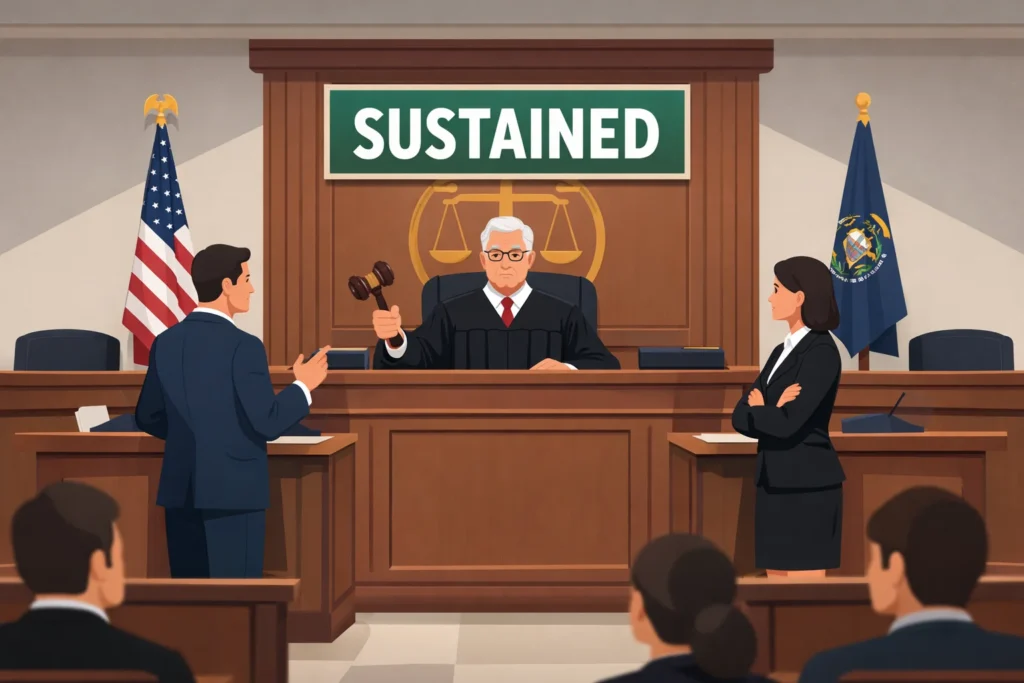
In a court of law, “sustain” means that a judge agrees with an objection, motion, or legal argument and rules in favor of the party who raised it.
When an objection is sustained, the opposing party must stop that line of questioning or argument, and the evidence or statement is not allowed to be considered by the court.
Understanding the legal meaning of “sustain” is important for anyone following court cases, watching trials, studying law, or simply trying to understand courtroom language used in news and legal dramas.
Courtroom language can sound confusing, especially when judges use short, formal terms that carry serious legal weight. One such word is “sustain.”
When a judge says “objection sustained,” it can immediately change the direction of a trial. Evidence may be excluded, a question may be stopped mid-sentence, or an argument may be dismissed entirely.
Knowing what “sustain” means helps you understand:
- Why certain questions are not answered
- Why evidence is ignored
- How judges control courtroom procedure
This word plays a key role in ensuring fairness and adherence to legal rules.
Origin and Legal Background of “Sustain”
The word “sustain” comes from Latin sustinere, meaning to uphold, support, or maintain. Over time, it entered legal English with a specific procedural meaning.
In law, “sustain” does not mean emotional support or physical endurance. Instead, it means to uphold a legal position or agree with a formal request made during a trial.
This usage has been part of common law courtrooms for centuries and remains standard in modern legal systems.
What Does “Sustain” Mean in Court?
In legal settings, “sustain” is most commonly used by a judge in response to an objection or motion.
Core Legal Meaning
| Legal Term | Meaning |
|---|---|
| Sustain | The judge agrees with the objection or request |
| Overrule | The judge disagrees with the objection |
When an objection is sustained, the judge is saying the objection is valid under the law.
How “Sustain” Is Used in Courtrooms
1. Sustaining an Objection
This is the most common usage.
Example:
- Lawyer: Objection, hearsay.
- Judge: Sustained.
What this means:
The judge agrees that the question or statement violates legal rules, and it must stop or be disregarded.
2. Sustaining a Motion
Judges may also sustain legal motions.
Example:
- Motion to dismiss is sustained.
Meaning:
The judge agrees with the motion, and the case or issue may be dismissed.
3. Sustaining a Verdict or Decision
In appellate courts, “sustain” can mean upholding a lower court’s decision.
Example:
- The appellate court sustained the trial court’s ruling.
This means the original decision remains valid.
Examples of “Sustain” in Legal Context
| Situation | Courtroom Use | Explanation |
|---|---|---|
| Trial objection | Objection sustained | The question or statement is not allowed |
| Appeal decision | Ruling sustained | Lower court decision remains unchanged |
| Evidence dispute | Evidence objection sustained | Evidence is excluded |
Tone and Context of “Sustain”
“Sustain” is a neutral and formal legal term. It carries no emotional tone.
| Context | Tone |
|---|---|
| Judge’s ruling | Formal |
| Legal documents | Professional |
| Court transcripts | Neutral |
Unlike everyday language, “sustain” in court is purely procedural.
Common Phrases Using “Sustain” in Court
- Objection sustained
- Motion sustained
- Ruling sustained
- Verdict sustained
- Appeal sustained
These phrases signal that a legal request has been approved by the judge.
Comparison With Related Legal Terms
Understanding similar courtroom terms helps clarify meaning.
| Term | Meaning | Difference |
|---|---|---|
| Sustain | Agree with objection | Stops the action |
| Overrule | Disagree with objection | Allows continuation |
| Deny | Reject a motion | No approval |
| Grant | Approve a request | Similar but broader |
“Sustain” is specific to legal challenges and objections, not general approval.
Alternate Meanings Outside Law
Outside the courtroom, “sustain” has different meanings:
| Context | Meaning |
|---|---|
| Everyday English | Support or maintain |
| Business | Keep something going |
| Environment | Protect resources |
These meanings do not apply in legal settings and should not be confused with courtroom usage.
Polite or Plain-Language Alternatives
In legal education or media explanations, simpler phrases are often used:
| Plain Term | Meaning |
|---|---|
| Approved | Judge agrees |
| Accepted | Objection is valid |
| Upheld | Decision stands |
However, in actual courtrooms, “sustain” remains the standard term.
FAQs
- What does “sustain” mean in a court of law?
It means the judge agrees with an objection, motion, or legal argument. - What happens when an objection is sustained?
The question or statement must stop or be disregarded. - Is “sustain” good or bad?
It depends on which side raised the objection. It favors the party who objected. - What is the opposite of sustain in court?
The opposite is “overruled.” - Can evidence be removed if an objection is sustained?
Yes, sustained objections often prevent evidence from being considered. - Is “sustain” used in appeals?
Yes, appellate courts may sustain lower court rulings. - Does sustain mean the case is over?
Not always. It usually affects only a specific issue or objection. - Why do judges say “sustained” instead of explaining?
Court procedure requires brief, clear rulings to maintain efficiency.
Practical Tips for Understanding Courtroom Use
- Listen carefully to objections and judge responses
- Remember sustain favors the objecting party
- Watch what happens immediately after the ruling
- Do not confuse legal sustain with everyday meanings
Conclusion
In a court of law, “sustain” means that the judge agrees with a legal objection or motion and rules in favor of it. This single word can shape the outcome of testimony, evidence, and even entire cases.
Understanding courtroom terms like “sustain” helps you follow trials more clearly, interpret legal news accurately, and build stronger legal knowledge.
- Legal insight: It enforces courtroom rules and fairness.
- Practical tip: Always pair “sustain” with what action was stopped or upheld.
Discover More Related Articles:
- UG Meaning in Texting :Insider Guide for Social Media Users (2026)
- YK Meaning in Texting, Chat, and Social Media (2026)

Ryan Thompson is an experienced content writer specializing in slang terms, texting abbreviations, and word meanings. He writes for meanvoro.com, where he creates accurate and easy-to-understand language content for readers.