
In the Bible, stewardship means faithfully managing and caring for everything God has entrusted to a person such as time, money, abilities, relationships, and creation recognizing that God is the true owner and humans are responsible caretakers.
From caring for the earth to managing money, time, and spiritual gifts, stewardship is one of the most practical yet deeply spiritual concepts in Scripture. It shapes how believers view ownership, responsibility, and obedience to God.
Before diving deep, here’s a clear, featured-snippet-ready definition to ground us.
Understanding Stewardship in the Bible
At its core, biblical stewardship is about trust and responsibility. God gives; humans manage. Unlike modern ideas that focus mainly on money, the Bible presents stewardship as a whole-life calling.
Biblical stewardship answers three essential questions:
- Who owns everything? → God
- Who manages it? → Humans
- Why does it matter? → Because stewardship reflects obedience, faithfulness, and worship
Stewardship is not optional or limited to leaders. Scripture presents it as a calling for every believer.
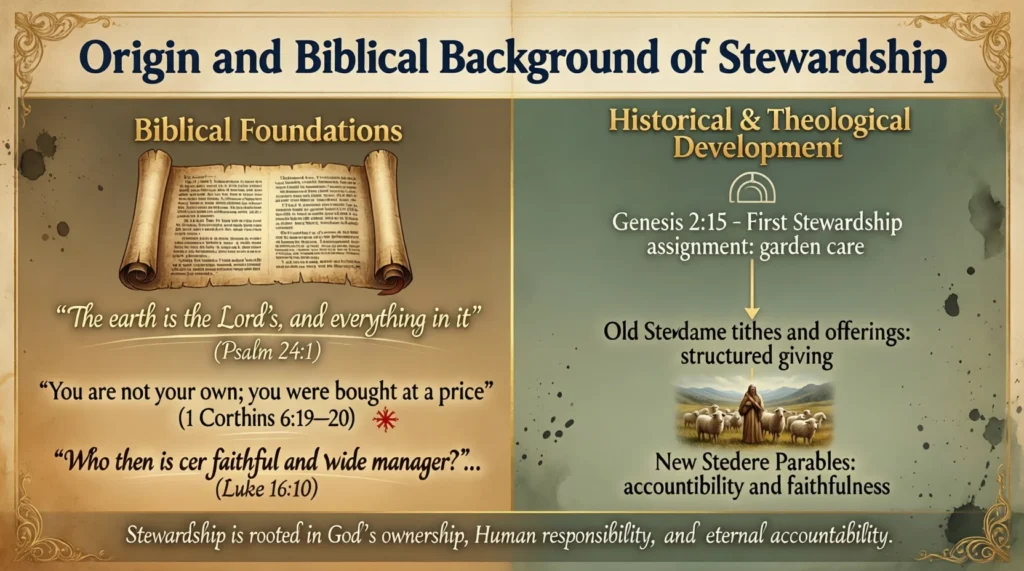
Origin and Biblical Background of Stewardship
Meaning of the Word “Steward”
The English word steward comes from Old English stigweard, meaning “house guardian.” In biblical times, a steward was a trusted manager placed in charge of a household or estate.
Key Biblical Terms
| Language | Word | Meaning |
|---|---|---|
| Hebrew | ish asher al-habayit | One in charge of the house |
| Greek | oikonomos | Household manager or administrator |
The Greek word oikonomos is especially important in the New Testament. It is the root of the modern word economy, highlighting management and accountability.
Stewardship in the Old Testament
Stewardship begins at the very start of the Bible.
1. Stewardship of Creation
“The Lord God took the man and put him in the Garden of Eden to work it and take care of it.” (Genesis 2:15)
Humans are assigned responsibility not ownership over creation.
Key ideas:
- Care, not exploitation
- Responsibility, not dominance
- Accountability to God
2. Stewardship of Resources
Figures like Joseph, David, and Solomon managed wealth, land, and authority on God’s behalf.
Joseph’s leadership in Egypt is a powerful stewardship example planning wisely, storing resources, and saving lives during famine.
Stewardship in the New Testament
The New Testament deepens the meaning of stewardship by connecting it to faithfulness and eternal accountability.
The Parable of the Talents (Matthew 25:14–30)
This parable is one of the clearest teachings on stewardship.
Main lessons:
- God entrusts different amounts to different people
- Faithfulness matters more than quantity
- Neglecting God’s gifts is a serious issue
Stewardship as a Spiritual Requirement
“Moreover, it is required of stewards that they be found faithful.” (1 Corinthians 4:2)
Faithfulness not success or comparison is the biblical standard.
What Are We Called to Be Stewards Of?
Biblical stewardship goes far beyond finances.
1. Stewardship of Money
- Giving generously
- Avoiding greed
- Using wealth to honor God and help others
2. Stewardship of Time
- Living wisely
- Prioritizing what matters
- Avoiding wasted opportunities
3. Stewardship of Gifts and Talents
- Spiritual gifts
- Skills and education
- Leadership and influence
4. Stewardship of the Body
- Health
- Self-control
- Respect for God’s creation
5. Stewardship of the Gospel
Believers are entrusted with sharing God’s message responsibly and truthfully.
Real-World Usage of Stewardship Today
The word stewardship is commonly used in both religious and non-religious contexts.
Modern Examples
- Environmental stewardship
- Financial stewardship
- Corporate or organizational stewardship
- Church leadership stewardship
While modern usage may be broader or more secular, the biblical meaning always emphasizes accountability to God.
Tone-Based Examples of Stewardship in Context
Friendly / Encouraging Tone 😊
“She views her finances as stewardship, asking how her money can serve God and others.”
Neutral / Educational Tone
“Biblical stewardship teaches responsible management of resources entrusted by God.”
Negative / Dismissive Tone
“He rejected the idea of stewardship, believing personal success required no accountability.”
Labeled Example Table: Biblical Stewardship in Practice
| Area of Life | Stewardship Example | Biblical Principle |
|---|---|---|
| Money | Giving generously | God owns all |
| Time | Serving faithfully | Life is temporary |
| Creation | Caring for the earth | Humans are caretakers |
| Talents | Using gifts to serve | Gifts are entrusted |
| Leadership | Serving humbly | Authority is borrowed |
Stewardship vs. Related Biblical Terms
DifferenceStewardship vs. Ownership
| Concept | Meaning |
|---|---|
| Ownership | Full control and rights |
| Stewardship | Care and responsibility under authority |
Using Stewardship vs. Servanthood
- Servanthood emphasizes obedience
- Stewardship emphasizes management and accountability
They work together but are not identical.
Stewardship vs. Dominion
Dominion in Genesis does not mean exploitation. Stewardship defines how dominion is exercised through care and responsibility.
Alternate Meanings of Stewardship
Outside the Bible, stewardship may refer to:
- Environmental conservation
- Corporate governance
- Resource management in nonprofits
These meanings overlap with biblical stewardship but may lack the spiritual accountability to God that defines the biblical view.
Polite or Professional Alternatives to “Stewardship”
Depending on context, you might use:
- Responsible management
- Faithful oversight
- Ethical leadership
- Trust-based responsibility
However, none fully replace the theological depth of stewardship in Scripture.
Why Stewardship Matters in Christian Life
Biblical stewardship:
- Shapes daily decision-making
- Reflects trust in God
- Connects faith with action
- Prepares believers for eternal accountability
Stewardship is not about restriction it’s about purpose.
FAQs
1. What does stewardship mean in simple biblical terms?
It means taking care of what God gives you and using it faithfully for His purposes.
2. Is stewardship only about money in the Bible?
No. It includes time, talents, creation, relationships, and spiritual responsibilities.
3. Who is the best biblical example of stewardship?
Joseph is a strong example, as are the faithful servants in Jesus’ parables.
4. What happens if someone is a poor steward in the Bible?
Scripture teaches that neglect and unfaithfulness lead to loss and accountability.
5. Is stewardship a command or a suggestion?
Biblically, stewardship is an expectation, not an option.
6. How does stewardship relate to giving?
Giving is one expression of stewardship, but stewardship itself is broader.
7. Does stewardship apply to non-Christians?
The concept appears throughout Scripture, but it is primarily a covenant responsibility for believers.
8. How can someone practice biblical stewardship today?
By managing resources wisely, serving others, giving generously, and honoring God in daily choices.
Conclusion:
So, what does stewardship mean in the Bible?
It means living with the understanding that everything belongs to God, and our role is to manage His gifts faithfully, wisely, and gratefully.
Stewardship transforms ordinary actions earning, spending, working, resting into acts of worship. It reminds believers that faith is not only about belief but about responsible living.
When stewardship becomes a lifestyle, it brings clarity, purpose, and spiritual maturity.
Search More Related Articles:
- Biblical Meaning of Defiled: What It Really Means According to Scripture (2026)
- Perseverance Mean in the Bible: Lessons from Paul, Job, and Jesus for 2026

Ryan Thompson is an experienced content writer specializing in slang terms, texting abbreviations, and word meanings. He writes for meanvoro.com, where he creates accurate and easy-to-understand language content for readers.