
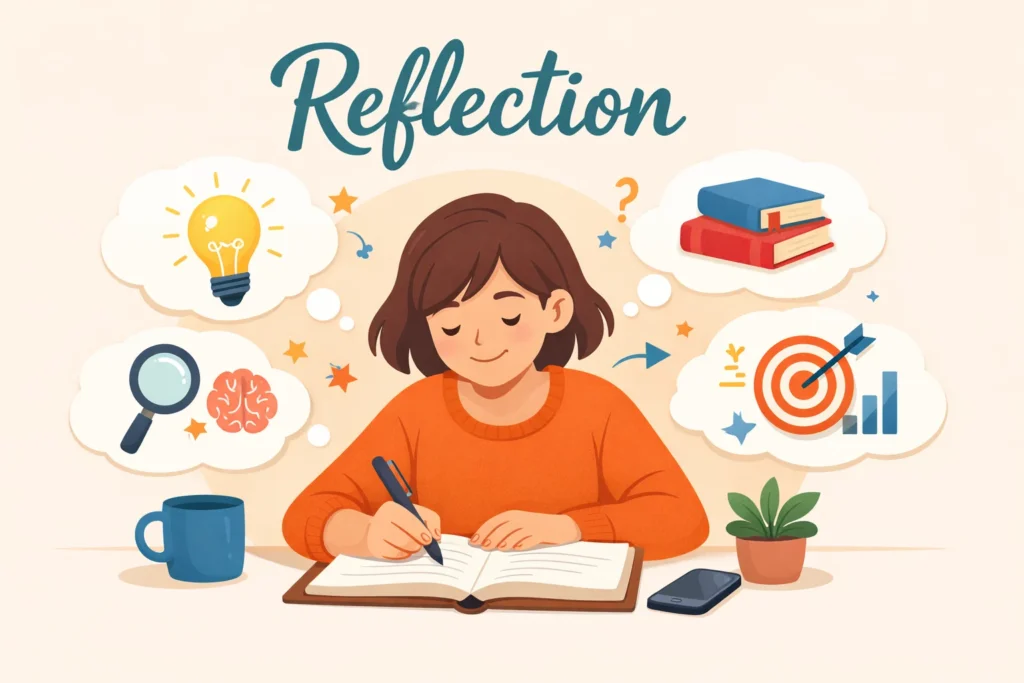
In writing, reflection is the process of thinking critically about your experiences, ideas, or learning and expressing those thoughts clearly on paper.
It involves analyzing personal experiences, drawing lessons, and connecting insights to broader concepts, making it a key skill in academic, professional, and personal writing.
Reflection is a core skill in education and professional development. Whether in academic essays, journals, or professional reports, reflective writing allows individuals to:
- Analyze experiences and actions
- Understand personal growth and development
- Connect theory to practice
- Express insights in a structured, thoughtful way
By mastering reflection in writing, you not only communicate ideas effectively but also demonstrate critical thinking and self-awareness, qualities highly valued in school and the workplace.
Reflection in writing is more than simply summarizing events it encourages self-awareness, critical thinking, and deeper understanding of the topic or experience.
Origin and Purpose of Reflection in Writing
The concept of reflective writing originates from educational theory, particularly from scholars like Donald Schön and John Dewey, who emphasized learning through experience.
- John Dewey (1933) introduced the idea that reflection transforms experiences into learning.
- Donald Schön (1983) highlighted reflection as a tool for professional growth, especially in fields like teaching and nursing.
Today, reflective writing is widely used in:
- Academic essays and journals
- Portfolios and assignments
- Professional development reports
- Personal diaries or blogs
Its main purpose is to make sense of experiences, evaluate them critically, and communicate insights effectively.
Meaning and Usage of Reflection in Writing
Reflection in writing involves analyzing experiences, connecting them to ideas, and expressing personal insights. Unlike narrative or descriptive writing, reflection focuses on thinking deeply and evaluating experiences.
Key Characteristics of Reflective Writing
| Characteristic | Explanation | Example |
|---|---|---|
| Personal | Uses first-person perspective | “I realized that teamwork improved my problem-solving skills.” |
| Analytical | Examines cause, effect, and implications | “I struggled with time management, which taught me the importance of planning.” |
| Insightful | Draws lessons or conclusions | “This experience showed me the value of communication in leadership.” |
| Evidence-based | Supports reflection with examples | “During the group project, we used feedback to improve outcomes.” |
Types of Reflection in Writing
Reflection can appear in different forms depending on the purpose:
- Academic Reflection
- Used in journals, essays, and assignments
- Focuses on learning from experiences
- Example: Reflecting on a lab experiment and analyzing results
- Professional Reflection
- Used in portfolios, reports, or workplace documentation
- Focuses on skills development and performance
- Example: Reflecting on patient care experiences in nursing
- Personal Reflection
- Used in diaries, blogs, or self-assessment
- Focuses on feelings, values, and personal growth
- Example: Reflecting on a volunteer experience and its emotional impact
Examples of Reflection in Writing
Here are examples showing reflective writing in different tones:
| Tone | Reflective Writing Example | Explanation |
|---|---|---|
| Academic | “I realized that my research skills improved after revising my essay multiple times.” | Shows learning and personal growth |
| Professional | “By reflecting on my presentation, I recognized that clear visuals enhanced audience engagement.” | Demonstrates evaluation and professional development |
| Personal | “Volunteering at the shelter helped me understand the importance of empathy in daily life.” | Highlights personal insight and feelings |
Steps to Writing a Reflective Piece
Writing reflection effectively often follows a structured approach:
- Describe the experience – Briefly explain what happened
- Analyze the experience – Examine why it happened and how it affected you
- Draw conclusions – Identify what you learned or how you changed
- Apply insights – Explain how this experience will influence future actions
Tip: Use first-person perspective (I, me, my) for personal reflection and connect your experience to broader concepts or theory for academic reflection.
Common Mistakes in Reflective Writing
| Mistake | Explanation | Solution |
|---|---|---|
| Being too descriptive | Simply narrating events without analysis | Focus on interpretation and insight |
| Lack of structure | Writing random thoughts without coherence | Follow the structured reflection steps |
| Using general statements | Avoiding specifics or personal experience | Include concrete examples |
| Overuse of first-person | Making the writing informal or repetitive | Balance with analysis and evidence |
Comparison With Other Types of Writing
| Writing Type | Purpose | Difference from Reflection |
|---|---|---|
| Narrative | Tell a story | Focuses on what happened, not analysis |
| Descriptive | Describe scenes or events | Focuses on details, not lessons learned |
| Expository | Explain or inform | Focuses on facts, not personal insight |
| Reflective | Analyze and evaluate | Focuses on personal learning and understanding |
Polite and Professional Alternatives
Sometimes, in academic or professional settings, reflection may be framed as:
- Critical analysis – Emphasizes evaluation and reasoning
- Self-assessment – Focuses on personal growth or performance
- Professional insight – Highlights lessons learned from experiences
Example: Instead of writing “I felt nervous giving the presentation,” you could write: “Reflecting on my presentation, I recognized areas to improve my public speaking skills.”
FAQs
- What does reflection mean in writing?
Reflection is the process of thinking critically about experiences or ideas and expressing insights in writing. - Is reflective writing the same as a diary?
Not exactly. Diaries can be reflective but may focus more on daily events without analysis. - What are examples of reflective writing?
Journals, academic essays, personal reflections, and professional development reports. - How do you structure a reflective essay?
Describe the experience, analyze it, draw conclusions, and explain how it will influence future actions. - Why is reflection important in writing?
It helps develop critical thinking, self-awareness, and deeper understanding of learning or experiences. - Can reflection be used in professional settings?
Yes, it is often used in portfolios, performance reviews, and training reports. - Should I use first-person in reflective writing?
Yes, using “I” or “my” makes the reflection personal and authentic. - What is the difference between reflection and analysis?
Reflection focuses on personal insight and learning; analysis focuses on evaluation of events or ideas objectively.
Practical Tips for Effective Reflective Writing
- Be honest and thoughtful about your experiences
- Use specific examples to support your insights
- Connect personal experience to broader learning or theory
- Maintain a clear structure: description, analysis, conclusion, application
- Avoid overgeneralization or overly casual tone
Conclusion
Reflection in writing is a powerful tool for personal, academic, and professional growth. By thinking critically about experiences and expressing insights, you develop self-awareness, critical thinking, and communication skills.
- Pro tip: Structure your writing to guide the reader through your thought process
- Practice tip: Regular journaling or reflective exercises helps strengthen reflective writing skills
Mastering reflective writing makes you a more thoughtful writer, learner, and professional.
Discover More Related Articles:
- Lamentation Mean in the Bible: Why It Matters for Christians in 2026
- Adam Mean in the Bible: Symbolism, and Impact in 2026

Madison Taylor is an experienced content writer who focuses on researching and explaining word meanings, slang, and texting terms. She writes for meanvoro.com, creating clear and accurate to help readers understand language easily.