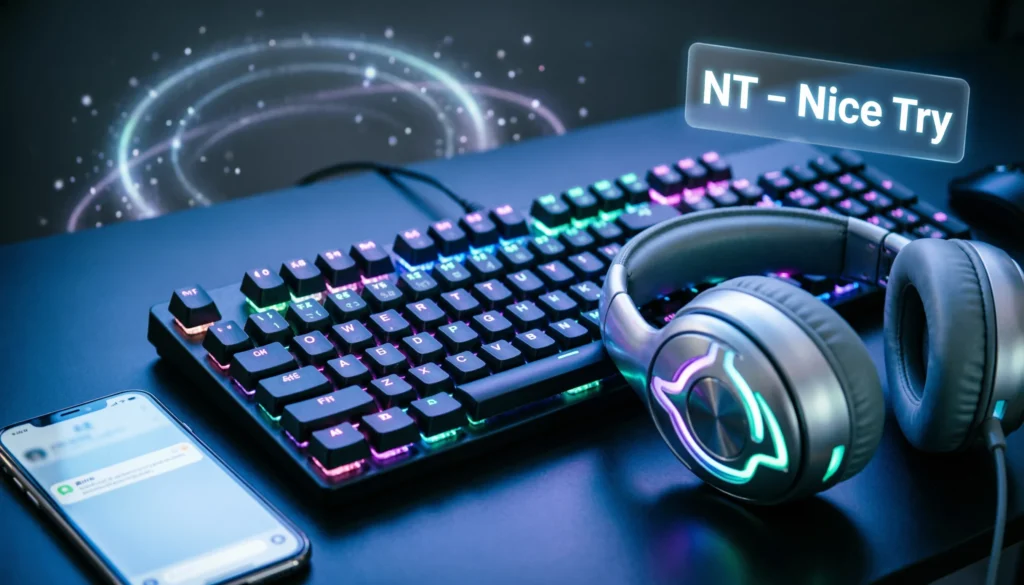
In gaming, “NT” stands for “Nice Try.” It is commonly used in online multiplayer games to acknowledge a teammate’s effort after an unsuccessful attempt, often in a supportive or encouraging tone.
If you’ve ever played an online multiplayer game whether it’s Valorant, Fortnite, Call of Duty, League of Legends, or CS:GO you’ve probably seen someone type “nt” in chat after a round ends. At first glance, it may look cryptic, especially if you’re new to gaming slang.
But in reality, NT is one of the most common and positive abbreviations used in competitive gaming.
Gaming communities rely heavily on quick shorthand communication. Since players don’t always have time to type full sentences during intense matches, abbreviations like NT help keep communication fast and efficient. But beyond speed, NT also plays an important role in team morale and sportsmanship.
In this guide, we’ll break down what NT means in gaming, how it’s used, tone variations, examples in context, comparisons with similar gaming slang, and when it might be used sincerely or sarcastically.
Literal Meaning of “NT” in Gaming
In gaming chat, NT = Nice Try.
It is typically used:
- After a teammate almost wins a round
- When someone fails but made a strong effort
- To encourage teammates
- To maintain positive team morale
Basic Example
- Player almost clutches a 1v4 situation but loses.
- Teammate types: “nt”
Meaning: You did well, even though we lost.
Why “NT” Is Popular in Online Games
Gaming moves fast. Players need quick, efficient communication. Typing “nice try” during or after a match takes time, so “nt” became the standard shorthand.
Reasons for Popularity:
- Quick to type
- Positive and supportive
- Recognized across multiple games
- Helps reduce toxicity
You’ll see NT in games like:
- Valorant
- CS:GO / CS2
- League of Legends
- Apex Legends
- Overwatch
- Rainbow Six Siege
How “NT” Is Used in Different Contexts
Although “NT” usually means “Nice Try,” tone matters a lot in gaming culture.
1. Genuine Encouragement (Positive Tone) 🎮
Used sincerely to support teammates.
Example:
- “nt, that was close!”
- “nt bro, good effort.”
Tone: Friendly, supportive, respectful.
2. Neutral Acknowledgment
Sometimes players use NT simply as routine etiquette.
Example:
- “nt”
- “nt wp” (Nice try, well played)
Tone: Casual, neutral, sportsmanlike.
3. Sarcastic or Toxic Use ⚠️
In competitive environments, NT can sometimes be used sarcastically.
Example:
- A teammate makes a clear mistake.
- Someone types: “nt…”
Tone: Could imply criticism or frustration.
💡 Tip: If you’re unsure about tone, look at the context of the match and previous chat behavior.
Example Scenarios Table
| Scenario | Chat Message | Meaning | Tone |
|---|---|---|---|
| Player almost wins 1v3 | “nt!” | Good effort | Positive |
| Player loses close round | “nt wp” | Nice try, well played | Encouraging |
| Player makes obvious mistake | “nt…” | Possibly sarcastic | Negative |
| Casual team match | “nt bro” | Friendly support | Positive |
Comparison With Similar Gaming Terms
Gaming slang includes many short abbreviations similar to NT.
| Abbreviation | Meaning | When Used |
|---|---|---|
| GG | Good Game | End of match |
| WP | Well Played | Compliment |
| GLHF | Good Luck, Have Fun | Start of match |
| TY | Thank You | Appreciation |
| MB | My Bad | Apology |
| NT | Nice Try | After failed effort |
NT vs WP
- NT = Acknowledges effort despite failure
- WP = Praises good performance (win or loss)
Example:
- “nt wp” = Nice try, well played.
Tone and Gaming Culture
Gaming culture varies by community. In competitive ranked matches, players may use NT strategically to:
- Maintain morale
- Prevent teammates from tilting
- Encourage teamwork
In toxic environments, however, tone can shift quickly.
🎮 Pro Tip: Using NT sincerely can make you a better teammate and improve team chemistry.
Alternate Meanings of “NT”
Outside gaming, NT can mean other things, including:
| Context | Meaning |
|---|---|
| Texting | No Thanks |
| Internet slang | Not True |
| Australia | Northern Territory |
| Business | Net Tons |
However, in gaming chat, it almost always means Nice Try.
When Should You Use “NT”?
You can use NT when:
- A teammate almost clutches a round
- Someone makes a strong effort but fails
- You want to reduce negativity
- You want to show sportsmanship
Avoid using it:
- Sarcastically
- After obvious trolling
- To mock teammates
Positive communication improves gameplay experience.
Polite or Longer Alternatives
If you’re using voice chat or typing more fully, you could say:
- “Nice try!”
- “That was close!”
- “Good effort!”
- “You almost had it!”
- “Unlucky, good attempt!”
These feel more personal than just “nt.”
FAQs
- What does NT stand for in gaming?
It stands for “Nice Try.” - Is NT positive or negative?
Usually positive, but tone can change meaning. - When do gamers say NT?
After a teammate nearly wins but loses. - Is NT used in all games?
Yes, especially in competitive multiplayer games. - What’s the difference between NT and GG?
NT = Nice Try (after effort).
GG = Good Game (end of match). - Can NT be sarcastic?
Yes, depending on tone and context. - Should beginners use NT?
Absolutely it promotes good sportsmanship. - Is NT considered toxic?
Not inherently. It depends on intent.
Conclusion
In gaming, “NT” means “Nice Try”, and it’s one of the most common abbreviations used in competitive online matches. While simple, it carries significant value in team-based gameplay. Used sincerely, NT promotes encouragement, sportsmanship, and positive team dynamics.
However, like many gaming terms, tone and context matter. In most cases, it’s supportive and respectful but it can become sarcastic if used improperly.
If you’re looking to improve your gaming communication, adding a genuine “nt” after a teammate’s effort is a small but powerful way to boost morale and create a better team environment.
Discover More Related Articles:
- Perseverance Mean in the Bible: Lessons from Paul, Job, and Jesus for 2026
- Subdue Meaning in the Bible: Lessons for 2026

Ryan Thompson is an experienced content writer specializing in slang terms, texting abbreviations, and word meanings. He writes for meanvoro.com, where he creates accurate and easy-to-understand language content for readers.