
In the Bible, justification refers to the act of God declaring a sinner righteous by faith in Jesus Christ. It is not based on human works or merit but on God’s grace, forgiving sins and restoring a right relationship between humanity and Himself.
Have you ever wondered what it truly means to be “justified” in the eyes of God? The term justification appears throughout the New Testament, particularly in the writings of the Apostle Paul, and forms a central concept in Christian theology.
At its core, justification is about God declaring us righteous, despite our imperfections, and reconciling us to Himself.
Think of it like this: if your spiritual account was a ledger filled with mistakes and debts, justification is God wiping that slate clean not because of anything you did, but because of His mercy and the sacrifice of Jesus Christ. This powerful idea brings comfort, hope, and a deep sense of spiritual freedom.
In this article, we’ll explore the origin, meaning, usage, examples, comparisons, and FAQs about justification, giving you a complete understanding of this cornerstone biblical concept.
Origin of the Term “Justification”
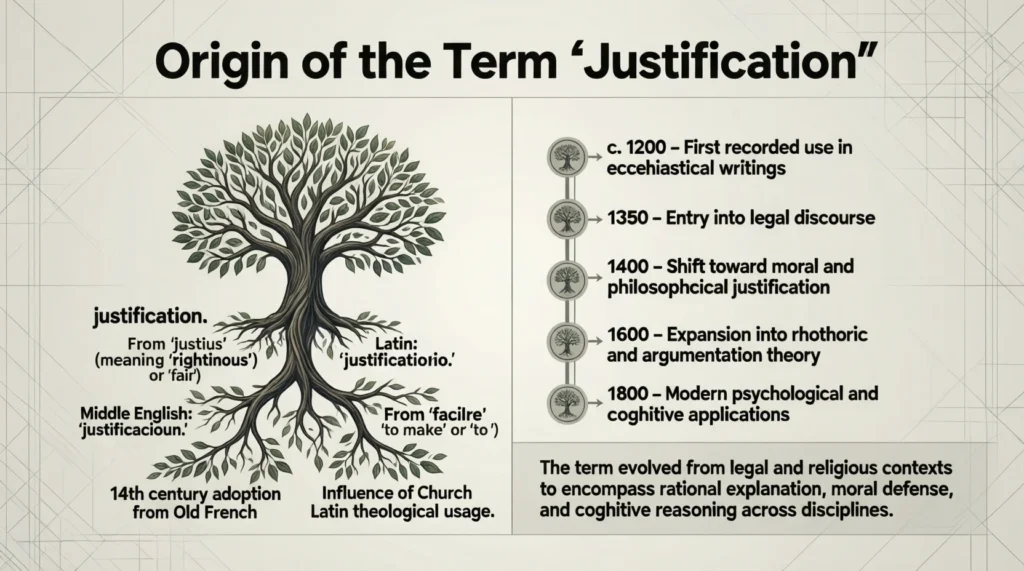
The word justification comes from the Latin justificatio, meaning “making righteous” or “declaring righteous.” In the Bible, it is translated from the Greek word δικαίωσις (dikaiōsis), which carries a legal and moral meaning: to declare someone to be in the right or to acquit them from guilt.
Biblical Usage Highlights
- Romans 3:28 (NIV): “For we hold that one is justified by faith apart from works of the law.”
- Galatians 2:16 (NIV): “…a person is not justified by the works of the law but through faith in Jesus Christ.”
These passages emphasize that justification is God’s declaration, not a personal achievement. It became a popular term during the Reformation, as Martin Luther highlighted justification by faith alone (sola fide) as a key principle, challenging the prevailing notion that human works could earn salvation.
Real-World Usage of Justification
While “justification” is primarily theological, the term is also used in everyday language to mean a reason or explanation that makes an action right or acceptable. For example:
- A student might say, “I have justification for missing class because of illness.”
- In legal terms, justification refers to a valid defense that explains why an action was lawful or excusable.
In a biblical sense, however, the justification we are talking about is spiritual, eternal, and based on faith in God’s grace, not merely practical or legal reasoning.
Examples
Here’s how justification works in real-world and biblical scenarios:
| Context | Example | Tone |
|---|---|---|
| Biblical | Paul explains in Romans 5:1 that believers “have peace with God through our Lord Jesus Christ.” | Neutral/Encouraging |
| Friendly/Personal | “Even though I’ve made mistakes, I know God has justified me through faith, giving me peace.” | Friendly/Encouraging |
| Negative/Dismissive | “Some people think they can earn God’s favor by good deeds, but justification is not about that.” | Slightly Critical |
Tip: Using examples helps readers relate the concept of justification to their own life, making it more meaningful and less abstract.
Comparison: Justification vs. Related Terms
To fully understand justification, it’s helpful to compare it with related biblical concepts:
| Term | Definition | Key Difference from Justification |
|---|---|---|
| Sanctification | The process of becoming holy or more like Christ over time. | Justification is a one-time declaration; sanctification is ongoing. |
| Redemption | Being rescued or bought back from sin. | Redemption focuses on the act of saving; justification focuses on being declared righteous. |
| Forgiveness | God removing guilt for sins. | Forgiveness cancels the penalty; justification also declares righteousness. |
| Grace | God’s unearned favor toward humanity. | Grace is the foundation; justification is the result. |
Understanding these differences helps prevent confusion between legal declaration (justification) and personal growth or moral improvement (sanctification).
Alternate Meanings
Though primarily theological, justification can also mean:
- Rational explanation: “He gave a justification for his late arrival.”
- Defense in law: “The lawyer argued justification for self-defense.”
In all uses, the core idea remains: something that makes an action or state acceptable or right.
Polite or Professional Alternatives
When writing or speaking outside theology, you can use alternatives such as:
- Explanation
- Reasoning
- Validation
- Defense
For example, instead of saying, “I need justification for this decision,” you might say, “I have a valid explanation for this decision.”
FAQs
1. What does justification mean in simple words?
Justification means being declared right or righteous by God, not because of what we do, but because of faith in Jesus Christ.
2. Is justification the same as salvation?
Not exactly. Justification is part of salvation the moment God declares you righteous. Salvation includes justification, sanctification, and eventual glorification.
3. How is justification received?
Through faith in Jesus Christ and trusting in His sacrifice, not through works or personal effort.
4. Can a person lose their justification?
Different Christian traditions have different views. Some believe justification is permanent (once justified, always justified), while others see it as conditional on continuing faith.
5. What is the difference between justification and sanctification?
- Justification: Being declared righteous immediately.
- Sanctification: Becoming righteous in behavior and character over time.
6. Where in the Bible is justification explained?
Key passages include:
- Romans 3:24-28
- Romans 5:1
- Galatians 2:16
- James 2:24 (note the role of works as evidence of faith)
7. Why is justification important in Christianity?
It assures believers of peace with God, removes guilt, and forms the foundation of the Christian faith.
8. How can I explain justification to a friend?
You can say: “Justification is God declaring us right with Him through Jesus, even though we make mistakes it’s like getting a clean spiritual slate.”
Practical Tips for Applying Justification
- Reflect on faith, not works: Remember that justification is about trusting God, not earning merit.
- Live with gratitude: Being justified inspires a life of obedience and thankfulness.
- Share the concept: Use relatable examples when explaining it to others.
- Distinguish from personal effort: Avoid confusing justification with personal achievement.
Conclusion
In summary, justification in the Bible is a profound, life-changing declaration: God pronounces sinners righteous through faith in Jesus Christ. It is the foundation of Christian belief, giving peace, hope, and spiritual freedom.
By embracing justification, believers can experience peace with God and the transformative power of His grace in daily life.
Search More Related Articles :
- Perseverance Mean in the Bible: Lessons from Paul, Job, and Jesus for 2026
- Subdue Meaning in the Bible: Lessons for 2026

Madison Taylor is an experienced content writer who focuses on researching and explaining word meanings, slang, and texting terms. She writes for meanvoro.com, creating clear and accurate to help readers understand language easily.