

Hallelujah in the Bible means “Praise the LORD.”
It comes from the Hebrew phrase hallel Yah, combining hallel (“to praise”) and Yah (a shortened form of Yahweh, the name of God).
In Scripture, “hallelujah” is a joyful command or declaration calling people to praise God for who He is and what He has done.
“Hallelujah!”
It’s a word shouted in joy, sung in worship, and spoken in moments of deep relief or gratitude. You hear it in church services, gospel songs, classical music, and even everyday conversations. But what does hallelujah really mean in the Bible, and why has this ancient word remained so powerful across centuries and cultures?
In this in-depth guide, we’ll explore the biblical meaning of hallelujah, its Hebrew roots, how it’s used in Scripture, and how its meaning shapes Christian worship today. Along the way, you’ll see examples, comparisons with similar biblical terms, tone variations, and practical tips for understanding and using the word accurately.
Why the Word “Hallelujah” Still Matters Today
Few biblical words have crossed from ancient worship into modern, everyday language as smoothly as hallelujah. It appears:
- In the Psalms
- In heavenly visions in Revelation
- In hymns, worship songs, and choirs
- In casual speech to express relief, joy, or victory
Understanding what hallelujah means in the Bible helps us use the word with deeper meaning rather than as just a religious catchphrase or emotional outburst.
Origin of Hallelujah in the Bible
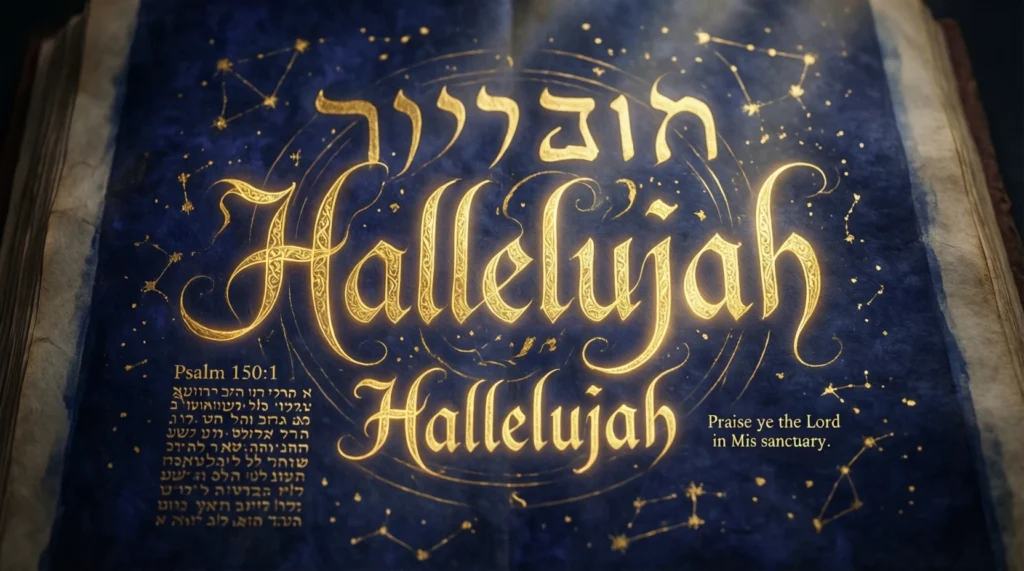
Hebrew Roots Explained
The word hallelujah comes directly from Biblical Hebrew:
- Hallel (הָלַל) – to praise, boast, or celebrate
- Yah (יָהּ) – a shortened form of Yahweh, the covenant name of God
Put together, hallelujah literally means:
“Praise Yah” or “Praise the LORD.”
Unlike many English religious words, hallelujah is not translated in most Bible versions it is transliterated, meaning the original Hebrew sound is preserved.
Where Hallelujah Appears in the Bible
Interestingly, hallelujah appears only in certain parts of Scripture, not throughout the entire Bible.
Old Testament (Hebrew Bible)
- Most commonly found in the Book of Psalms
- Especially frequent in Psalms 146–150
- Often opens or closes a psalm
Example idea (paraphrased for clarity):
“Praise the LORD. Praise the LORD, O my soul.”
These psalms are sometimes called the “Hallelujah Psalms.”
New Testament
- Appears only in Revelation 19
- Spoken by heavenly multitudes praising God for His justice and victory
This makes hallelujah one of the few Hebrew words used directly in the Greek New Testament, emphasizing its sacred importance.
What Hallelujah Means Theologically
From a biblical perspective, hallelujah is more than emotional excitement.
Key Biblical Meanings
In Scripture, hallelujah expresses:
- Worship – honoring God for His holiness
- Gratitude – thanking God for His goodness
- Victory – celebrating God’s triumph over evil
- Hope – trusting God’s eternal reign
It is both:
- A command (“Praise the LORD!”)
- A response (“We praise You, Lord!”)
How Hallelujah Is Used in the Bible
1. As a Call to Worship
Many psalms begin with hallelujah as an invitation to worship together.
- It draws attention
- It unites people in praise
- It sets a joyful tone
2. As a Response to God’s Actions
In Revelation, hallelujah follows God’s judgment and salvation, showing that praise can coexist with awe and reverence.
3. As Pure Celebration
Sometimes, hallelujah is simply joy overflowing praise without explanation.
Real-World Usage of “Hallelujah” Today
While hallelujah has a deep biblical meaning, it’s also widely used outside church settings.
Common Modern Uses
- Religious: Worship services, prayers, sermons
- Music: Hymns, gospel, pop, and classical music
- Everyday speech: Expressing relief or happiness
Example:
“Hallelujah! I finally passed my exam!”
In these cases, the word may not always consciously mean “praise the LORD,” but its joyful tone comes from its biblical roots.
Examples
| Tone | Example | Context |
|---|---|---|
| Joyful | “Hallelujah! God answered our prayers!” 🙌 | Celebration |
| Reverent | “Hallelujah, for the Lord reigns.” | Worship |
| Grateful | “Hallelujah for His mercy.” | Thanksgiving |
| Casual | “Hallelujah, the weekend’s here!” | Informal speech |
| Dismissive | “Oh, hallelujah… another meeting.” | Sarcasm (non-biblical usage) |
Note: Sarcastic or dismissive use is common in speech but does not reflect biblical meaning.
Hallelujah vs. Related Biblical Terms
Many people wonder how hallelujah compares to other praise-related words in the Bible.
Comparison Table
| Term | Meaning | Language | Usage |
|---|---|---|---|
| Hallelujah | Praise the LORD | Hebrew | Joyful praise |
| Amen | So be it / Truly | Hebrew | Agreement, affirmation |
| Hosanna | Save, please / Praise | Hebrew | Worship and plea |
| Praise God | Honor God | English | General worship |
| Alleluia | Praise the LORD | Greek/Latin | Liturgical worship |
Hallelujah vs. Alleluia: What’s the Difference?
- Hallelujah – Hebrew-based spelling, common in English Bibles
- Alleluia – Greek/Latin form, used often in liturgical traditions
Meaning: Exactly the same
Difference: Language and tradition, not theology
Are There Alternate Meanings of Hallelujah?
Strictly speaking, hallelujah has only one true meaning in the Bible: Praise the LORD.
However, culturally it can imply:
- Relief (“Thank goodness!”)
- Celebration (“We did it!”)
- Triumph (“Victory at last!”)
These are applications, not alternate biblical definitions.
Polite or Professional Alternatives to “Hallelujah”
In formal writing or professional settings, you might choose alternatives that convey gratitude or joy without religious language.
Examples:
- “Thank God”
- “I’m deeply grateful”
- “This is wonderful news”
- “We are thankful for this outcome”
In worship or faith-based contexts, hallelujah remains entirely appropriate.
Popularity of Hallelujah in Music and Worship
The word hallelujah is one of the most sung words in religious music.
Why?
- It’s short and powerful
- It transcends language barriers
- It carries centuries of meaning
From ancient chants to modern worship songs, hallelujah continues to unite voices in praise.
FAQs
1. What does hallelujah literally mean in the Bible?
It literally means “Praise the LORD.”
2. Is hallelujah a prayer or a statement?
It can be both a command to praise or a response of praise.
3. Why is hallelujah not translated in most Bibles?
Because it is considered a sacred expression preserved in its original form.
4. How many times does hallelujah appear in the Bible?
It appears multiple times in Psalms and four times in Revelation 19.
5. Is it wrong to say hallelujah casually?
Not necessarily, but casual use may lack the depth of its biblical meaning.
6. Is hallelujah only a Christian word?
No. It originates in Jewish Scripture and is shared across Judeo-Christian traditions.
7. What’s the difference between hallelujah and praise God?
“Hallelujah” is a direct biblical phrase, while “praise God” is a translated expression.
8. Why is hallelujah associated with joy?
Because in Scripture it is often spoken after God’s victory, mercy, or faithfulness.
Conclusion: The Timeless Power of Hallelujah
So, what does hallelujah mean in the Bible?
At its heart, it is a joyful, reverent call to praise the LORD a word that connects worshippers across generations, cultures, and languages.
Whether spoken in a quiet prayer, sung in a crowded church, or whispered in gratitude during everyday life, hallelujah carries a depth far beyond its syllables. Understanding its biblical meaning helps us use the word not just emotionally, but meaningfully.
Practical tip:
The next time you say hallelujah, pause and remember you’re echoing an ancient, sacred call to praise God.
Search More Related Articles:
- Biblical Meaning of Defiled: What It Really Means According to Scripture (2026)
- Perseverance Mean in the Bible: Lessons from Paul, Job, and Jesus for 2026

Ryan Thompson is an experienced content writer specializing in slang terms, texting abbreviations, and word meanings. He writes for meanvoro.com, where he creates accurate and easy-to-understand language content for readers.