
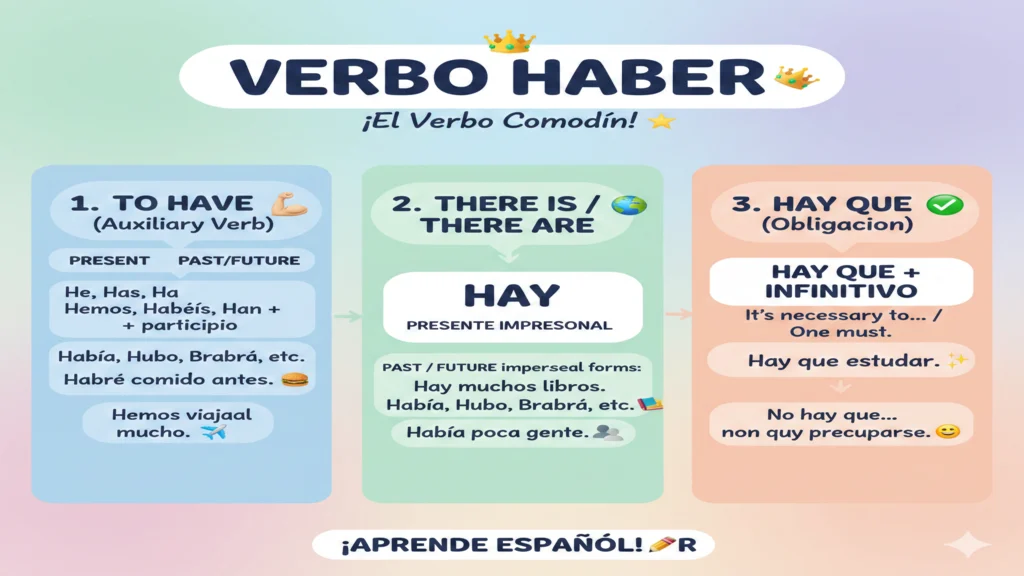
Definition:
“Haber” in Spanish is a versatile auxiliary verb commonly used to indicate existence, form perfect tenses, or imply obligation. Depending on context, it can mean “to have,” “there is/are,” or appear in expressions like “hay que” to convey necessity.”
Spanish learners often encounter haber early in their studies, but its usage can be tricky due to its multiple functions. In this article, we’ll break down everything you need to know from origins to real-world usage, examples, comparisons, and polite alternatives so you can master haber with confidence. 🌟
Origin and Popularity of “Haber” in Spanish
The verb haber has deep roots in the Spanish language:
- Origin: Derived from the Latin verb habere, which meant “to have” or “to hold.” Over time, Spanish retained its auxiliary function, especially for forming compound tenses.
- Popularity: Haber is one of the most commonly used verbs in Spanish because it appears in perfect tenses (like he comido – “I have eaten”), existential phrases (like hay un libro – “there is a book”), and expressions of necessity (like hay que estudiar – “one must study”).
- Why learners struggle: Unlike English “have,” haber isn’t directly used for possession in most modern Spanish this is usually tener. Instead, haber is primarily an auxiliary or existential verb, which makes understanding context essential.
Main Uses of “Haber” in Spanish
1. Existential Use – “There is / There are”
Haber is widely used in the form hay to indicate existence:
| Spanish | English | Context / Tone |
|---|---|---|
| Hay un perro en el jardín. | There is a dog in the garden. | Neutral / informative |
| No hay pan en la tienda. | There is no bread in the store. | Slightly negative / factual |
| ¿Hay alguien aquí? | Is anyone here? | Friendly / questioning |
- Tip: “Hay” is impersonal. It doesn’t refer to a specific person as the subject it simply announces existence.
2. Perfect Tenses – “To Have Done Something”
Haber acts as an auxiliary verb to form perfect tenses like present perfect, past perfect, and future perfect.
- Present Perfect (pretérito perfecto compuesto): he, has, ha, hemos, habéis, han
Example: He terminado mi tarea. → “I have finished my homework.” ✅ - Past Perfect (pluscuamperfecto): había, habías, había, habíamos, habíais, habían
Example: Habíamos comido antes de salir. → “We had eaten before leaving.” - Future Perfect: habré, habrás, habrá…
Example: Habré terminado para mañana. → “I will have finished by tomorrow.”
Key point: Always pair haber with a past participle (-ado, -ido) to form these tenses.
3. Expressions of Obligation – “Hay que”
Haber appears in impersonal constructions to express necessity:
- Hay que + infinitive = “One must / It is necessary to…”
Examples:- Hay que limpiar la casa antes de la fiesta. → “The house must be cleaned before the party.”
- Hay que estudiar para aprobar el examen. → “You have to study to pass the exam.”
Tip: This is neutral or slightly formal, perfect for polite instructions.
4. Conditional / Subjunctive Uses
In more advanced Spanish, haber appears in compound forms with subjunctive or conditional moods:
- Present Subjunctive: Espero que hayas comido. → “I hope you have eaten.”
- Past Subjunctive: Si hubiera sabido, habría venido. → “If I had known, I would have come.”
Tip: This usage is essential for hypotheticals and polite or formal scenarios.
Examples with Context and Tone
Here are some everyday examples of haber in different tones:
- Friendly / Casual:
- Hay mucha comida en la fiesta 😋. → “There’s a lot of food at the party.”
- He visto tu mensaje. → “I have seen your message.”
- Neutral / Informative:
- Hay un informe importante en tu escritorio. → “There is an important report on your desk.”
- Hemos completado el proyecto. → “We have completed the project.”
- Negative / Dismissive:
- No hay razón para preocuparse. → “There’s no reason to worry.”
- No había solución evidente. → “There wasn’t an obvious solution.”
Emoji tip: Using light emojis can convey friendliness or casual tone, especially in text conversations.
Comparison with Similar Terms
Haber vs Tener
| Verb | Primary Meaning | Example | Key Difference |
|---|---|---|---|
| Haber | Auxiliary / Existential | He comido. → “I have eaten.” | Does not indicate possession directly in modern Spanish. |
| Tener | Possession / Physical / Obligations | Tengo un coche. → “I have a car.” | Shows ownership or necessity; not used for compound tenses. |
- Tip: Confusing haber and tener is common for beginners. Remember:
- Haber = “there is / have (done something)”
- Tener = “to have / to possess”
Existential “Haber” vs “Estar / Ser”
- Hay → “There is / There are”
- Está → “It is located / it is currently”
- Es → “It is (permanent / descriptive)”
| Sentence | Correct Verb | Explanation |
|---|---|---|
| Hay un café cerca. | Haber | Announces existence of a café. |
| El café está cerca. | Estar | Indicates the café’s location. |
| El café es delicioso. | Ser | Describes a permanent characteristic. |
Alternate Meanings
While haber primarily serves as an auxiliary or existential verb, it also appears in some expressions:
- Haber lugar → “There is room / space”
- Haber suerte → “To be lucky / Have luck”
- Haber de + infinitive → Old-fashioned or formal: “must / ought to” (He de estudiar → “I must study”)
Polite and Professional Alternatives
Sometimes haber can be replaced with more formal or polite constructions:
- Instead of Hay que enviar el informe, you could say:
- Es necesario enviar el informe. → “It is necessary to send the report.” ✅
- Instead of He terminado el proyecto, in formal writing:
- El proyecto ha sido completado. → “The project has been completed.” ✅
Tip: Passive voice or formal infinitive phrases often sound more professional in emails, reports, or academic contexts.
Common Mistakes to Avoid
- Confusing haber with tener for possession.
- Forgetting to use past participles in compound tenses.
- Using hay in inappropriate contexts (e.g., for permanent traits instead of existence).
- Overusing haber de, which is mostly archaic.
Example Table – Haber in Different Contexts
| Function | Spanish Example | English Translation | Tone |
|---|---|---|---|
| Existential | Hay tres libros en la mesa. | “There are three books on the table.” | Neutral |
| Present Perfect | He viajado a España. | “I have traveled to Spain.” | Friendly / Informative |
| Past Perfect | Habíamos visto la película antes. | “We had seen the movie before.” | Neutral / Past tense |
| Obligation | Hay que respetar las reglas. | “One must respect the rules.” | Polite / Instructional |
| Hypothetical | Si hubiera sabido, no habría ido. | “If I had known, I wouldn’t have gone.” | Conditional / Formal |
| Idiomatic | Hay suerte hoy. | “There is luck today.” | Casual / Friendly |
FAQs
1. What does “haber” mean in Spanish?
It primarily functions as an auxiliary verb for perfect tenses, indicates existence (hay), or expresses obligation (hay que).
2. How do you use “haber” for “have done something”?
Combine haber in the correct tense with a past participle: he comido → “I have eaten.”
3. Is “haber” used for possession?
Not usually. Use tener for ownership: tengo un coche → “I have a car.”
4. What is the difference between “hay” and “está”?
Hay announces existence; está indicates location or state.
5. Can “haber” be used in polite instructions?
Yes. For example: Hay que completar el formulario → “One must complete the form.”
6. What are common expressions with “haber”?
Haber de (must/ought to), haber suerte (to be lucky), hay lugar (there is room).
7. How do you form the past perfect with “haber”?
Use the imperfect form of haber + past participle: habíamos estudiado → “We had studied.”
8. Are there regional differences in using “haber”?
Mostly consistent, but some formal constructions like haber de + infinitive are less common in Latin America than in Spain.
Conclusion:
Haber is essential for fluent Spanish, acting as:
- An auxiliary verb in perfect tenses.
- An existential verb (hay) for “there is/are.”
- A formal/impersonal way to express obligation (hay que).
Practical Tips for Learners:
- Memorize hay and he/has/ha forms first.
- Pair haber with past participles for compound tenses.
- Use tener for possession to avoid confusion.
- Practice common expressions: hay que, hay suerte, haber de.
Mastering haber will boost your Spanish fluency, comprehension, and confidence in both casual and formal contexts! 🎉
Discover More Related Articles:
- Biblical Meaning of Defiled: What It Really Means According to Scripture (2026)
- The Meaning of the Rainbow in the Bible : Explained for Christians (2026)

Ryan Thompson is an experienced content writer specializing in slang terms, texting abbreviations, and word meanings. He writes for meanvoro.com, where he creates accurate and easy-to-understand language content for readers.