
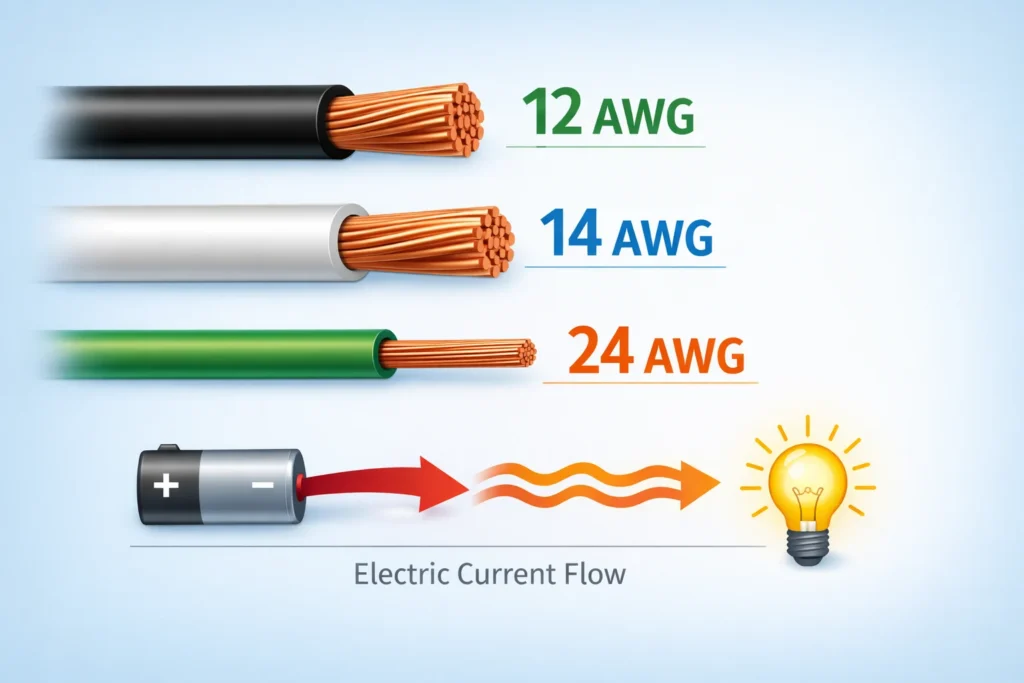
In electrical terms, “gauge” refers to the thickness or diameter of a wire. The gauge determines the wire’s current-carrying capacity, resistance, and suitability for different applications.
A smaller gauge number means a thicker wire, while a larger gauge number indicates a thinner wire.
If you’ve ever shopped for electrical wire, worked on a DIY project, or studied electronics, you’ve likely seen terms like “12-gauge wire” or “AWG 24.” But what does gauge mean in wire, and why is it important?
Wire gauge isn’t just a number it affects safety, efficiency, and performance in electrical systems. Using the wrong gauge can lead to overheating, energy loss, or even fire hazards.
In this guide, we’ll explain what wire gauge is, how it’s measured, its standards, real-world applications, and practical tips. You’ll also find comparisons, tables, and examples to help you choose the right wire gauge for any project.
Literal Meaning of “Gauge” in Wire
In the context of electricity and wiring, gauge measures the physical size (diameter) of the conductor:
- Smaller gauge number → thicker wire → higher current capacity
- Larger gauge number → thinner wire → lower current capacity
Example:
- “12-gauge wire” is thicker than “14-gauge wire”.
- Thicker wires can safely carry more electricity over longer distances.
Wire Gauge Standards
Different countries and industries use standardized wire gauge systems to ensure consistency:
1. American Wire Gauge (AWG)
- Most common in North America
- Measures the diameter of round, solid, nonferrous wires
- Rule of thumb: Lower number = thicker wire
Example Table (AWG Size vs Diameter)
| AWG | Diameter (inches) | Typical Use |
|---|---|---|
| 4 | 0.2043 | Large appliances, service entrance |
| 8 | 0.1285 | Air conditioners, heavy tools |
| 12 | 0.0808 | Household outlets, lighting circuits |
| 14 | 0.0641 | Small household appliances, lamps |
| 24 | 0.0201 | Electronics, low-voltage wiring |
2. SWG (Standard Wire Gauge)
- Used in UK and some Commonwealth countries
- Slightly different diameter values compared to AWG
- Often used for metal fabrication, jewelry, and small electronics
3. Metric Wire Gauge
- Measures wire diameter in millimeters (mm)
- Common in Europe and Asia
- Example: 1.5 mm², 2.5 mm², etc.
Conversion Tip: AWG and mm² are not directly intuitive use conversion charts for safety.
Why Wire Gauge Matters
Choosing the right gauge is crucial for safety, efficiency, and functionality.
1. Current-Carrying Capacity
- Thicker wires carry more current without overheating.
- Thin wires carrying too much current can cause melting insulation or fire hazards.
2. Voltage Drop
- Thin wires over long distances cause higher voltage drops, reducing efficiency.
- Thicker wires maintain voltage and protect sensitive electronics.
3. Mechanical Strength
- Larger gauge wires are stronger and more durable for installation.
- Smaller wires are flexible but fragile, suitable for electronics or low-power circuits.
Real-World Examples of Wire Gauge Usage
| Wire Gauge | Typical Use | Notes |
|---|---|---|
| 4 AWG | Electric ovens, main panel feeds | High-current circuits |
| 8 AWG | AC units, large appliances | Heavy-duty household circuits |
| 12 AWG | Standard outlets, lighting | Safe for 20A circuits |
| 14 AWG | Lamps, low-power outlets | 15A circuits max |
| 24 AWG | Electronics, speaker wires | Low current, sensitive devices |
Example Sentences:
- “For a 20-amp circuit, you should use 12-gauge wire.”
- “Don’t use 14-gauge wire for your oven; it can overheat.”
Comparison With Related Terms
| Term | Meaning | Difference |
|---|---|---|
| Gauge | Wire thickness/diameter | Determines current capacity |
| AWG | American Wire Gauge system | Specific standard for gauge |
| Stranded wire | Multiple small wires twisted together | More flexible, same gauge rating |
| Solid wire | Single conductor | Less flexible, same gauge rating |
| Cross-sectional area | Area of the wire conductor (mm²) | Metric equivalent to gauge |
💡 Tip: When comparing wires, consider gauge, material (copper vs aluminum), and length to calculate proper current capacity.
Polite and Professional Alternatives / Technical Terms
- Conductor diameter – precise engineering term
- Cross-sectional area – commonly used in technical specifications
- Wire size – layman-friendly alternative
Example:
- “The conductor diameter for this circuit must be at least 2.5 mm² to handle 20 amps.”
FAQs
- What does gauge mean in wire?
It’s the thickness or diameter of the wire, affecting current capacity. - Does a smaller gauge number mean thicker wire?
Yes, smaller AWG numbers = thicker wire. - What is the most common household wire gauge?
12 AWG and 14 AWG for outlets and lighting circuits. - Can I use a smaller gauge wire for high-power devices?
No it risks overheating and fire hazards. - Is wire gauge the same everywhere?
No, AWG is used in North America; metric sizes are common elsewhere. - What is stranded wire vs solid wire?
Stranded = multiple small wires twisted together, flexible; solid = single conductor, rigid. - How do I convert AWG to millimeters?
Use an AWG-to-mm² conversion chart; e.g., 12 AWG ≈ 3.31 mm². - Why is wire gauge important for voltage drop?
Thicker wires reduce resistance, maintaining proper voltage over long distances.
Conclusion
In electrical systems, understanding wire gauge is critical for safety, efficiency, and performance. The gauge tells you the thickness of the wire, which determines current-carrying capacity, resistance, and suitability for specific applications. Using the wrong gauge can lead to overheating, voltage drop, or electrical failure.
By knowing the right wire gauge for each project, whether for household wiring, appliances, or electronics, you can ensure efficient, safe, and reliable electrical circuits. Always consult standards like AWG or metric tables before installation.
Discover More Related Articles:
- Lamentation Mean in the Bible: Why It Matters for Christians in 2026
- Adam Mean in the Bible: Symbolism, and Impact in 2026

Madison Taylor is an experienced content writer who focuses on researching and explaining word meanings, slang, and texting terms. She writes for meanvoro.com, creating clear and accurate to help readers understand language easily.