
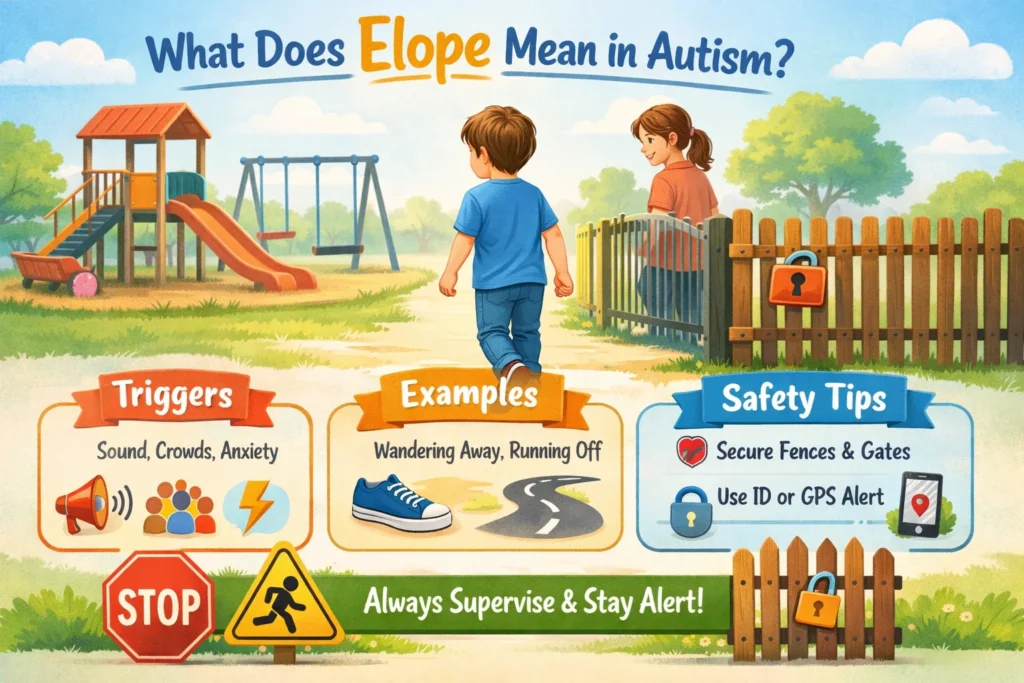
Definition:
In the context of autism, “elope” means when a person with autism leaves a safe area or environment without permission, often suddenly, and without telling caregivers or supervisors.
This behavior can be unintentional and may be driven by curiosity, stress, anxiety, or sensory needs, rather than a desire to escape or misbehave.
Understanding elopement is critical for caregivers, educators, and family members to ensure the safety and well-being of individuals with autism.
Origin of the Term “Elope” in Autism
The word “elope” originally comes from the general English usage, meaning to run away secretly, usually referring to couples escaping to marry without parental consent. Over time, professionals in psychology, special education, and autism support adopted the term to describe sudden, unsupervised departures from safe environments by children or adults with developmental differences.
- Historical context: First recorded in the 19th century for secret marriage.
- Autism adaptation: Became widely used in clinical and educational settings in the late 20th century.
- Professional adoption: Used in therapy notes, behavior analysis, and safety protocols.
The term is now common in autism support communities, educational settings, and parent support groups, making it important for awareness, prevention, and safety strategies.
Understanding the Usage of “Elope” in Autism
In autism, elopement is not about defiance it is often a behavioral response to environmental triggers, sensory input, or emotional states. Here’s how it is typically seen:
Key Characteristics of Elopement in Autism
- Sudden departure: The individual leaves an area unexpectedly.
- Lack of communication: Often, they do not inform caregivers or staff.
- Potential risk: Can lead to safety hazards like wandering into traffic or unfamiliar places.
- Triggers:
- Overstimulation (noise, lights, crowds)
- Stress or anxiety
- Curiosity and desire for exploration
- Avoidance of uncomfortable tasks or situations
Note: Elopement can occur in children and adults with autism, and the risk may vary depending on communication skills, environment, and support strategies.
Examples of Elopement in Autism
Here are practical examples to illustrate the concept in real-world contexts:
| Situation | Example | Tone/Context |
|---|---|---|
| School setting | A child leaves the classroom during recess without telling the teacher. | Neutral, safety-focused |
| Home environment | A teen quietly opens the front door and walks into the neighborhood while parents are distracted. | Friendly, cautionary |
| Community outing | An adult at a shopping mall suddenly walks away from a group due to sensory overload. | Neutral/serious |
| Playground scenario | A child climbs over a fence to chase a dog, ignoring nearby caregivers. | Safety-alert, urgent |
Friendly Tip: Use gentle communication and visual cues to prevent elopement, such as picture schedules, clear boundaries, and social stories.
Why Elopement Happens: Insights for Caregivers
Elopement is usually a behavioral signal, not misbehavior. Understanding the underlying cause is critical. Common reasons include:
- Sensory sensitivity: Loud sounds, bright lights, or crowded spaces can be overwhelming.
- Curiosity & exploration: Some children are naturally drawn to explore new environments.
- Stress or anxiety: Avoidance of stressful situations, tasks, or routines.
- Social motivations: Desire to join peers, family members, or favorite activities.
Pro Tip: Observing patterns of elopement can help caregivers anticipate and prevent incidents.
Comparison with Related Terms
Understanding related terms can help clarify what elopement is and isn’t:
| Term | Meaning | Difference from Elopement |
|---|---|---|
| Wandering | Moving from one place to another, may be aimless or exploratory | Wandering can be intentional or unintentional; elopement usually involves leaving a supervised area |
| Running away | Leaving home or care intentionally to escape or rebel | “Running away” implies intent to avoid authority; elopement is often unintentional or curiosity-driven |
| Bolt | Quick, sudden movement | A bolt can be a form of elopement but may also be reaction to immediate fear |
| Abscond | To leave secretly or suddenly | More formal/legal term; elopement is behavioral and safety-focused in autism |
Alternate Meanings of “Elope”
While in autism “elope” refers to leaving a safe area unsupervised, the word can also mean:
- Marriage context: To secretly run away to get married.
- General English usage: To escape or leave secretly.
When communicating professionally or with caregivers, it’s important to clarify context to avoid confusion.
Polite or Professional Alternatives to “Elope”
In professional settings, especially therapy or educational documentation, the term “elopement” may be paired with neutral, descriptive alternatives:
- Unexpected departure
- Unsanctioned movement
- Wandering from supervised area
- Safety exit behavior
Using these terms can reduce negative connotations and maintain a neutral, supportive tone.
Tips for Managing and Preventing Elopement
Here are some practical strategies caregivers, educators, and therapists use:
Environmental Strategies
- Secure doors, gates, and windows with childproof locks.
- Create safe indoor/outdoor zones for exploration.
- Reduce sensory triggers (e.g., loud sounds, bright lights).
Behavioral Strategies
- Teach functional communication for expressing needs or stress.
- Use social stories explaining rules and safety.
- Reward staying in safe areas with praise or small incentives.
Supervision & Monitoring
- Increase staff-to-child ratio in schools or therapy settings.
- Use wearable tracking devices if needed (with consent).
- Maintain visual contact during outings.
Emotional Support
- Identify triggers and plan proactive strategies.
- Practice calming techniques (deep breathing, fidget toys).
- Ensure consistent routines to reduce anxiety.
FAQs
1. Is elopement common in autism?
Yes, studies suggest that up to 50% of children with autism engage in some form of elopement. It is more common in children with limited communication skills.
2. At what age does elopement usually start?
Elopement can begin in early childhood, often between ages 3–10, but it may persist into adolescence or adulthood.
3. Is elopement dangerous?
It can be. Leaving a safe environment unsupervised poses risks like traffic accidents, drowning, or getting lost. Safety strategies are essential.
4. How do caregivers prevent elopement?
Prevention strategies include environmental modifications, teaching communication skills, using social stories, and close supervision.
5. What is the difference between wandering and elopement?
Wandering is moving around without supervision, which may be harmless. Elopement specifically involves leaving a safe area unexpectedly.
6. Should I punish a child for eloping?
No. Elopement is usually a behavioral response to stress, sensory needs, or curiosity. Punishment can increase anxiety and risk.
7. Can therapy help with elopement?
Yes. Applied Behavior Analysis (ABA), occupational therapy, and social skills training can reduce elopement incidents and improve safety.
8. Are there tools to track or alert caregivers about elopement?
Yes. Devices like GPS trackers, wearable alarms, and smart door sensors can alert caregivers if a person leaves a designated safe area.
Elopement Example Table
| Trigger | Example Behavior | Intervention Strategy |
|---|---|---|
| Sensory overload | Child runs from a noisy classroom to the hallway | Noise-cancelling headphones, quiet zone |
| Anxiety/stress | Teen leaves therapy session abruptly | Social story preparation, coping strategies |
| Curiosity | Child explores playground fence area | Supervised exploration, visual boundaries |
| Avoidance | Student leaves math class mid-lesson | Breaks, task modification, positive reinforcement |
Conclusion
Elopement in autism is not a sign of misbehavior, but a behavioral response to curiosity, stress, anxiety, or sensory needs. Understanding what elope means in autism helps caregivers, educators, and family members anticipate risks and provide safe environments.
With awareness, patience, and proactive strategies, individuals with autism can safely explore, learn, and enjoy their surroundings while caregivers maintain peace of mind.
Discover More Related Articles:
- Lamentation Mean in the Bible: Why It Matters for Christians in 2026
- Adam Mean in the Bible: Symbolism, and Impact in 2026

Madison Taylor is an experienced content writer who focuses on researching and explaining word meanings, slang, and texting terms. She writes for meanvoro.com, creating clear and accurate to help readers understand language easily.