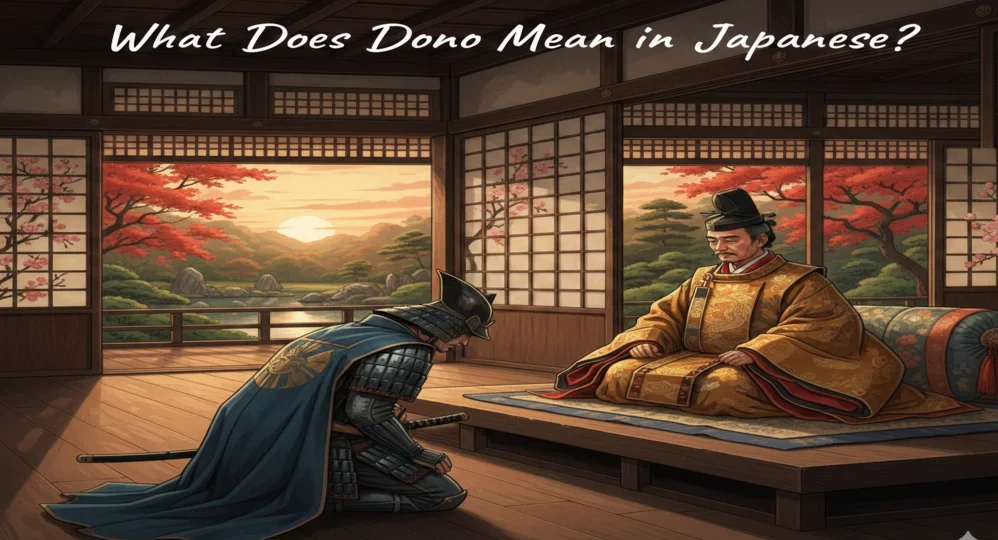
Definition:
Dono (殿, どの) is a formal Japanese honorific suffix used to show respect or deference to someone, often translated as “lord,” “master,” or “milord.” It conveys a higher level of politeness than -san and is traditionally used in formal or historical contexts.
When learning Japanese, you may come across various honorifics like -san, -sama, or the less common -dono. These terms carry subtle social meanings that reflect respect, hierarchy, and tone. One question that often comes up for learners and anime fans alike is: “What does dono mean in Japanese?”
In this article, we’ll explore the origin, usage, examples, comparisons with other honorifics, polite alternatives, and common FAQs to give you a complete understanding of dono.
Origin of Dono
Etymology
The kanji 殿 literally means “palace” or “mansion,” symbolizing respect and status. Historically, it was used when addressing samurai, lords, or high-ranking officials.
Historical Usage
In feudal Japan, people used dono to show deference to someone of higher social rank. Letters, official documents, and formal speeches often included this honorific.
Modern Popularity
While -dono is rarely used in everyday conversation today, it survives in formal writing, historical dramas, and anime/manga set in samurai eras. It sometimes appears in business or ceremonial contexts for a touch of respect or old-fashioned politeness.
Key Point: Unlike casual honorifics, dono implies a higher social awareness and humility toward the addressee.
How Dono Is Used in Japanese
Basic Usage
Dono is primarily an honorific suffix attached to a person’s name:
- Format: [Name] + dono
- Example: Tanaka-dono – “Lord Tanaka” or “Mr. Tanaka, with respect”
- Tone: Formal, respectful, and occasionally old-fashioned
- Contexts:
- Historical dramas, samurai interactions
- Letters or formal communications
- Roleplay, cosplay, or anime/manga references
Example Table – Dono Usage in Context
| Name + Dono | English Translation | Context/Tone |
|---|---|---|
| Tanaka-dono | Lord Tanaka / Mr. Tanaka (formal) | Business letter or formal speech |
| Samurai-dono | Honorable Samurai | Historical anime or drama |
| Sensei-dono | Respected Teacher | Rare, formal classroom setting |
Quick Note: Using dono incorrectly can sound overly formal, archaic, or even humorous in modern conversation.
Examples of Dono in Different Tones
Friendly/Formal Tone
- “Tanaka-dono, thank you for your guidance today!”
- Used with respect but still approachable
- Common in business emails or letters when showing humility
Neutral Tone
- “Matsumoto-dono will attend the meeting.”
- Reporting someone’s attendance politely
- Often used in announcements or formal introductions
Negative/Dismissive Tone
- Rarely, dono can be used sarcastically or ironically in modern media:
- “Oh, Shiba-dono, so noble, huh?” – Playful teasing or mock respect
Emoji Tip: In casual online contexts (like anime forums), -dono might be accompanied by respectful emojis like 🙏 or 🏯 to emphasize the old-fashioned or “samurai” feel.
Comparison with Other Japanese Honorifics
Key Differences
| Honorific | Meaning / Usage | Tone & Context |
|---|---|---|
| -san | Mr./Ms., polite | Everyday politeness, universal |
| -sama | Lord/Master, very polite | Customer service, formal letters |
| -dono | Lord/Master, respectful, old-fashioned | Historical, formal, samurai-era contexts |
| -kun | Young male, friendly | Peer or junior level, casual |
| -chan | Cute/familiar | Children, pets, close friends |
Key Insight:
- -dono is more formal than -san but less common than -sama in modern Japanese.
- Its charm is often nostalgic or stylistic, adding elegance or humor depending on context.
Alternate Meanings of Dono
Writing & Formal Usage
Sometimes used in business correspondence as a very polite suffix equivalent to “esteemed.”
Names
Rarely appears as part of a family name (e.g., Dono family).
Modern Slang
Some anime/manga communities use -dono humorously to mimic samurai speech.
Takeaway: Stick to the honorific usage for clarity; alternative meanings are niche.
Polite or Professional Alternatives to Dono
-Sama
More common in formal contexts:
- Example: Tanaka-sama
Keigo (敬語)
Polite language structures without suffixes:
- Example: Tanaka-san ni oai dekite ureshii desu – “I’m glad to meet Mr. Tanaka”
Formal Job Titles
Example: Shacho (社長) – “President” or “CEO”
Tip: Reserve -dono for letters, historical roleplay, or creative writing to retain authenticity.
Practical Usage Tips
Key Tips
- Use dono only when formal respect is needed or for stylistic effect.
- Avoid casual everyday conversations with friends or colleagues.
- Pair dono with historical or professional settings for authenticity.
- Use -sama if you want a modern, polite equivalent.
FAQs
- What does dono mean in Japanese anime?
In anime, dono is often used humorously or stylistically to mimic samurai speech or show exaggerated respect. - Is dono still used in modern Japanese?
Yes, but rarely. It survives mostly in formal writing, historical dramas, and roleplay. - Can you use dono with friends?
Typically no. Using dono with friends sounds overly formal, humorous, or sarcastic. - How do you pronounce dono?
It’s pronounced “do-no”, with equal stress on both syllables. - What is the difference between dono and sama?
- -sama = very polite and modern
- -dono = formal, old-fashioned, and respectful with historical nuance
- Is dono gender-specific?
No, dono can be used for anyone regardless of gender. - Can dono be used in business emails?
Yes, especially to show formal respect, though -sama is more standard today. - Are there any playful uses of dono?
Yes, anime fans or online communities sometimes add -dono to usernames or posts for humor or roleplay.
Conclusion:
Understanding dono can give you a deeper insight into Japanese culture, language, and social etiquette. Here’s what to remember:
- Meaning: Dono (殿, どの) is a formal honorific meaning “lord” or “master,” showing high respect.
- Context: Rarely used in everyday modern conversation, but common in historical settings, formal letters, anime, or roleplay.
- Tone: Formal, respectful, and slightly old-fashioned. Can also be playful or ironic in modern media.
- Alternatives: Use -sama or polite keigo expressions if you want modern, professional respect.
- Practical Tip: Reserve -dono for formal writing, historical references, or creative content. For daily interactions, stick to -san or -sama.
Practical Tip: When in doubt, save -dono for letters, roleplay, or historical references, and use -san or -sama for everyday politeness.
Discover More Related Articles:

Madison Taylor is an experienced content writer who focuses on researching and explaining word meanings, slang, and texting terms. She writes for meanvoro.com, creating clear and accurate to help readers understand language easily.